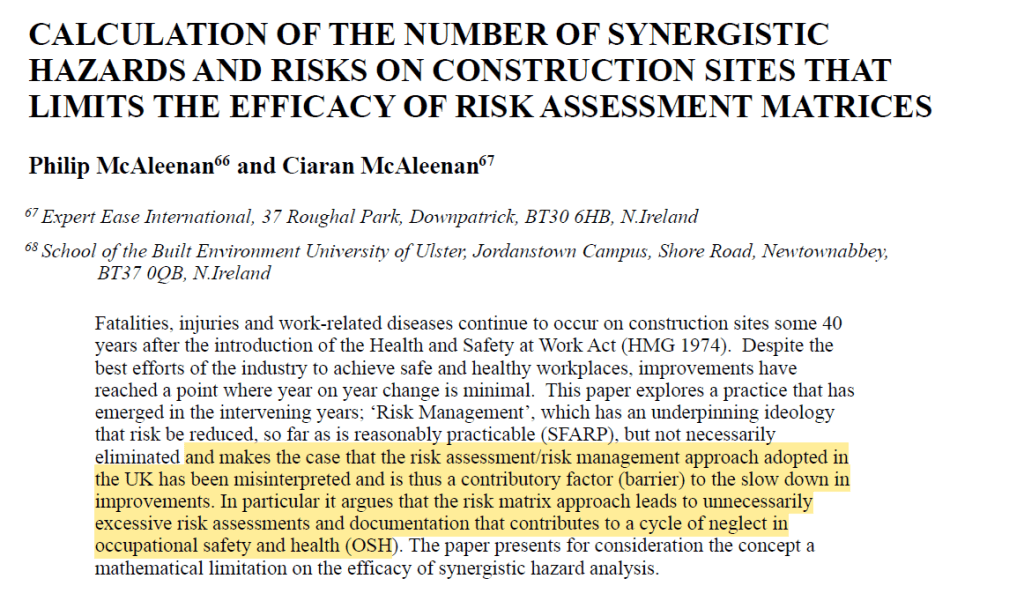
An interesting theoretical and mathematical paper discussing the potentially “ineffectual … traditional risk assessment and risk matrix approach” for accounting for synergistic hazards (e.g. the interaction of hazards, reflecting the complexity of real-world situations).
Not a summary – so check out the paper:
· “Maharaj (2012) has described synergistic hazards as those involving the interaction of the hazards presented by people, the environment in which the work takes place and the tasks being undertaken”
· “The number of hazards that can exist on a construction site is large, for example in Maharaj et al (2012) 40 types of hazard have been categorised”, and when combined with the number of workers on site, the “number of synergistic hazards to be assessed can rise exponentially”
· “A standard risk matrix, used not infrequently by the safety profession … utilises a simple likelihood of an event occurring x severity of outcome”, often with a scale from 1-5 for each component
· This “gives a 5 x 5 = 25 possible outcomes that are classified” via red, amber and green
· “However this matrix fails in that it does not take into account the possibility of multiple non-fatal injuries per worker in any given accident”
· That is, matrices typically consider single, discrete hazard interactions

· When synergistic hazards are considered in the context of 5 workers exposed to 5 hazards with 3 levels of injury = >14k possible injurious outcomes
· Further, on a larger site with 40 hazard types and 100 workers = 1.393…x 10^42 subsets or synergistic hazards [*** wow]
· “This is a truly phenomenal figure of synergistic hazards and all have the potential for the same 4 levels of (non-fatal) injury”
· When fatalities are factored in, there are potentially: 2.091…x 10^43 subsets of non-fatal injury combinations [!!!!]

In summing up the “truly phenomenal figure[s] of synergistic hazards”, they argue:
· “The process of risk assessment … cannot realistically achieve what it aims to do because of the truly vast numbers of synergies generated, but nonetheless has succeeded in generating substantial amounts of unnecessary paperwork” (emphasis added)
· “Hazards exist, often discretely, but in the interaction between the worker when on site, the tasks being conducted and those hazards, new synergistic hazards emerge with increasing degrees of complexity as multiple hazards, workers and activities merge in the developing project”
· “These synergies mean that the hazard cannot be eliminated, they must be controlled in a manner commensurate with the nature of the hazards and the degree of complexity”
· “The mathematics herein illustrates how many synergistic hazards there may be on a construction site, but more importantly it illustrates how ineffectual the traditional risk assessment and risk matrix approach is in accounting for, describing and identifying all the controls for all the synergies” (emphasis added)

Ref: McAleenan, P., & McAleenan, C. (2015). Calculation of the number of synergistic hazards and risks on construction sites that limits the efficacy of risk assessment matrices. Proceedings of CIB W099 Benefitting Workers and Society through Inherently.
My site with more reviews: https://safety177496371.wordpress.com
LinkedIn post: https://www.linkedin.com/pulse/calculation-number-synergistic-hazards-risks-sites-risk-hutchinson-six4c

 SafetyInsights.org