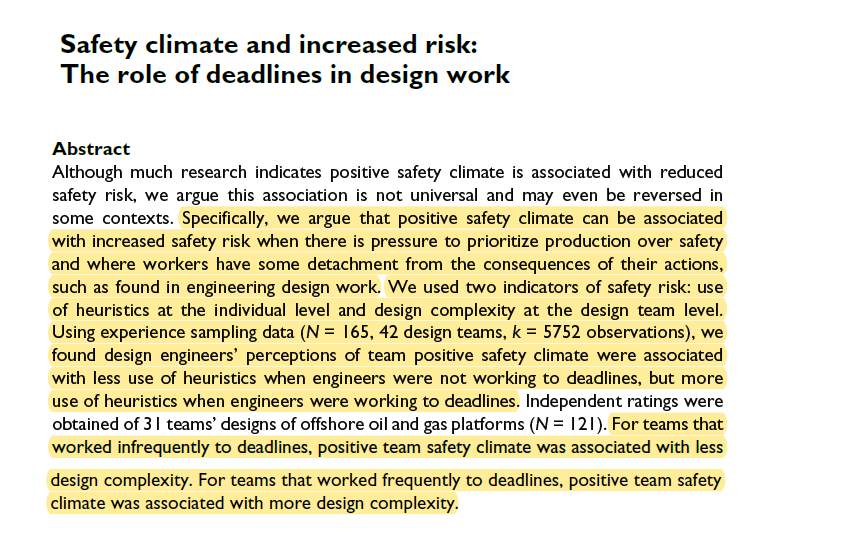
This was cool. It studied the relationships between safety climate (SC), safety risk, engineering design work, deadlines & work intensification.
Argued is although SC is often seen as an always positive attribute, in some cases positive SC may increase the potential for harm.
Specifically they argue that since designers are often detached from the harmful consequences of their designs. Engineers with high perceived team SC under times of tight deadlines may prioritise production over safety more increasingly compared to those with low SC.
In teams of high perceived SC, during deadlines/work intensification an engineer may assume that other team members will address safety (because of high SC & importance of safety), so they themselves can rather focus on production.
They refer to one study that found workers to be less likely to voice safety concerns if they believe co-workers to be competent with dealing with safety issues (and thus, high perceived SC).
[I struggled a bit at first with the logic of the ‘reverse’ association with SC, but the paper explains it a lot better than I did].
Greater use of heuristics (mental shortcuts) was used as a proxy for potentially increased safety risk, where engineers prioritise mental shortcuts (e.g. filling in missing data) over detailed calculations etc. Also, higher design complexity was used as a proxy for potentially increased safety risk.
Data was from 165 design engineers.

Results
When design engineers had high perceived team SC and weren’t working to deadlines, use of heuristics were lessened. However, when working to deadlines under positive SC, were more likely to use heuristics.
For teams working infrequently to deadlines, positive SC was associated with less design complexity, but for teams working frequently to deadlines and high perceived SC, higher design complexity was found.
The relationship between deadlines & design heuristics became more positive at more positive values of perceived SC. Quoting the paper, “the association between working to deadlines and design heuristics is stronger at higher levels of perceived positive safety climate, with positive perceived safety climate being associated with the greatest use of design heuristics when designers work to deadlines” (p1196).
For complexity, results indicate that teams with positive SC produce less complex designs when teams infrequently work to deadlines, but more complex designs when frequently working to deadlines. Interestingly, “For teams with negative safety climate, there is no relationship between design complexity and working to deadlines” (p1199).
Authors argue that deadlines could be a discrete & dynamic contextual factor that activates group & social compensation processes (rather than just individual factors), leading to elevated risk to constructors downstream by more frequent use of decision heuristics over more robust analytical techniques.
They suggest that regarding design work, “working to deadlines may be a discrete contextual factor that operates as a tipping point, reversing the relationship between positive safety climate and reduced safety risk to one in which positive safety climate is associated with increased safety risk” (p1199).

Thus, in some cases positive SC can mutually reinforce synergistic effects on safety outcomes, whereas in other cases positive SC “appears to buffer potentially adverse effects on safety outcomes of complex work” (p1199).
Argued is that when decision makers are disconnected from “those that bear the safety-related consequences of decisions” and under conditions of work intensification, improvements in SC alone may not be sufficient to minimise risk exposure – but, expectedly, the processes that produce work intensification may also need to be addressed.
[In my view this has parallels to almost everything else in performance: trying to address peoples’ behaviour of rule following rather than why rules aren’t being followed & their utility/value etc.; addressing symptoms rather than the contributing systems factors].
In concluding they note that positive SC may have adverse impacts on safety-related outcomes (or at least, on upstream design decisions) at multiple levels, indicating that potentially adverse consequences of positive SC need to be addressed across multiple levels of the organisation.

Authors: Daniels, K., Beesley, N., Cheyne, A., & Wimalasiri, V. (2016). Safety climate and increased risk: The role of deadlines in design work. human relations, 69(5), 1185-1207.
Study Link: https://doi.org/10.1177%2F0018726715612900
My site with more reviews: https://safety177496371.wordpress.com
LinkedIn post: https://www.linkedin.com/pulse/safety-climate-increased-risk-role-deadlines-design-work-hutchinson-wrfjc

 SafetyInsights.org