
A 2014 conference paper from Hollnagel discussing ETTOing.
Not a summary as the full paper is available.
Some points:
- “The Efficiency-Thoroughness Trade-Off (ETTO) principle is a convenient way to characterise the adjustments that are an essential part of everyday performance in complex socio-technical systems
- Despite resource/time limitations, “People nevertheless in most cases manage to do what they should by adjusting how they do it to meet the current conditions”
- The ubiquity of efficiency-thoroughness trade-offs—called ETTOing, is illustrated by a number of individual, collective and organisational rules; types of justifications used when making trade-offs

- Some individual rules include “it looks fine”, “it is good enough”, “it will be checked by someone else later”
- Since work normally takes place in a social context, some rules relate to the collective, like “we always do it this way here”, “we must get this done”
- Some organisational ETTO rules also exist, like “the negative reporting rule” (only deviations or things that go wrong are reported”

- Hollnagel discusses the relationship between ETTO and ‘human error’, arguing that “To invoke the notion of ‘human error’ is unquestionably the most common ETTO in safety management”
- And human error “is efficient because it provides a single and simple explanation; but it lacks thoroughness because the explanation is insufficient, if not outright wrong”
- “Humans try to balance efficiency and thoroughness in everything they do; indeed, they are usually expected to do so. It is only in hindsight, when the outcome is wrong, that the choice of efficiency over thoroughness conveniently is labelled ‘human error.’”
- There are several practical benefits to studying ETTOing in practice – revealing differences between WAI and WAD; and the “clever solutions” workers find in their everyday work
- Moreover, “neither problems nor solutions can be found in the traditional event reports or work analyses. But recognising the trade-offs that people make can be used to identify potential flaws in the system, as well as to develop more efficient ways of working”
- Hollnagel then discusses ETTOing in science, and how concepts like error modes or human cognition (e.g. skill, rule and knowledge behaviours)
- He argues that descriptions of phenomena, like the use of models, taxonomies etc. are always almost some type of simplification
- Nevertheless, “we should acknowledge that it is unlikely that a single explanation that will suffice, but that multiple factors and conditions need to be considered together”
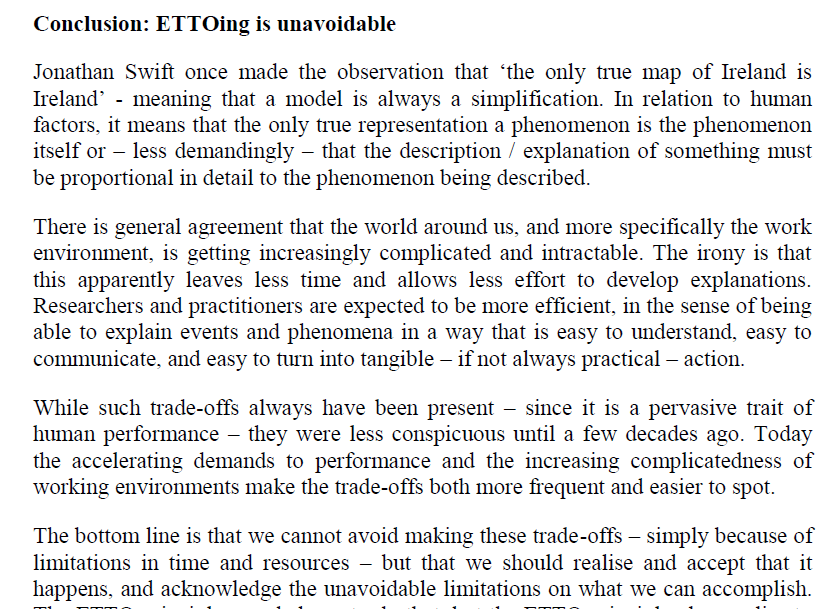
- And “Jonathan Swift once made the observation that ‘the only true map of Ireland is Ireland’ – meaning that a model is always a simplification. In relation to human factors, it means that the only true representation a phenomenon is the phenomenon itself or – less demandingly – that the description / explanation of something must be proportional in detail to the phenomenon being described.”
- “The bottom line is that we cannot avoid making these trade-offs – simply because of limitations in time and resources – but that we should realise and accept that it happens, and acknowledge the unavoidable limitations on what we can accomplish.”
- Finally, the ETTO principle itself is also an example of ETTOing—a simplified explanation
Ref: Hollnagel, E. (2012, October). The ETTO principle as ETTOing–or Occam’s Razor redux. In Human Factors: a view from an integrative perspective. Presented at the Human Factors and Ergonomics Society Europe Chapter Annual Meeting.
Study link: https://www.hfes-europe.org/wp-content/uploads/2014/06/Hollnagel.pdf
My site with more reviews: https://safety177496371.wordpress.com

 SafetyInsights.org
One thought on “The ETTO principle as ETTOing–or Occam’s Razor redux”