I found these extracts interesting from Foundations of Safety Science – summarising some key developments and interpretations from over a century of safety-scientific approaches.
They observe that despite a myriad of approaches, and developments, “almost every approach seems to end up reverting, one way or another, to the people who work in that system”.
As an overview of the approaches (images denoted with a #1):
· Taylor and Gilbreths’ work around waste and inefficiency spawned a movement of ‘scientific management’, focusing on the systematisation of work tasks
· Epidemiology perspectives led to accident-proneness theses, and where “The original impetus was systematic and scientific”, targeting the system
· Heinrich’s seminal work to “investigate systematically ways to stop hazard trajectories [and] placed a strong focus on improving the physical conditions and physical safeguards at work”
· Human factors was “born out of the realization that the human was the recipient of error-prone and error-intolerant system designs”

· “System safety promoted the notion that safety needs get built into the system from the very beginning”
· “Man-made disaster theory understood accidents and disasters squarely as administrative or organizational phenomena”
· and more that I’ve skipped (see the images and book)

They argue that such approaches gradually develop and professionalise.
And in doing so, there appears to be a “transformation from professionalization to moralization” of which “the approach—that started with the system, the technology, the organization, upstream—lands back on the individual people in that system”
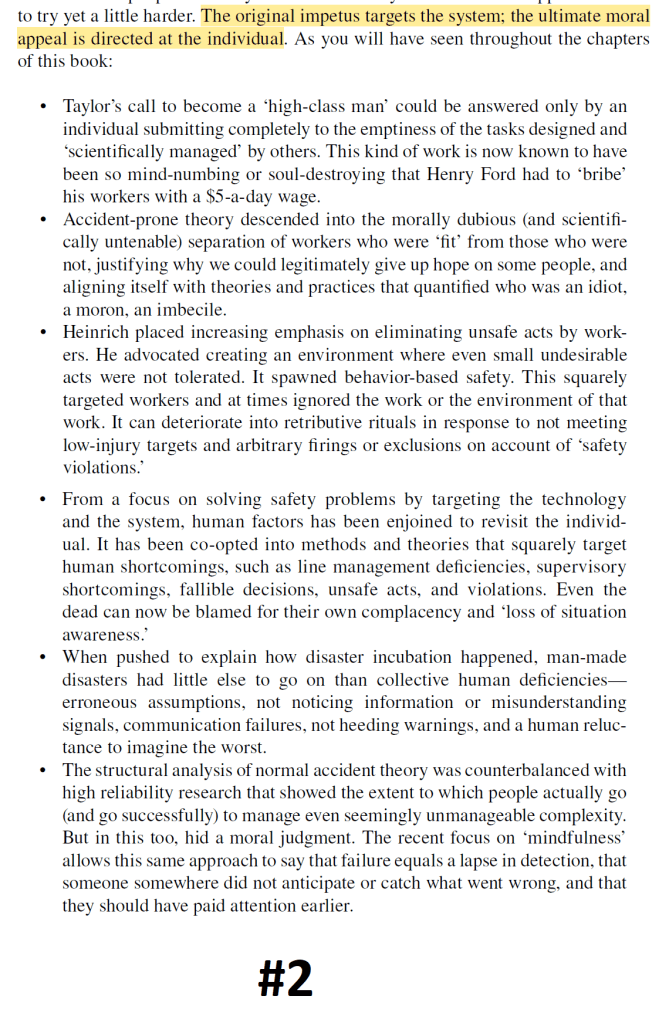
For instance, as per images denoted with #2:
· The ‘Tayloristic’ approaches may have created an “emptiness of the tasks designed and ‘scientifically managed’ by others”
· “Accident-prone theory descended into the morally dubious (and scientifically untenable) separation of workers who were ‘fit’ from those who were not”
· Heinrich’s pioneering work was commandeered into behavioural approaches that “Squarely targeted workers and at times ignored the work or the environment of that work” and which could “deteriorate into retributive rituals in response to not meeting low-injury targets”
· Human factors which started with a focus on technology and the system was “co-opted into methods … that squarely target human shortcomings”
· Man-made disaster theory “had little else to go on than collective human deficiencies—erroneous assumptions [etc.]” [*** I disagree…]
· “Safety culture research, when operationalized, stopped being about culture and upstream, organizational factors fairly swiftly. It instead became reduced to the attitudes and behaviors of individuals in the organization”
· “resilience engineering has been turned around and used to blame people for not having enough resilience” and deployed to “force individuals to … adapt to dangers that brew … beyond their control”
· and more (see images and book)

Ref: Dekker, S. (2019). Foundations of safety science: A century of understanding accidents and disasters. Routledge.


 SafetyInsights.org