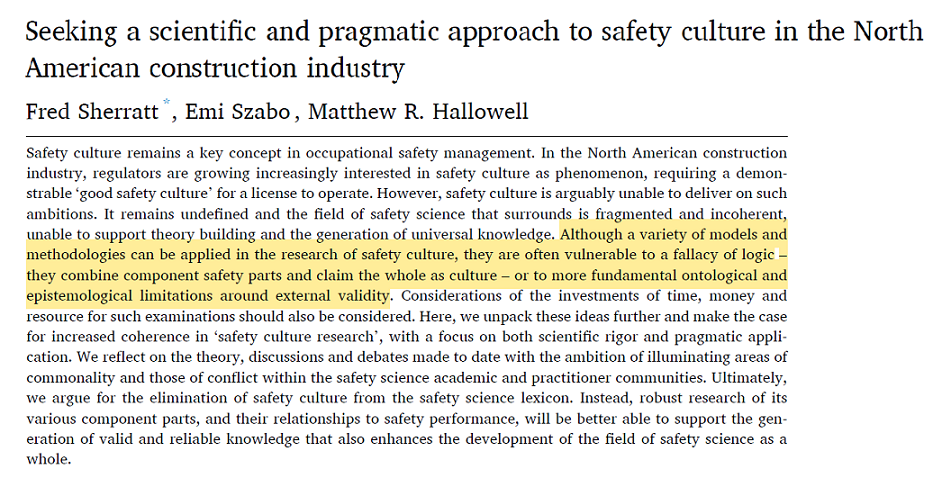
This study from Sherratt, Szabo and Hallowell unpacked the concept of safety culture, with a focus on US construction.
I’ve skipped heaps and can’t do this justice, so check out the full paper.
Ultimately, they “argue for the elimination of safety culture from the safety science lexicon”.
Background
Off the bat they say:
“It is unlikely that the authors of those three little words – ‘inadequate safety culture’ – written in the summary report of the 1986 Chernobyl nuclear disaster … (International Atomic Energy Agency 1986) quite realized the extent of the consequences that would result for the field of safety science”.
‘Safety culture’ is said to be ‘deceptively simple and neatly abstract’; yet, is said to be an enigma that has “plagued” the literature since its inception.
Definitions
They cover the confusion and multitudes of definitions around SC, noting that if SC is to scientifically progress, then it needs to be defined and governed and applied consistently.
In saying that, though, “It may be the case that safety culture should not be defined”, or perhaps used as a key concept in researching or describing safety.
For instance, “It may simply be too tainted and problematic for any future utility”.
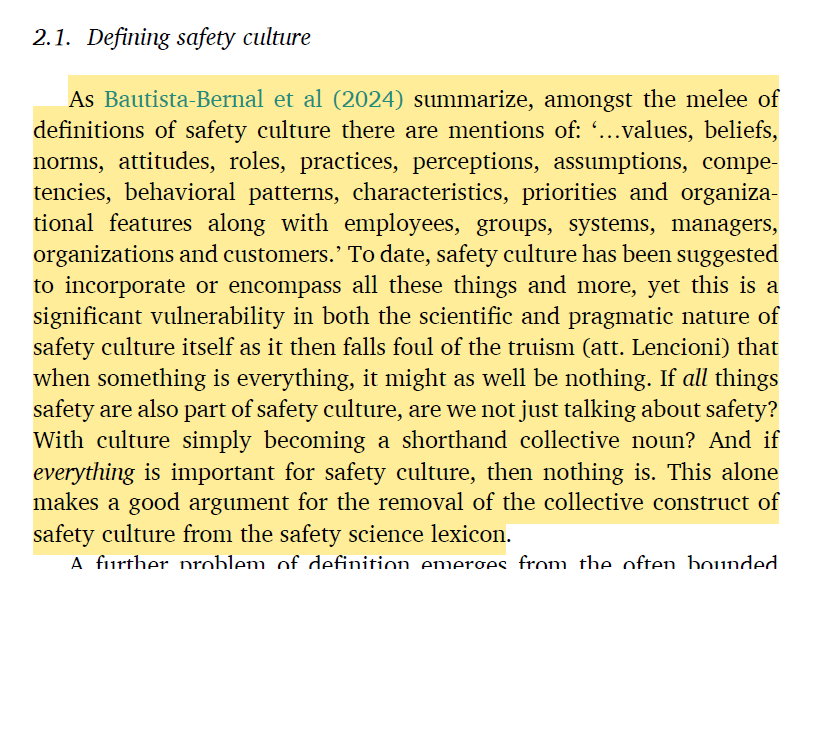
SC has been captured via a wide range of items, like values, beliefs, norms, attitudes, practices, perceptions, assumptions, competencies, behaviours, organisational features and more.
Hence, if SC means everything, “it might as well be nothing. If all things safety are also part of safety culture, are we not just talking about safety?”. Moreover, they proposition whether if “everything is important for safety culture, then nothing is.”
They argue that this alone makes a compelling argument for the “collective construct” of SC to be retired from the safety science lexicon.
Debates are also numerous. Like Hopkins argues that ‘the way we do things around here’, is a rather sophisticated definition for SC – reflecting its group properties. In contrast, Schulman argues for the necessity of incorporating attitudes, beliefs and assumptions, values and motivations behind behaviour.
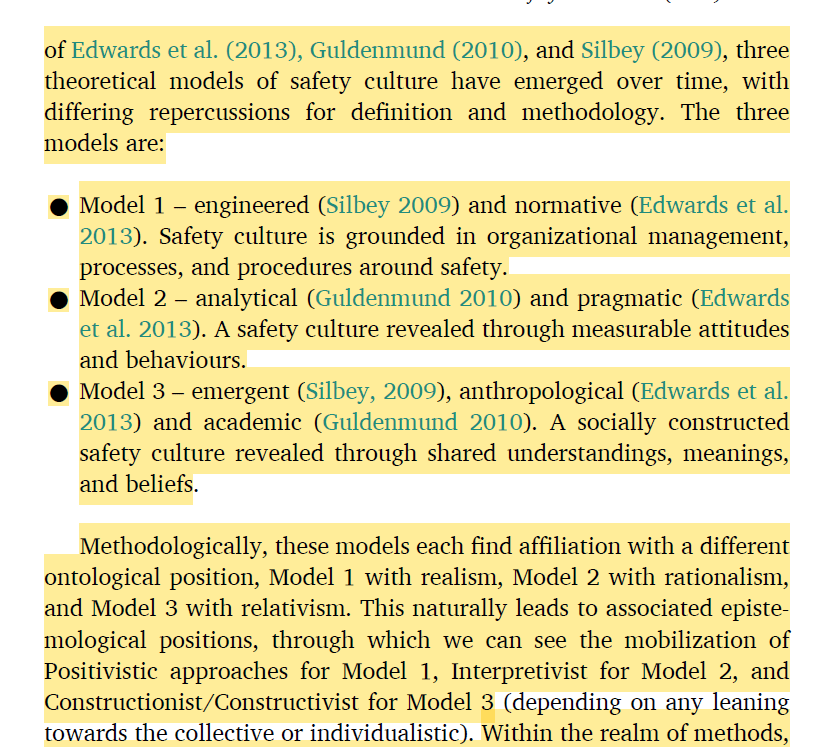
Broadly, SC can be divided into three streams:
· Model 1 – a view of ‘engineering’ or normative SC, being grounded in organisational management and processes around safety; a positivistic lens, and revealed via documentary data analysis and the like
· Model 2 – an analytical or pragmatic view, reflecting via measurable attitudes and behaviours; an interpretivist lens and revealed via proxies like surveys, interviews etc.
· Model 3 – an emergent and anthropological view, being socially constructed and revealed via shared understandings and beliefs etc; a constructionist/constructivist lens and revealed via immersive longitudinal studies and ethnographic work
They then discuss the context around each model, which I’ve mostly skipped. One point is that model 2 while professing to capture ‘culture’, may rather be climate when leveraging surveys and worker perceptions.
Models 1 and 2 are said to potentially fall prey to a “fallacy of logic” – the fallacy of composition, being the false equivocation of the whole via studying the constituent parts. For instance, studying policies, training, commitment and using these components to assess the culture as a whole.
Model 3 is more problematic to evaluate because it’s also the “most neglected”, and most difficult to unpack.
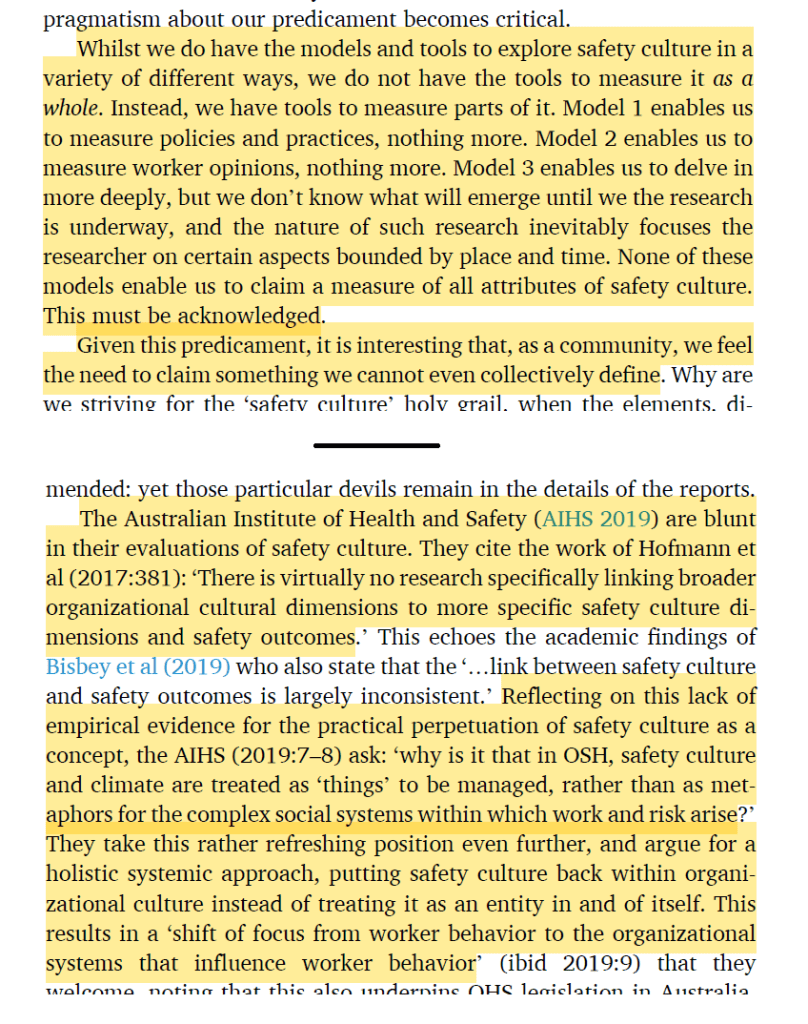
Notably, they argue that “Whilst we do have the models and tools to explore safety culture in a
variety of different ways, we do not have the tools to measure it as a whole” and rather, we have tools to measure ‘parts’ of culture.
Hence, given this predicament, “it is interesting that, as a community, we feel the need to claim something we cannot even collectively define”.
Quoting other research, they highlight that “There is virtually no research specifically linking broader organizational cultural dimensions to more specific safety culture dimensions and safety outcomes”, and “the ‘…link between safety culture and safety outcomes is largely inconsistent”.
Moreover, they quote the AIHS BOK report on culture, asking why the safety field treats culture as something to be managed, over treating it as a metaphor for the complex social systems where work and risk arses? The same report prompts a move back to safety culture within the context of organisational culture, resultingly shifting focus away from worker behaviour to organisational systems influencing behaviour.
Safety culture and the construction industry
Next they discuss SC within US construction – I’ve skipped most of this brief section.
However, they said that SC is even more problematic for construction than other industries. Namely, this is driven by the project-driven work, and transient workforces which move between projects.
SC is seen as something generally shaped gradually over time by multiple levels, resulting in a relatively stable phenomena – factors not typically associated with construction.
Therefore, “This begs the rather fundamental question of whether the highly variable and inconsistent construction industry even has the capacity to develop safety culture within its normal scope of operations?”.
The researchers then report on their own survey data from 516 US construction personnel. I’ve skipped most of this (check out the full paper), but they broadly divided the definitions of SC into tangible and intangible conceptualisations. Most of the personnel conceptualised SC more by the intangibles, than the tangibles.
Six percent deliberately avoided the use of the term.
Discussion: What to keep and what to throw away?
Next they tie together the key arguments and provide some their position.
While some have argued for more work on building a unifying framework which can standardise SC approaches, the current authors disagree.
Instead, while they recognise the “admirable” ambitions of trying to unify the multitude of definitions, they believe it is likely “unachievable”. They agree with Andrew Hopkins, who stated “The term safety culture is so confusing it should be abandoned”.
Instead of focusing on the vacuous concept of SC, they suggest focusing on the constituent elements. E.g. instead of using SC as a proxy for worker engagement or whatever else – actually focus on understanding worker engagement etc.
Further in support of focusing on the actual things that we’re interested in understanding or influencing, they quote Hopkins who states “Practices can be directly affected by management while values cannot…focusing on practices, therefore, is not a superficial strategy”.
In concluding, they state:
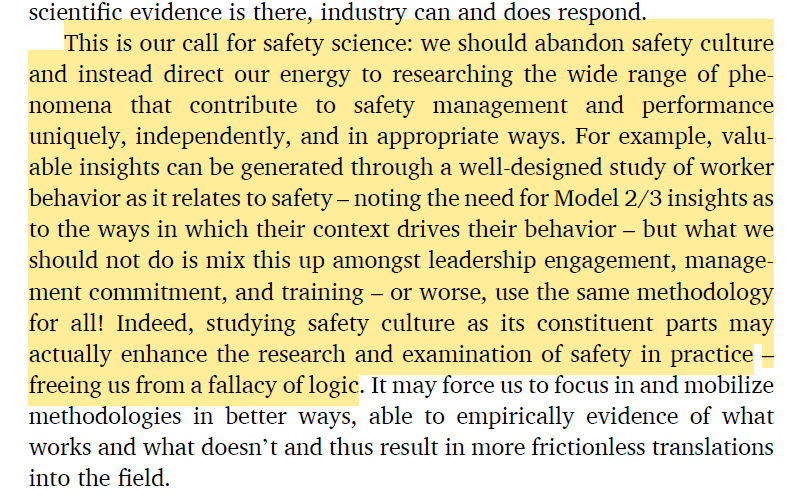
· “This is our call for safety science: we should abandon safety culture and instead direct our energy to researching the wide range of phenomena that contribute to safety management and performance uniquely, independently, and in appropriate ways”
· “studying safety culture as its constituent parts may actually enhance the research and examination of safety in practice – freeing us from a fallacy of logic lacking in theory and universal truths to show for it”
· “It is time for safety culture to be retired from the safety science lexicon. We need to put it out with the trash”
· “As a field we need to admit that safety culture’s time is over, and we can and certainly should do better in our shared goal of improving safety for workers across the world”
Authors: Sherratt, F., Szabo, E., & Hallowell, M. R. (2025). Seeking a scientific and pragmatic approach to safety culture in the North American construction industry. Safety Science, 181, 106658.
Study link: https://doi.org/10.1016/j.ssci.2024.106658
My site with more reviews: https://safety177496371.wordpress.com
LinkedIn post: https://www.linkedin.com/pulse/seeking-scientific-pragmatic-approach-safety-culture-north-ben-a5tjc

 SafetyInsights.org