
More extracts from Foundations of Safety Science, this time some points around the different perspectives of drift and disaster incubation.
Some points:
· “Disasters do not come out of the blue, says man-made disaster theory” but are “preceded by sometimes lengthy periods of gradually increasing risk”
· These risks often go unnoticed or unrecognised – incubation period as per Turner’s ideas
· During incubation “latent errors and events accumulate which are culturally taken for granted or go unnoticed because of a collective failure of organizational intelligence”

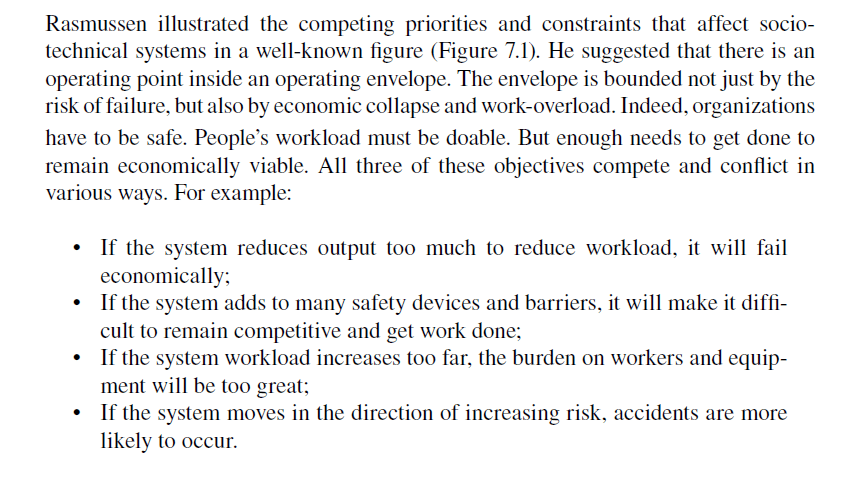
· From Rasmussen’s perspective, major accidents “have not been caused by a coincidence of independent failures and human errors. They were the effect of a systematic migration of organizational behavior toward accident under the influence of pressure toward cost-effectiveness in an aggressive, competitive environment”
· For Vaughan, after each launch “evidence initially interpreted as a deviation from expected performance was reinterpreted as within the bounds of acceptable risk. Success with launches, even those that created damage to the O-rings, meant that engineers recurrently observed the problem with no consequence”
· Hence, “Flying with the flaw became normal and acceptable”
· Further, Vaughan found “normal people, experts even, under normal pressurized conditions of an engineering organization wrestling to interpret the behavior of unproven, unruly (and probably operationally unready) technology”
· Starbuck and Miliken explored how organisations “can learn to “safely” borrow from safety while achieving gains in other areas. Counterintuitively, fine-tuning until something breaks, or drifting into failure has, at its heart, a form of organizational learning”
· For Snook, accidents result from individual, group, organisational and cross-levels, where “a dynamic, cross-level mechanism, or theory that he called ‘practical drift”

· Further, “This is the slow, steady uncoupling of practice from written procedure in individual units over time, which is no problem— until a stochastic event brings them together in a tightly coupled situation with sudden interdependencies”
· “The first echoes Turner’s important observation that accidents, and the drift that precedes them, involve normal people doing normal work in normal organizations—not miscreants engaging in spectacular acts or immoral deviance”
· “We can call this the banality-of-accidents thesis”
· Between resource scarcity and economic and goal conflicts “The major engine of drift hides somewhere in this conflict, in this tension between operating safely and operating at all”
· “drifting into failure is incremental. Accidents do not happen suddenly, nor are they preceded by monumentally bad decisions or bizarrely huge steps away from the ruling norm”

Ref: Dekker, S. (2019). Foundations of safety science. Routledge.

Book: https://www.taylorfrancis.com/books/edit/10.4324/9781351059794/foundations-safety-science-sidney-dekker
My site with more reviews: https://safety177496371.wordpress.com

 SafetyInsights.org
One thought on “Models of drift: man-made disaster & incubation, systemic migration, normalisation of deviance, practical drift”