This paper is highly recommended.
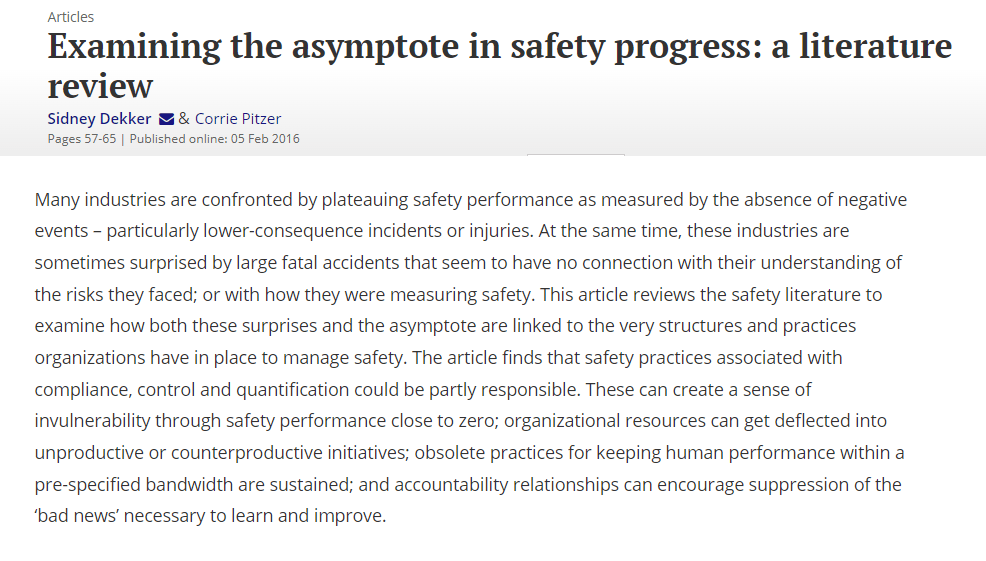
I can’t do it justice as it covers a lot of material, but the authors argue that a range of safety practices and beliefs are linked to a plateau in safety performance improvements.
Practices associated with compliance, control and quantification could be, at least partially, responsible for this inability to continually improve.
Besnard and Hollnagel’s (excellent) paper was cited, discussing how safety practices are “driven by persistent ‘myths’. The myths include (directly quoting the paper): “a) human error is the major cause of disasters, (b) compliance is key for safety, (c) better barriers create greater safety, (d) root causes can be found and explain why accidents happen, (e) accident investigation is the rational activity that does just that and (f) safety has organizations’ highest priority”.
One factor contributing to the asymptote may be a focus on linear causation in complex systems, where sociotechnical issues are dealt with as linear problems to be solved. Also argued is that organisations may focus too much on minor potential issues, in the belief that this will impact high potential issues. Further, the idea of linearity in causation contributes to people overpredicting how well they could have predicted and prevented major incidents, so called “failures of foresight”.
They cover a Finnish construction study which found a strong reverse correlation between fatalities and injuries – that is, the “fewer incidents a construction site reported, the higher its fatality rate”
Another factor related to the asymptote is argued to be a relentless focus on compliance. This compliance mindset sees safety and consistent performance maintained by strict adherence to process rather than recognising the degree of improvisation needed by people to keep dysfunctional processes operating in the face of ill-defined problems and inadequate resources. The gap between work-as-imagined and work-as-done features prominently here.
They point out the weird logics in accident investigations where apparent non-compliances are observed. They argue that these conclusions, e.g. the operator failed to adhere to the procedure, are “no more than the attribution of a particular set of analysts” and also trivial. This is because non-accidents, that is, during everyday work, are also preceded by non-compliance.
Risk control is then discussed by the authors. It’s said that the “growth of complexity in many industries has outpaced our understanding of how complex systems work and fail, and how we can best regulate them” (p12). In response, organisations try to stabilise parts of the complex and dynamic systems through process, paperwork and protocol. This can lead to a focus on managing systems and process at the expense of the core issues.
Other factors said to be related to the asymptote is a “resurgence” in behavioural safety interventions, which is said to frame issues as matters of people erring over addressing the contextual work environment issues. They note that “Worker error is a post-hoc attribution which we give to assessments and actions that are, on closer scrutiny, locally rational and systematically connected to people’s tools and tasks” (p13).
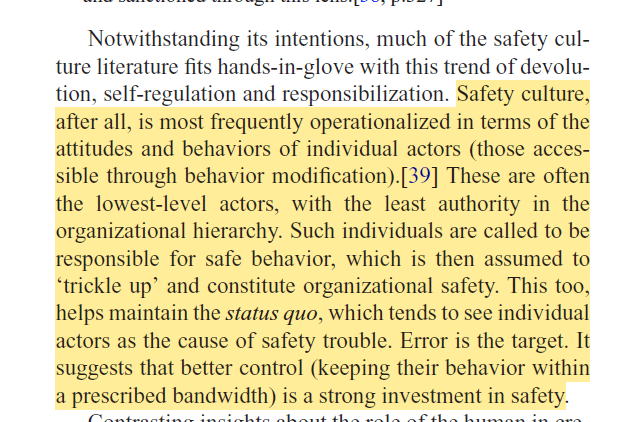
Interestingly, they argue that much of the safety culture literature “fits hands-in-glove with this trend of devolution, self-regulation and responsibilization”, which they argue is often pitched at changing the attitudes and behaviours of individuals; of whom typically have the least authority in the organisational hierarchy.
Two other factors relate to quantification and invulnerability, which I won’t cover.
In arguing how these factors of compliance, control and quantification could be partly responsible for the plateau in safety improvement and organisations’ inability to break through this, it’s said that “Assumptions about linear causation, about the value of consistency, and about operators’ “unsafe acts” as the final weak link in otherwise well-defended systems, tend to lock into place these and other practices (p19).
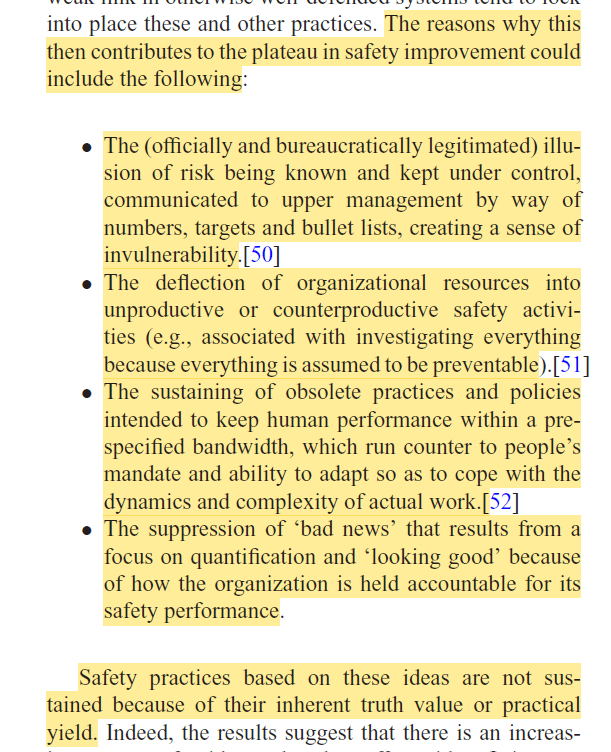
These factors then contribute to the plateau because (p19):
· An illusion of risk being legitimated and driven by bureaucratic systems, where it’s believed that issues can always be known and kept under control; leading to a sense of invulnerability
· A deflection of organisational resources into “unproductive or counterproductive safety activities”, including investigating everything “because everything is assumed to be preventable” (p19)
· The continuation of obsolete practices intended to micro-manage human performance, impacting their ability to dynamically cope with the challenges of real work
· Suppression of bad news, in part because of a focus on quantification and “looking good” because of how the organization is held accountable for its safety performance” (p19).
However, the authors suggest some points to move beyond compliance and control and to remain sensitive to the possibility of failure:
· Monitoring of safety monitoring (Understanding how it measures and constructs risk and whether these are appropriately calibrated)
· Do not take past success as guarantee of future safety
· Resist distancing through differencing (Resisting the inclination to see other failures and events, including those at other organisations, as irrelevant since they appear to be dissimilar)
· Resist fragmented problem-solving (Understanding the big picture)
· Knowing the gap between work-as-imagined and work-as-done:
· It’s said that the “messy interior” of any organization always features a gap between how work is imagined and how work is performed.
· Calling that gap a “violation” or “non-compliance” is a moral judgment which obscures the adaptations and resilience necessary to get real work done under resource constraints and goal conflicts” (p9)
· Keeping the discussion about risk alive even when everything looks safe
· Having people with the authority, credibility, and resources to go against common interpretations about safety and risk
· The ability and extent of bringing in fresh perspectives
Authors: Sidney Dekker & Corrie Pitzer (2015), International Journal of Occupational Safety and Ergonomics,

 SafetyInsights.org
One thought on “Examining the asymptote in safety progress: A literature review”