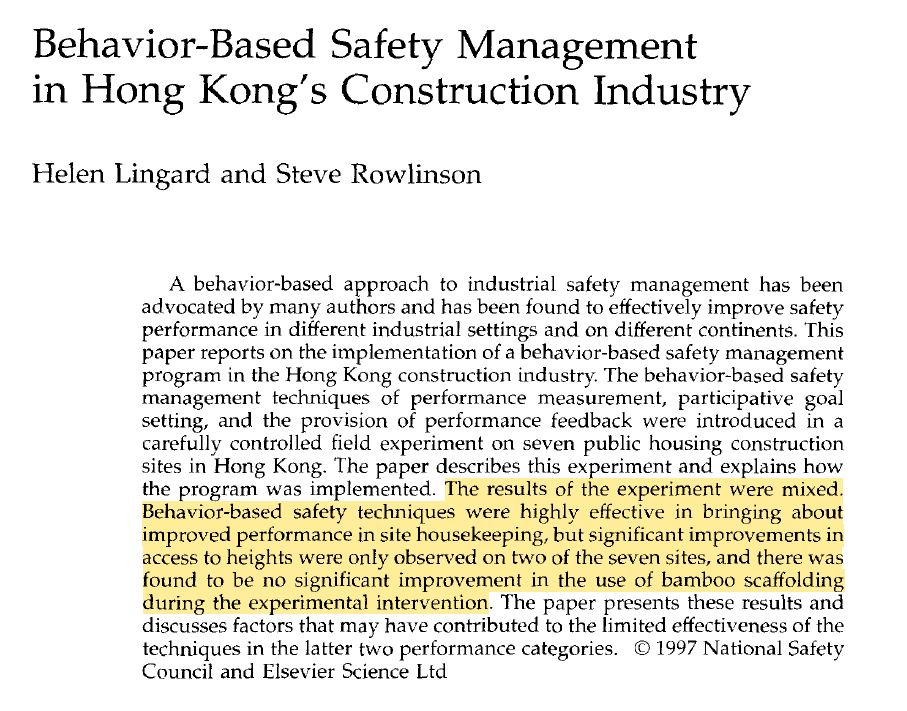
I found this an interesting throw-back to 1997, where Helen Lingard and Steve Rowlinson studied the impact of a BBS intervention in Hong Kong construction.
** Note 1: Noting the findings relate to HK industry from 1997, but there’s some broader learnings I think are really interesting and not just related to BBS, e.g. system and structural changes.
** Note 2: Yes I’ve cherry-picked. Read the paper and form your own view.
Some findings:
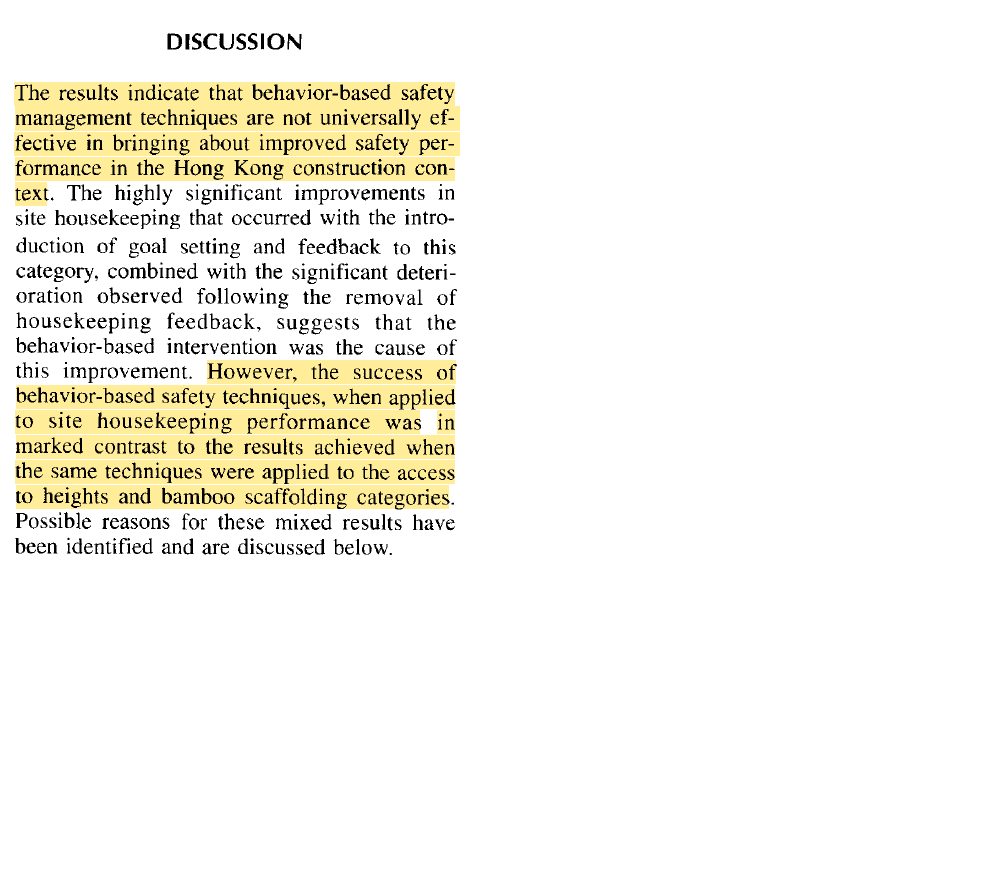
· “The results indicate that behavior-based safety management techniques are not universally effective in bringing about improved safety performance in the Hong Kong construction context”
· they found highly significant improvements in site housekeeping after the intro of the experiment, which deteriorated when the experiment was stopped, suggesting BBS was effective in improving housekeeping
· However, “significant improvements in access to heights were only observed on two of the seven sites, and there was found to be no significant improvement in the use of bamboo scaffolding during the experimental intervention”
· While housekeeping is a highly visible aspect of safety which everyone can contribute, and can be achieved without too much additional materials or equipment without significantly disrupting work schedules
· In contrast, “improvements in access to heights and bamboo scaffolding would require the deployment of extra resources, including materials, equipment, and considerable time”
· Evidence found that compliance to heights access and bamboo scaffolding safety standards, which they were being measured against, was believed to be “impossible to achieve”
· “These arguments against the feasibility of taking basic safety measures … suggest that it was not in the power of individual workers to behave safely with regard to access to heights or bamboo scaffolding. Under these circumstances, techniques aimed at improving worker motivation would certainly fail”
· Hence, “the effects of goal setting and feedback safety interventions are often disappointing because the techniques are implemented in an environment that is otherwise unsupportive of safe performance”

Finally:
· There are some “serious limitations to the effectiveness of behavior-based safety management”
· “Their effectiveness is limited because they ignore other, more fundamental, social and organizational factors that determine the industrial safety situation”
· As indicated by the limited success of improving access to heights and bamboo scaffolding “suggest that the safety problems experienced by the Hong Kong industry are deeper and more complex than the commonly expressed problems of “worker attitude” or “worker carelessness”
· “if behavior-based safety techniques are to be universally effective in Hong Kong’s construction industry, attempts to change behavior must be preceded by changes in the way in which … construction work is organized”

Ref: Lingard, H., & Rowlinson, S. (1997). Behavior-based safety management in Hong Kong’s construction industry. Journal of safety research, 28(4), 243-256.
Study link: https://www.academia.edu/32933077/Behavior_based_safety_management_in_Hong_Kongs_construction_industry
My site with more reviews: https://safety177496371.wordpress.com

 SafetyInsights.org