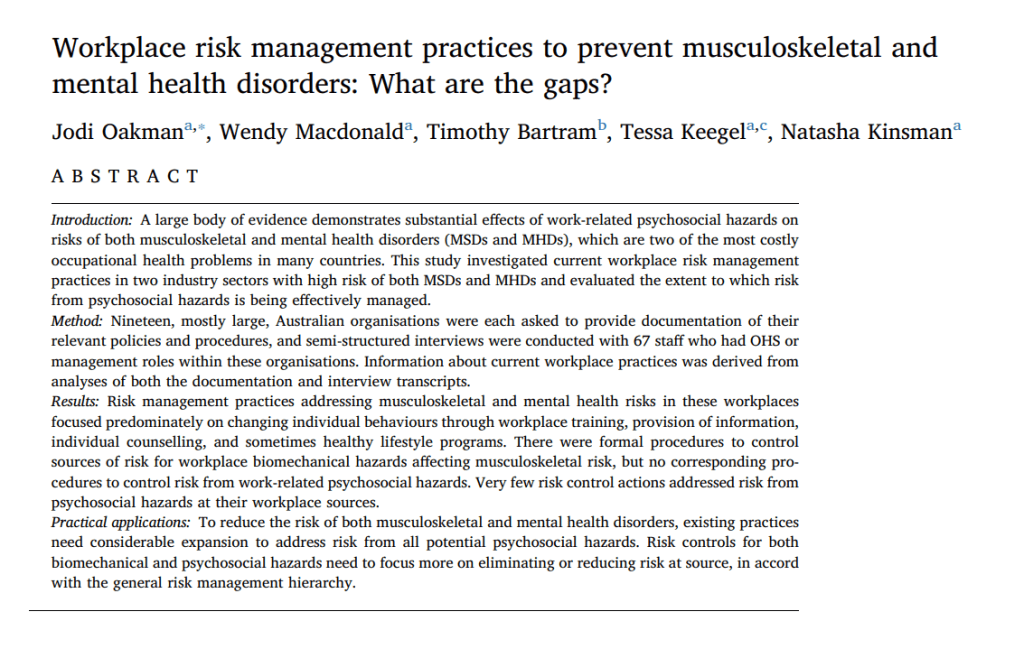
This explored two industry sectors with high risk of both musculoskeletal disorders (MSD) and mental health disorders (MHDs) and what workplace risk management practices are in place to manage those issues.
Safety documents were revised and interviews were obtained from organisations within both sectors. 10 logistics/transport companies & 9 residential aged care facilities were selected; with 67 interviews undertaken.
Results

Revealed was that risk management practices addressing MSD and MHD focused predominately on changing individual behaviours through workplace training, information and counselling, and sometimes healthy lifestyle programs rather than effective, higher-order controls.
Formal procedures for addressing biomechanical hazards impacting MSD was common but rarely corresponding procedures for controlling work-related psychological hazards.
In reviewing documents related to manual handling, it was found that manual handling was seen as synonymous with MSD, whereas the psychosocial hazards which impact MSD was generally poor. There was little in the way of documents detailing how to address MSD risk besides manual handling.
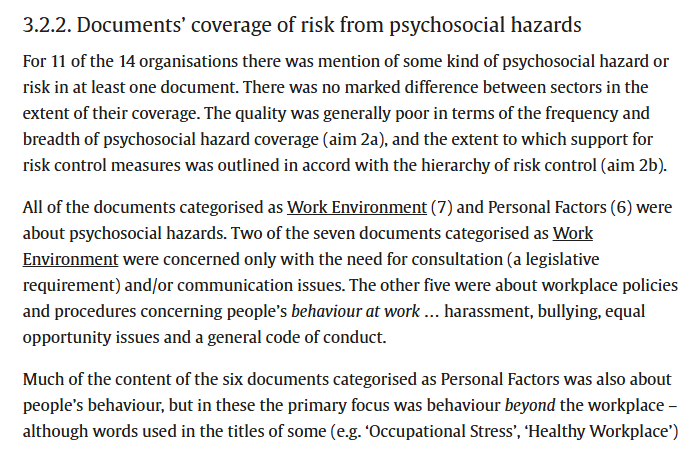
For psychosocial guidance, the majority of focus was on people’s behaviour and there were no documents “that dealt specifically with workplace requirements for managing risk of stress-related health disorders, or with all types of psychosocial hazards in the context of MH risk management, or with risks from psychosocial hazards more generally” (p224).
For worker’s mental health, focus was on personal characteristics rather than organisational factors influencing mental health.
For specific interventions for MSD/MHD, risk management focused on training and providing information. Another common approach was performance management, where supervisors/managers would try to enforce procedures. This is in contrast to effective work system design, where most psychosocial hazards are located, receiving very little targeted practices.
Thus, “risk from psychosocial hazards and associated stress is being given inadequate attention, regardless of whether the context is MSD or MHD risk management” (p228).
Overall, very few risk control actions addressed risk from psychosocial hazards at their workplace sources and had few organisational means or guidance documents to assist.

Of the interventions which existed, for MSD these focused primarily on manual handling and providing training, for MHD these focused primarily on worker behaviour outside of the work setting.
Therefore, “a significant proportion of the financial and other resources available at enterprise level to improve workers’ health and safety is not being expended with the maximum possible cost-effectiveness” (p229).

Oakman, J., Macdonald, W., Bartram, T., Keegel, T., & Kinsman, N. (2018). Workplace risk management practices to prevent musculoskeletal and mental health disorders: what are the gaps?. Safety science, 101, 220-230.
Study Link: http://dx.doi.org/10.1016/j.ssci.2017.09.004
LinkedIn post: https://www.linkedin.com/pulse/workplace-risk-management-practices-prevent-mental-what-hutchinson-tvqwc

 SafetyInsights.org
One thought on “Workplace risk management practices to prevent musculoskeletal and mental health disorders: What are the gaps?”