
This study compared whether ChatGPT can assist in hazard recognition during Construction Hazard Prevention Through Design (CHPtD) sessions (e.g. safety in design).
Via randomised controlled experimental design, 162 civil and construction engineering students were tasked with hazard recognition activities with or without ChatGPT assistance.
Providing background:
- CHPtD “places emphasis on identifying potential workplace hazards that may arise from design choices made during the design development phase … Its primary objective is to proactively select safer design solutions that minimize the risk of injuries to field workers”
- “Extensive research has consistently shown that design-related factors are responsible for roughly 40% of both fatal and non-fatal injuries in construction (Behm, 2005; Driscoll et al., 2008; Seo and Choi, 2008)”
- “Gibb et al. (2004) examined reported injuries in the United Kingdom and found that up to 47% of the incidents could have been prevented through the adoption of safer design choices. Likewise, Driscoll et al. (2008) investigated fatal injuries in Australia and determined that design factors may have contributed to approximately 37% of the reported fatalities”
- “poor hazard recognition remains widespread. For example, investigations from the US, found that over 40% of hazards remain unrecognized (Albert et al., 2020; Bhandari et al., 2020; Pandit et al., 2019). Other investigations from Australia and UK found that up to 57% of hazards may remain Unidentified”
- “designers may fail to identify over 60% of hazards, compared to 55% by field personnel (Hardison et al., 2020), hindering CHPtD implementation”

Results:
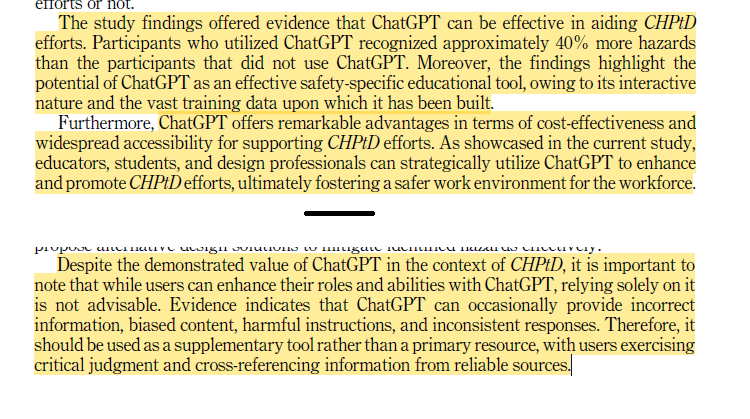
- “Participants who utilized ChatGPT during CHPtD sessions demonstrated a significant improvement in hazard recognition, identifying approximately 40% more hazards compared to those who did not use ChatGPT”
- “The results highlight the practical utility of harnessing ChatGPT in CHPtD sessions to enhance hazard recognition and ultimately promote workplace safety”
- “By leveraging ChatGPT, designers and engineers can better anticipate and mitigate potential hazards during the design phase, thus creating a safer working environment for field workers”
- “the findings highlight the potential of ChatGPT as an effective safety-specific educational tool, owing to its interactive nature and the vast training data upon which it has been built”
- “The AI platform possesses a vast repository of knowledge pertaining to building elements, construction operations, and related hazards – thereby offering valuable insights for CHPtD efforts”
- “ChatGPT offers remarkable advantages in terms of cost-effectiveness and widespread accessibility for supporting CHPtD efforts. As showcased in the current study, educators, students, and design professionals can strategically utilize ChatGPT to enhance and promote CHPtD efforts”
- “Despite the demonstrated value of ChatGPT in the context of CHPtD, it is important to note that while users can enhance their roles and abilities with ChatGPT, relying solely on it is not advisable. Evidence indicates that ChatGPT can occasionally provide incorrect information, biased content, harmful instructions, and inconsistent responses”
Ref: Uddin, S. J., Albert, A., & Tamanna, M. (2024). Harnessing the power of ChatGPT to promote Construction Hazard Prevention through Design (CHPtD). Engineering, Construction and Architectural Management.
Study link: https://doi.org/10.1108/ECAM-03-2024-0314
My site with more reviews: https://safety177496371.wordpress.com

 SafetyInsights.org