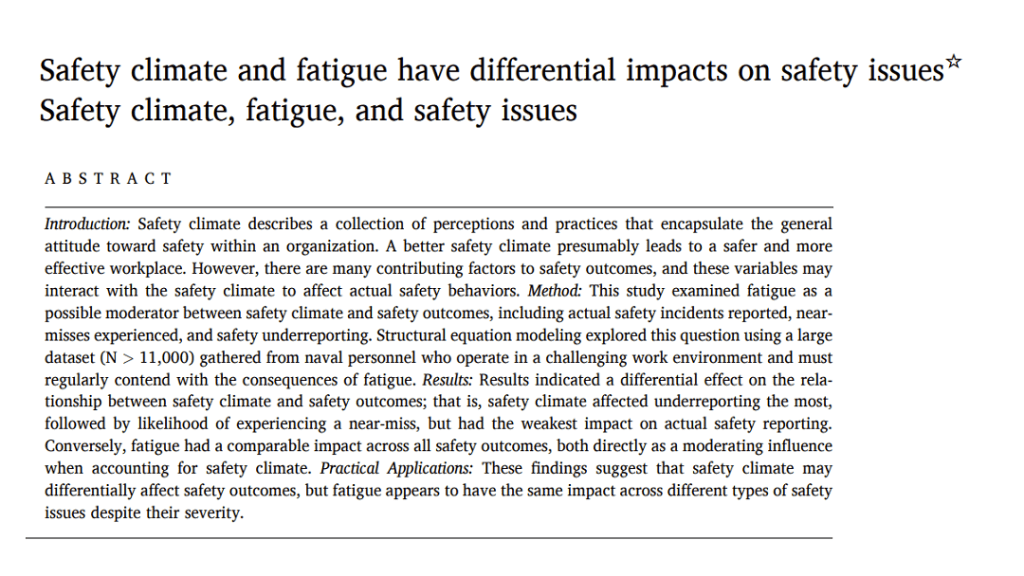
This study explored the role of safety climate and fatigue on safety issues and outcomes, based on survey of >11k US naval personnel.
Note: Self-reported data.
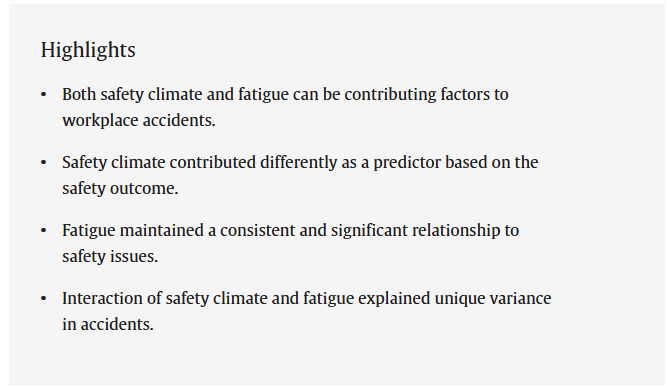
They found:
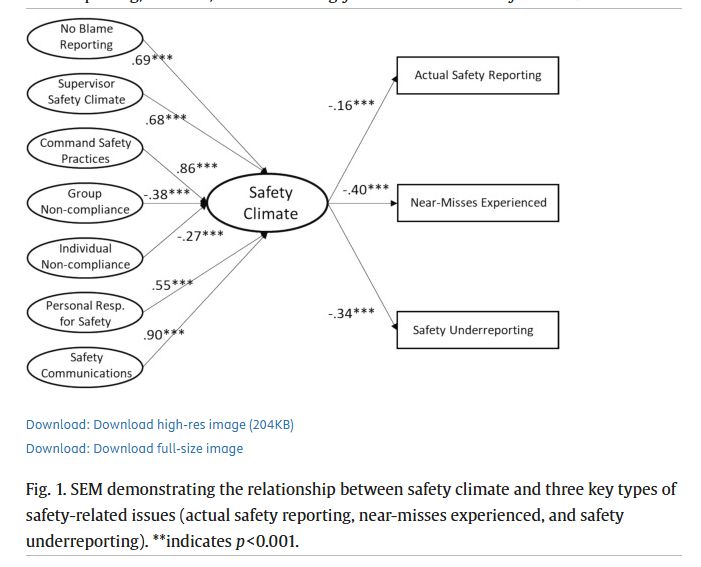
· “Results indicated a differential effect on the relationship between safety climate and safety outcomes; that is, safety climate affected underreporting the most, followed by likelihood of experiencing a near-miss, but had the weakest impact on actual safety reporting”
· “The strongest relationship was observed between safety climate and safety underreporting, which described individuals knowingly withheld safety-related issues from their organization”
· “There was a similarly robust, but weaker relationship between safety climate and near-misses experienced—that is, incidents that could have resulted in injury, but did not. The weakest relationship between safety climate and the three safety outcomes involved actual incidents reported to the supervisor”
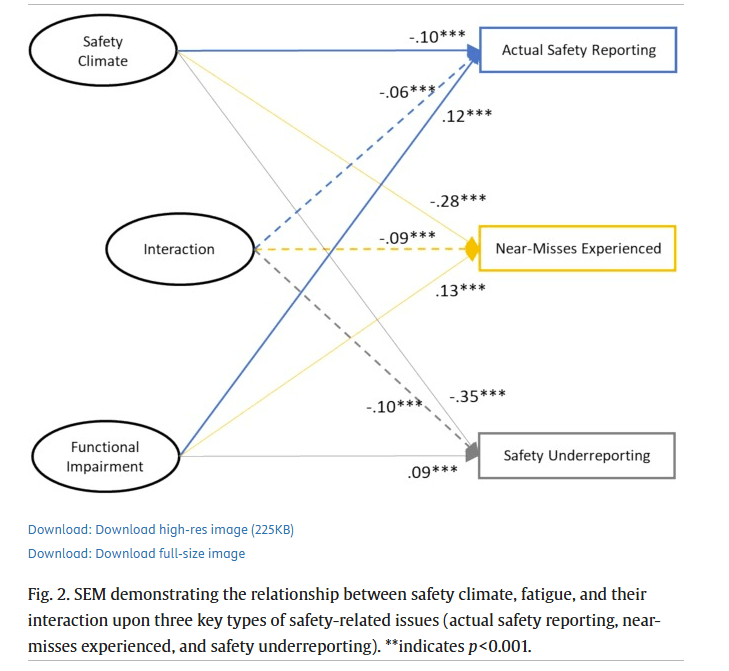
· “Conversely, fatigue had a comparable impact across all safety outcomes, both directly as a moderating influence when accounting for safety climate”
· “Whereas factors such as communication among personnel or a cumbersome safety reporting system might lead to different influences in perception and action, fatigue appears to have the same overall negative influence across all safety outcomes both in direction and scope”
· “fatigue represents a pervasive problem that cannot be overcome by a positive safety climate, and indeed may explain a portion of the safety outcome variance independent of the safety climate”
· “The trend thus suggests a larger influence for safety climate on attitudes and behaviors that could lead to safety issues, as might be expected since safety climate itself is largely composed of safety-related attitudes, whereas actual safety issues reported are the byproduct of more complex influences”
· “fatigue can be considered the more consistent influence on safety outcomes … One interpretation could be that the underlying impairment in cognitive functions from fatigue does not increase specific safety violation types, but rather the cognitive deficits exert a comparable influence across all facets of the safety environment”
· “Obtaining adequate rest is an important tool to prevent fatigue and relies on several factors. For one, adequate rest includes the ability to obtain routine high-quality, sleep of sufficient duration”
· “operational schedules that permit more regularity (reducing or eliminating shift rotations) will reduce the impact of circadian disruption on fatigue”
· “if work hours must be long, there should be frequent opportunities to take breaks allowing individuals to change activities for a period of time (Tucker, 2003). Unfortunately, there is substantial evidence that naval personnel have trouble achieving either quality sleep”
Ref: Biggs et al. (2025). Journal of Safety Research, 92, 142-147.
Study link: https://doi.org/10.1016/j.jsr.2024.11.017
My site with more reviews: https://safety177496371.wordpress.com

 SafetyInsights.org
One thought on “Safety climate and fatigue have differential impacts on safety issues: Safety climate, fatigue, and safety issues”