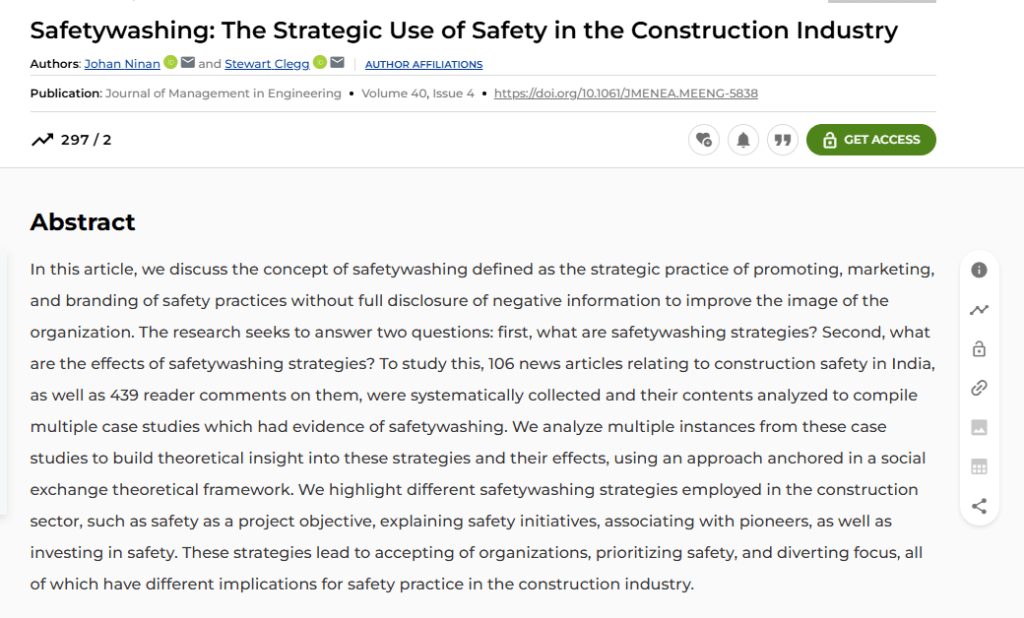
This paper investigated the influence of safetywashing in the case of 106 Indian newspaper articles relating to construction and 439 reader comments.
Namely, they were interested in:
· What safetywashing strategies are used?
· What are the effects of safetywashing?
Providing context:
· Numerous safety strategies are used, ranging from design, technology and interpersonal. Some include the use of pictures and simple messages via posters, newsletters, videos and slogans
· These campaigns are supposed to signal to people that safety is important. While the effects of interventions within organisations has been studied a lot, less is known about about the promotion of safe practices outside of organisations
· Safetywashing is defined as the “strategic practice of promoting, marketing, and branding of safety practices without full disclosure of negative information to improve the image of the organization”
· For the external audience, perceptions of the construction industry are often promoted through news media. There are “social implications of the strategic use of safety discourses, particularly in the news media”
· That is, news can shape perceptions of corporate decisions based on how receivers view the media
· The idea of safetywashing came from greenwashing, but other types exist including healthwashing, ethicswashing and bluewashing
· These ‘washing’ phenomenons are said to focus on “marketing purposes that are not an accurate reflection of what is really done in relation to [their actual] practices”; such that an overly positive corporate image is created
· Different elements of greenwashing have been proposed, including hidden trade-offs, offering no proof, vagueness in claims, using false labels, irrelevant claims, offering lesser of two evils, and deceitful fibbing
· Most members of the public have no direct personal experience of safety in construction outside of media; hence, “People’s attitudes toward safety are mediated by their experiences of news media representations of construction safety”
· It’s argued though, that safetywashing in itself may not all be negative, and that it can bring about positive awareness and improvements
Results
They found that representations on safety can be grouped into different strategies, being:

1. Safety as a project objective:
· Safety was discussed in the media as a characteristic of the project, e.g. like a tunnel project saying that it had “all the modern technical safety arrangements”
· The construction of a nuclear plant made similar claims, but “No proofs were offered to support the claims of modern or safest nuclear power plant in the world, which is one of the seven sins of greenwashing”
· Here, safety was found to be promoted as a product, project or government that can “act as a driving force in creating trust”
2. Explaining safety initiatives:
· Sometimes the safety features in projects were explained in more details, like the safety features discussed in a proposed expressway (like a smart highway traffic system)
· These examples of safety features “communicated a perception of the project as safe”
· Based on the comments, “the inefficiency of safety practices were used by protesters to communicate safety concerns and discredit the initiative or its organization”
· Explaining safety initiatives are a type of safetywashing in their view, since “since it includes hidden trade-offs with a focus on an unreasonably narrow set of attributes without attention to other important issues”
3. Associating with pioneers:
· This safetywashing strategy built trust in the project by associating itself with known international companies or technologies
· For instance, a metro rail project claimed to have “used internationally tried and tested monitoring tools to address safety concerns”
· Another project said that they used electro-mechanical components imported from Switzerland
· In other cases, the association with pioneer strategy was also used to discredit a project; like with a NASA feasibility report used to discredit a hyperloop project
4. Investing in safety:
· This strategy built trust by highlighting the amount to be spent on safety. In one case the safety budget was discussed for a railway. While this figure looked large, it’s said that “the amount equates to only 0.4% of the total budget of the railways and is significantly less in contrast to an average US transport organization spending about 20% of its budget on safety measures”
· Hence, the “numbers do not stack up comparatively”,
· This was considered safetywashing since the use of money claims lacked specificity and were generally vague
· Claims discussing how a nuclear plant will be supervised by two French nuclear safety officers was seen to be “more a safety image building exercise than a central safety strategy in practice”
Safetywashing Effects
Next they look at the effects of safetywashing by exploring the comments on these articles. These were grouped into the following themes:

Comments indicated that the safetywashing efforts improved perceptions of the city, project or product, leading to their acceptance by the public
Safetywashing in construction “extends from product and project level to even the city and country level”
· Prioritizing safety:
o The focus on safety in public discourse isn’t necessarily bad, and can improve societal perceptions of safety
o Some comments on a tunnel project indicated that the ‘safety as a project objective’ can lead to the community perceiving safety as important
o This was similar to greenwashing, where it can increase awareness of sustainability in the community
· 2. Diverting focus
o Safetywashing was used to divert attention from other critical aspects, like a metro rail project that promoted a safety award to “[divert] focus from the ground issues”
o Safetywashing can divert focus from other aspects like cost, time and quality
Implications for Safety Research and Practice
Next they discuss the implications of their research:
1. Safetywashing was found to occur via four strategies – essentially as a type of safety marketing
2. Organisations use safety to market their initiatives, similar to greenwashing
3. Promoting safety of a project can lead to increased asset usage and sales during the operational phase
4. “Along with providing positive information to create an overly positive image, safetywashing involved hiding negative information”
5. Safetywashing can be used for political purposes, like to discredit a city, project or product
6. Safetywashing can improve a focus on safety, but also risks diverting focus from other critical areas
Ref: Ninan, J., & Clegg, S. (2024). Safetywashing: The Strategic Use of Safety in the Construction Industry. Journal of Management in Engineering, 40(4), 05024008.
Study link: https://doi.org/10.1061/JMENEA.MEENG-5838
My site with more reviews: https://safety177496371.wordpress.com
LinkedIn post: https://www.linkedin.com/pulse/safetywashing-strategic-use-safety-construction-ben-hutchinson-fvxrc

 SafetyInsights.org
One thought on “Safetywashing: The Strategic Use of Safety in the Construction Industry”