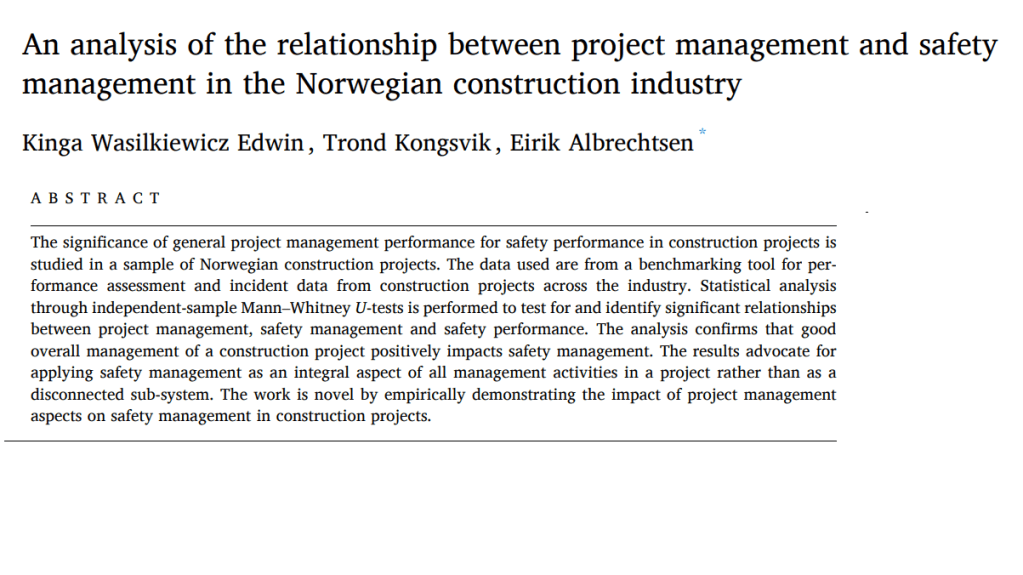
This study evaluated the relationship between project management and safety management in the Norwegian construction industry.
Data was from 111 unique projects and 26 firms. They assessed projects on a range of different project management capacities and safety management.
Providing background:
· While a robust body of research has looked at both project management/production, and safety, less have evaluated their interaction
· “Safety performance and management cannot be seen as independent of other organisational activities. Project management is thus a key contributing factor to controlling hazards in construction projects”
· “Construction projects involve temporary organisations with a specific objective to be completed within certain specifications and a defined start and end date” and “Project management is about managing such a temporary project organisation to reach its objectives … within time, cost and resource constraints”
· Some studies have examined the relationship between project management and safety performance in projects
· Significant relationships have been observed between things like managerial activities, procurement, human resources, economic investments, labour management, resources, pre-task planning
· One study found project management was a “clear influencing factor in 24 per cent of accidents” in construction
· Other work has found that the project managers’ experience level was associated with safety performance, and other work has found strong correlations between general management factors and injury frequency rates
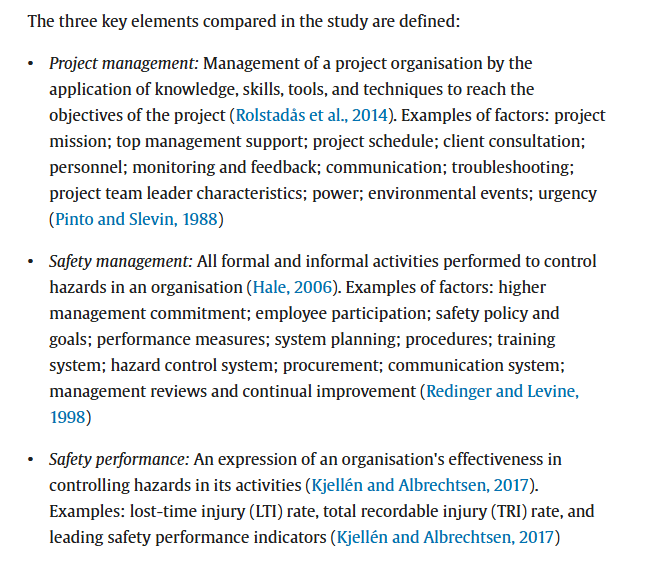
Some of the project and safety management facets they explored were:

Results
They found:
· “good overall management of a construction project positively impacts safety management”
· “results advocate for applying safety management as an integral aspect of all management activities in a project rather than as a disconnected sub-system”
· “projects that perform well on project management also perform well on safety management”
· “the same contributing factors both create value and enable the control of hazards” (emphasis added)
· ”Safety needs to be an essential component of the overall system to provide value across business processes”
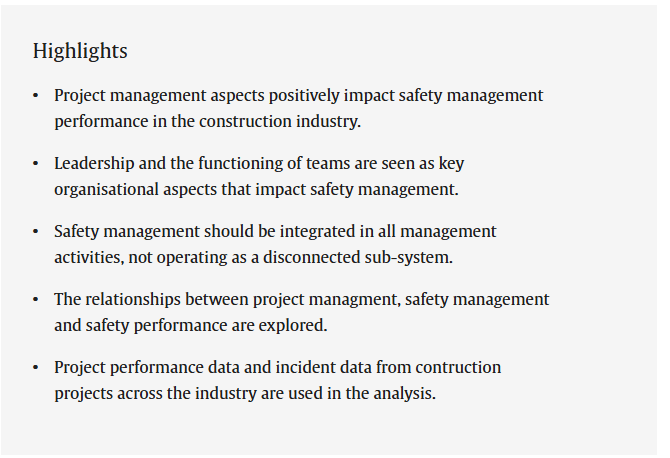
These findings support some other work finding that safety needs to be integrated as part of other sub-systems. Hence, “Leaving safety management merely as a side unit, without the strings to steer the factors that affect the safety objectives, hinders satisfactory safety management”.
And not only does the insufficient integration of safety as an aspect system impact safety performance, but it also has downsides for the whole system. Moreover, “The project manager is the operational responsible for safety on a project, and the study shows a strong and significant relationship between good leadership and good safety management”.
The project managers role seems to be influential and particularly important based on these findings. Other work has found that a project managers’ “capabilities and commitment are found to be important factors for construction projects’ success”.
The project management-related factors that were studied in this paper were found to contribute to project success and good safety management. It’s argued that having an in-house competence and capability for safety resources is important and warn about outsourcing these responsibilities.
The relationship between safety performance
Next they cover some of everybody’s favourite shindig – injury measures. Notably, injury measures like LTI and TRI have been criticised by many, for several reasons.
While they recognise these criticisms, they highlight that the measures are still used across industry, so had a place in this study as one measure (but not the only measures they used for comparison). While they found that project management and safety management performance were complimentary and interconnected (e.g. projects performing better in project management also performed better in safety management), injury rates were not. That is, no significant differences were found between projects that performed well and those that performed poorly.
They cover some explanations for why no effect on injury rates were found, including error types, climate, statistical issues with these measures and more.
But, importantly, these results “might thus elucidate the limitations of using incident rates such as TRI and LTI rates as indicators for measuring safety performance during projects” (emphasis added).
These indicators give delayed feedback on performance, and may be susceptible to underreporting and manipulation. Also, and importantly, “as incidents and outcomes mostly occur randomly and require large sample sizes for statistical analyses, the measures might not give sufficient reliable information to control or improve safety during the project lifespan”.
Hence, the randomness in injury rates, short measuring span and the limited sample size may be reasons why no effects on injury rates was observed in higher performers in this study.
They briefly discuss strengths of other types of measures. Although they cover ‘leading indicators’, usefully they move beyond just this throw-away comment and argue that indicators should really move towards measuring the quality of project management elements that impact safety.
Moreover, their findings “provides evidence that factors related to general project management activities and characteristics should be considered for leading safety indicators’.
They say there are two main contributions of this study for practice and research:
1) “safety in construction projects is created and maintained both by project management, aiming at reaching the objectives of a project and safety management, aiming at supporting decisions for hazard control”
a. Suggesting that “that one should avoid polarisation between value creation and safety which can lead to conflicting objectives”
b. Safety shouldn’t be treated as a fifth wheel and bolted on, but integrated throughout the whole project management lifecycle. Perhaps also supporting adaptive/S-II perspectives in looking at what makes a project successful and maximising those potentials
2) “safety performance indicators should be complemented by leading safety performance indicators that measure expected control of hazards. This can be done by measuring project management factors such as the characteristics of project managers and their leadership and factors related to information flow and project management systems”.
a. Developing indicators should focus on identifying critical success factors that matter for the achievement of safety and project management, and develop ways to measure and analyse these factors
Then they discuss some of the challenges around indicators. One is the complexity of “how safety performance is ‘produced’”, but also the specific characteristics of industries, projects, workplaces, workforces and more.
Also, and finally, “conditions that ‘produce’ safety performance change over time, for example by changes in top management and turnover of personnel, illustrating the need to maintain indicators to ensure their validity”.

Ref: Edwin, K. W., Kongsvik, T., & Albrechtsen, E. (2024). An analysis of the relationship between project management and safety management in the Norwegian construction industry. Safety Science, 180, 106654.
Study link: https://doi.org/10.1016/j.ssci.2024.106654
My site with more reviews: https://safety177496371.wordpress.com
LinkedIn post: https://www.linkedin.com/pulse/analysis-relationship-between-project-management-ben-hutchinson-qwqbc

 SafetyInsights.org
One thought on “An analysis of the relationship between project management and safety management in the Norwegian construction industry”