I’ve long been critical of the construct, and application of, ‘safety culture’ (at best, I’d probably be described as from the interpretive camp—e.g. ‘culture-as-metaphor’).
I’ve covered lots of articles why – and others have argued far more nuanced reasons. So, I’m not covering that now.
But in saying that, I’ve always found the following definition really unexplainably appealing… where ‘safety culture’, or a culture of safety, can be seen as:
“A safety culture is in turn the set of assumptions, and their associated practices, which permit beliefs about danger and safety to be constructed”

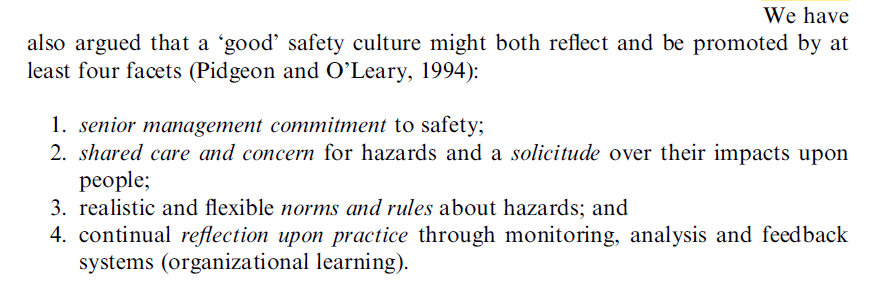
What I also like about this type of perspective is that it highlights how cultures can both sensitise and desensitise us to danger, e.g., talking of NASA’s culture:
“provided a way of seeing that was simultaneously a way of not seeing”.
Moreover, these:
“institutionalised assumptions and norms have the capacity to simultaneously illuminate some hazards while shifting attention away from others is a fundamental paradox of any organizational safety culture”.

Is this really indicative of ‘safety culture’? A culture of safety? A macro or collection of subcultures? Or something else? Do we even need to invoke the concept of culture to discuss institutional assumptions, norms etc?
I don’t know. But I like it anyway, despite the fact I almost never use or refer to ‘safety culture’.
PS. I’m not arguing in favour of SC by pointing out this definition, nor arguing we should adopt this definition. I just like it. That’s all.
PPS. I’m sometimes asked what is my favourite paper – I’m not sure if I have a single no.1, but this paper is surely in the top 5.

Ref: Pidgeon, N., & O’Leary, M. (2000). Man-made disasters: why technology and organizations (sometimes) fail. Safety science, 34(1-3), 15-30.
Study link: https://doi.org/10.1016/S0925-7535(00)00004-7
My site with more reviews: https://safety177496371.wordpress.com

 SafetyInsights.org
One thought on “Safety Culture or: How cultures can both sensitise or blind us to danger”