

This was a banger – exploring the application of community ergonomics with a strong systems lens.
If you’re interested in HF/E, systems thinking, social dynamics, power gradients and more then this will interest you.
Can’t do it justice, so a few random extracts.
Extracts:
- Community ergonomics is a “design approach to the interfaces between people and system design in societal contexts”, used to enable underserviced communities to achieve a better community-environment fit
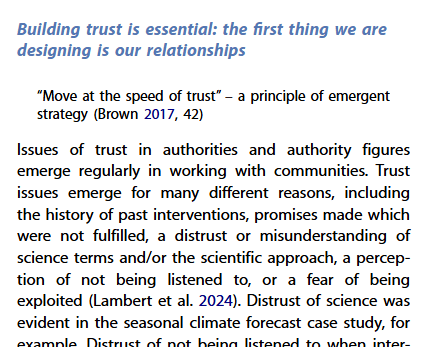
- Nicely, they say “Building trust is essential: the first thing we are designing is our relationships”
- “Defining system boundaries is a dynamic process: communities are the experts on their system”
- “Power differentials are inevitable and must be addressed outright”
- Notably, “System boundaries identified by ergonomists may not be the system boundaries that are most relevant for the community”
- “Community members are the most well-equipped to identify relevant system boundaries”
- “Defining system boundaries is a statement on what matters and is complicated by dynamic group membership and definition”
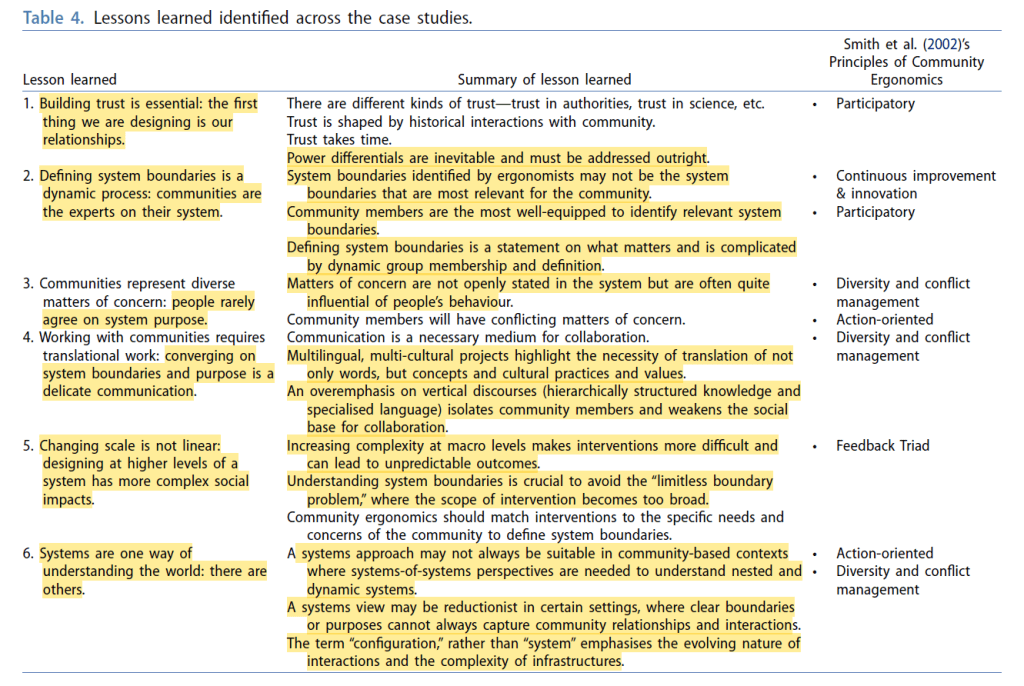
- “Communities represent diverse matters of concern: people rarely agree on system purpose”
- “Matters of concern are not openly stated in the system but are often quite influential of people’s behaviour”
- “Communication is a necessary medium for collaboration”
- “Multilingual, multi-cultural projects highlight the necessity of translation of not only words, but concepts and cultural practices and values”
- “An overemphasis on vertical discourses (hierarchically structured knowledge and specialised language) isolates community members and weakens the social base for collaboration”
- “Changing scale is not linear: designing at higher levels of a system has more complex social impacts”

- “Increasing complexity at macro levels makes interventions more difficult and can lead to unpredictable outcomes”
- “Understanding system boundaries is crucial to avoid the “limitless boundary problem,” where the scope of intervention becomes too broad”
- “Systems are one way of understanding the world: there are others” and that a systems approach “may not always be suitable in community-based contexts”
- Further, a “systems view may be reductionist in certain settings, where clear boundaries or purposes cannot always capture community relationships and interactions”
- “The term “configuration,” rather than “system” emphasises the evolving nature of interactions and the complexity of infrastructures”
- “with increasing scope, comes more complex socio-political-technological complications”, like factors with only distal impacts at micro-levels (government policy) have more direct impacts at macro-levels
- “The larger and more complex the systems, the more interconnections are present and grow exponentially, which makes untangling the interconnectedness tricky”
- “It is tempting to want to intervene at the highest level possible (since this implies the design of fewer interventions or fewer iterations of the same intervention), but the more complex the level where we aim to intervene the greater the number of interconnections and the longer it takes for interventions to take effect”
- “approaching a community with a pre-identified problem and solution would be counter to this approach”
- “design is political. The outcome of a design process reflects the values and beliefs of the people who designed it, which means having appropriate skills in navigating power differentials is essential”
Finally they talk about ways to improve this practice – via collaborative community design, navigating complexity via boundary objects and more; but I’ve skipped.
Study link: https://doi.org/10.1080/00140139.2025.2450726
My site with more reviews: https://safety177496371.wordpress.com
Shout me a coffee: https://buymeacoffee.com/benhutchinson


 SafetyInsights.org