
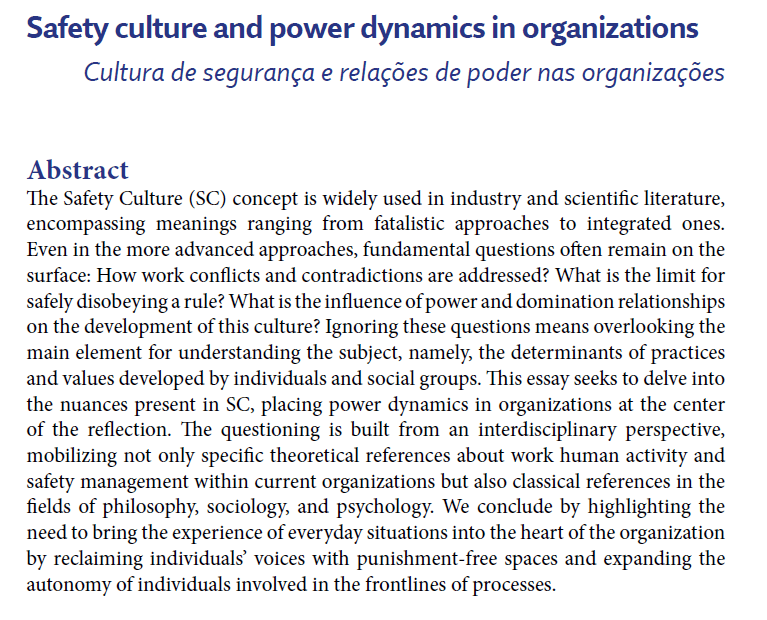
Not much to say here. This article briefly touched upon the interactions of power dynamics and safety culture.
Some really cool stuff has been written about power in safety (check out my site).
This only really briefly touches on a few points:
· Starting with safety culture (SC), they say it has “even been abandoned by various authors”
· Some argued that SC “do not lead to practical transformations unless decision-making in companies provide guarantees and resources in favor of safety”
· They point out Antonsen’s description of power, leveraging Lukes’ work
· Lukes’ proposed that dimensions of power are “power linked to social relations among individuals based on their capacity to recognize, articulate, and achieve their interests”
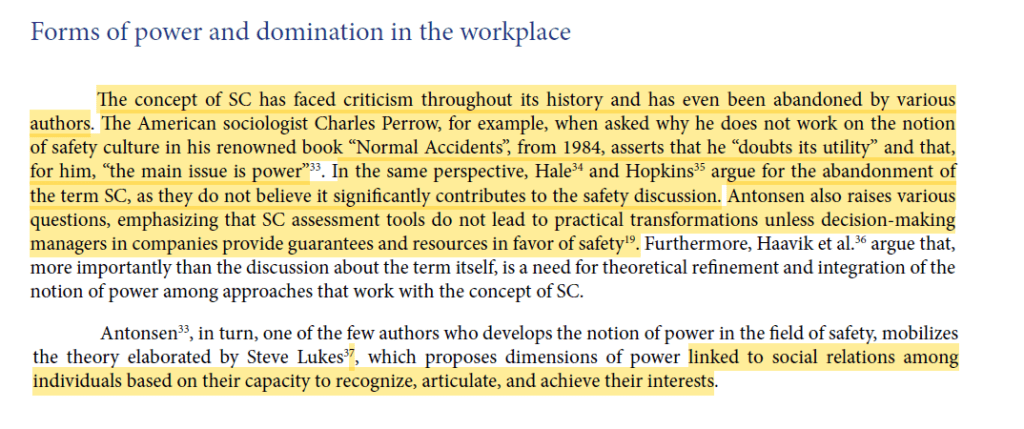
1. Hierarchical power
· The first type of power is the type of political actors imposing will on others. This includes organisational policies, decisions and more. It’s said to be easily observable and “also known as manifested power”
· It can be seen in hierarchical positions, expertise, alliances and more
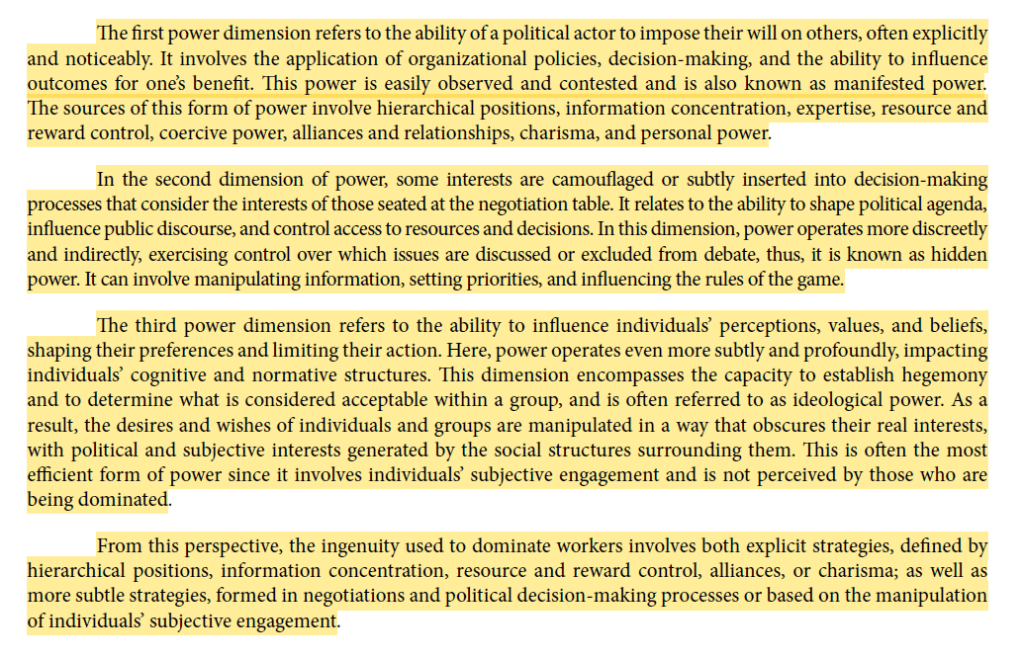
2. Hidden power
· This is camouflaged or subtly inserted into decision making to “ensure the interests of those seated at the negotiation table”
· It’s about shaping political agenda, influencing public discourse and controlling access to resources etc
· Compared to the first power dimension, this “operates more discreetly and indirectly, exercising control over which issues are discussed or excluded from debate”
3. Ideological power
· The most subtle of power forms, it involves manipulating info, setting priorities and influencing “the rules of the game”
· It targets influencing individual perceptions, values and beliefs, or shaping their preferences
· “Here, power operates even more subtly and profoundly, impacting individuals’ cognitive and normative structures”
· “As a result, the desires and wishes of individuals and groups are manipulated in a way that obscures their real interests, with political and subjective interests generated by the social structures surrounding them”
· It’s said to be the “most efficient form of power since it involves individuals’ subjective engagement and is not perceived by those who are being dominated”
To paraphrase Sid Dekker from another paper, “there’s power in safety, and safety in power”.
Ref: Rocha, R., Pucci, F., & Walter, J. (2023). Safety culture and power dynamics in organizations. Revista Brasileira de Saúde Ocupacional, 48, edcinq12.

Study link: https://www.scielo.br/j/rbso/a/ghnrhMFyqSssFxFFSMfQbXd/?format=pdf&lang=en
Shout me a coffee: https://buymeacoffee.com/benhutchinson

 SafetyInsights.org
One thought on “Safety culture and power dynamics in organizations”