
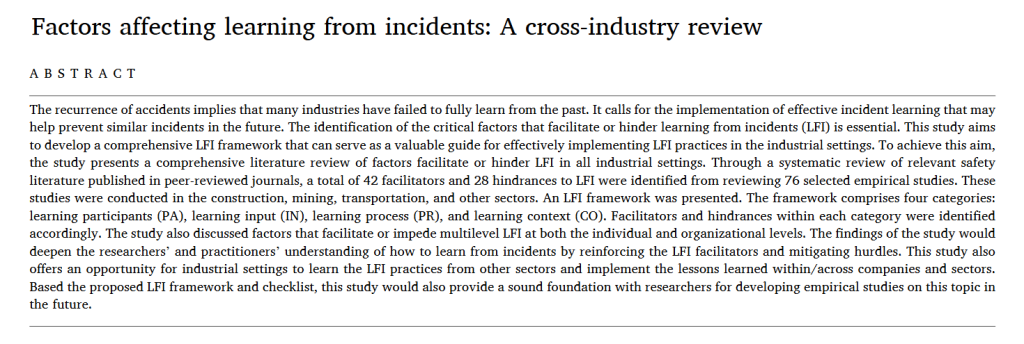
This study systematically reviewed the research to unpack the factors that influence learning from incidents (LFI).
Likely nothing new to anybody, but it is a good reference paper for tracking down specific research.
Background:
· Common reasons for ineffective LFI are “underreporting of incidents (Sanne, 2008), incapacity to identify latent circumstances (Jacobsson et al., 2009), the propensity to seek a scapegoat (Pidgeon and O’Leary, 2000), and organizational and political decision-making factors”
· They divided LFI into four categories – learning participants (PA), learning input (IN), learning process (PR), and learning context
· Learning input is the info and knowledge feeding into the LFI system, e.g. accident reports, lessons learnt, training, and info exchanges
· LI is predicated on incident reporting, since “Without the detection and subsequent reporting of safety issues, there will be little to no oppor-tunity to learn from such event”
· Inconsistencies in what constitutes reportable events hampers learning and disparities “understanding of what counts as arisky circumstance worthy of reporting among different work groups”
· One study concluded that “it is challenging for construction industry workers to understand what counts as an incident when nothing happens”
· Learning context is the organisational and external environment where learning occurs, and influenced by willingness of participants to learn, and how organisational rules, norms, structures, behaviours and processes affect employees participating in learning
· Geller suggests that some organizational behaviors block learning, e.g. “setting high and inappropriate safety goals and misuse of feedback such as giving negative/corrective feedback more than giving positive/supportive feedback”
· Learning process, which is the continuous knowledge flow and efficiency of knowledge sharing; how organisations approach single vs double loop learning is one factor here
· Single loop addresses the immediate issue, whereas double loop focuses on reorientating mental models and approaches to prevent the issue
· “Skills training, punitive decisions, and technical modifications are all examples of single-loop techniques”
· Learning participants is the fourth category and involves, of course, involvement of the multiple parties
· They found that “commitment from managerial staff”, and “Underreporting and blame culture were the most frequently reported hindrances”

· Moreover, “Blame culture is the most important factor that inhibits incident learning”
· Some work found “frontline workers are reluctant to assist with the LFI procedures (e.g., information collection, knowledge dissem- ination, and implementation measures)”
· Improper incident techniques or approaches may also lead to incomplete info, as with “too professional or technical LFI tools may not be effectively used in practice”
· Usual suspects like “Hasty submission of incident investigation re- ports can lead to superficial and formalistic reporting, which reduces the effectiveness of LFI”
· Time constraints also limits effectiveness of LFI processes, where teams “may overlook further hazards to finish the work on schedule, making it impossible to identify the system failure that caused the incident”
· “Complementary methods may be more beneficial than single methods” when it comes to incident tools/processes
· Moreover, while investigations often have follow-up/corrective actions “effective measures to determine and execute imple- mentation are lacking” [** we found the same thing in auditing too]
· Not surprisingly, how people “were treated following the incident would have a huge impact on organizational learning”
· Prioritising “flawed” systems over blame can help recognise fallibility, and create an atmosphere of trust and disclosure
· “Trust is built on strong cohesion, honest communication, and mutual respect”
· Blame can “significantly reduce the effectiveness of organizational learning … and even lead to negative interpersonal relationships and incident silence”
· LFI is also hampered by the use of goals, tendering and ‘looking good’, where “emphasis on reputation and safety performance exerts pressure on employees and may also reduce their involvement in reporting incidents”
· And, “As most organizations view low incident rates as a sign of great safety performance, the organization’s emphasis on reputation provides employees a greater incentive to cover up incidents”


Study link: https://doi.org/10.1016/j.jlp.2024.105297

 SafetyInsights.org
2 thoughts on “Factors affecting learning from incidents: A cross-industry review”