

This literature review evaluated the impact of boards of directors on workplace safety.
49 studies met inclusion.
Way too much to cover.
Background:
· “There is a growing understanding that operative leadership, from line managers to senior management, plays an important role in occupational health and safety”
· Leadership “do not act in a vacuum” and are influenced by the organisation, including from senior management, who themselves are responsible for setting agendas and resources
· They highlight that while there is quite a bit of research in this area, “all of these descriptions of roles and responsibilities focus on operative management (the day-to-day running of a business), rather than strategic leadership and governance; that is, the system by which an organization is directed and controlled”
· And “The body responsible for strategic leadership and governance is the board of directors”
Results
Key findings:
· “Empirical studies gave no insight into the scope of impact of board activities on OHS, and no studies assess the causal mechanisms by which board activities influence OHS outcomes”
· “Most studies focused on both health and safety (n 5 20; 41%) or only safety (n 5 15; 31%)”
· “Context might explain the focus on safety rather than health, but is not clearly elucidated by the studies”
· “Several studies are describing leadership behavior, although not framed as such”
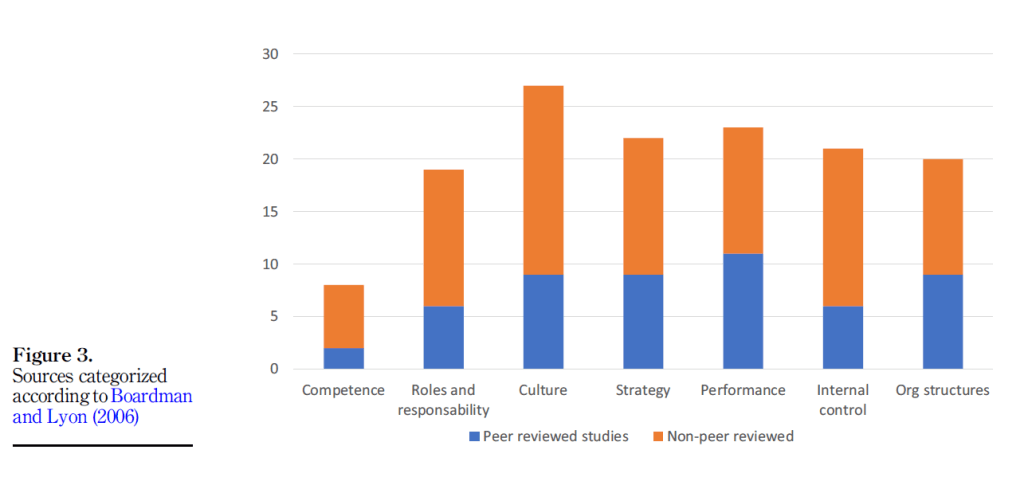
They categorised the frequency of topics that research focused on:
A random assortment of other findings were:
· Based on the 49 studies, they found that 57% contained empirical data, others were entirely normative (33%), and a few “contained normative claims far beyond empirical data”.
· Most of the sources focused on both heath and safety (41%), or only safety (31%).
· Board-level governance of OHS was more common in top-performing companies, and board-level involvement “was motivated by a need for power and control, mandated by legislation or based on a need for corporate governance”
· One source indicated that boards get involved with OHS issues was for reasons beyond just liability, and included things like a duty towards stakeholders or pride in achievement
· The overarching categories of a boards’ OHS responsibility were grouped under planning, delivering, monitoring and reviewing by some sources
· One safety manager remarked that “the responsibility of boards was not to “drive” safety, but to make sure that managers do so”
· For how boards should organise responsibilities – some sources said for there to be one nominated director for developing and monitoring safety, other work suggested that the CEO should automatically be the nominated safety director, and others disagreed
· They note “Although having an assigned “director of OHS” can provide a strong signal that OHS is a
· prioritized issue (Hughes and Ferrett, 2011), it also risks that person becoming a scapegoat for failures … or increases the risk of power struggles between board members with different areas of responsibilities”
· Some work suggested that safety should be integrated into other areas of a boards’ responsibilities, in order to create synergies and improve knowledge management, whereas others argued against this approach eg “such an integration may increase the risk of OHS work becoming completely subsumed by other focus areas”
· Sources identified the need for directors to have a basic understanding of OHS, and to understand their legal and formal responsibility – especially the chairperson
· Interestingly, quoting the paper “a Canadian study found no evidence that members of OHS committees had any formal OHS education/qualification, and its authors argued that such a lack of competence would never be accepted in, for example, a financial subcommittee” (emphasis added)

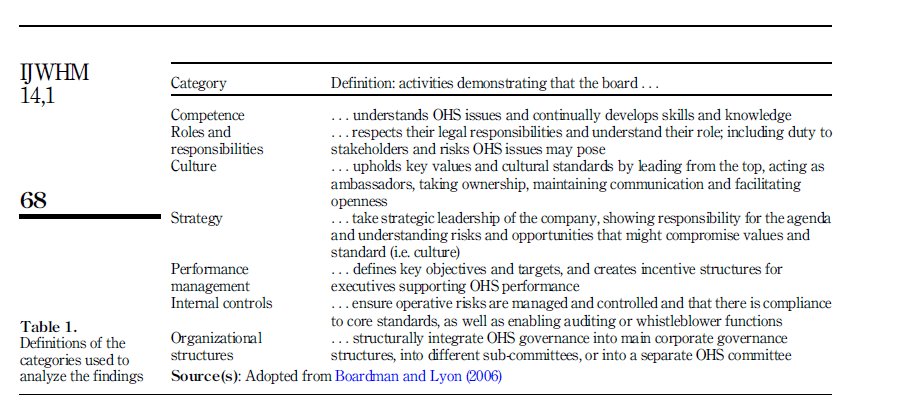
The paper unpacked a few other areas. Boards would focus on culture & strategy of safety. However, the research in this area was highly focused on defining and “captur[ing] culture”, rather than on how boards actually influence cultural elements. Also, a lack of OHS was seen as a threat to daily operations.
Boards also focused on performance management. Some sources suggested that boards should establish key objectives, KPIs, incentives and more relating to safety.
From what I can tell, the recommendations on indicators were the usual suspects – leading/lagging, strategic/outcome/process and more.
Some sources related strategic to culture and less tangible elements of performance; outcome measures were absences from work and the like; process measures include training measures, perception surveys [*** and probably control effectiveness, system effectiveness etc?]
They say “Overall, several sources suggested mixing quantitative and qualitative indicators, covering tangible and intangible aspects”.
Some sources covered OHS incentive structures. Usefully, some of this work pointed out the potential unintended consequences of incentives, e.g. “A performance measurement system should pay attention to the potential trade-off between OHS and other indicators such as financial performance”.
Also, usefully, some work pointed out the difference between “what is easy to measure and what is important to measure” (emphasis added).
Some studies concluded that boards should oversee how organisations manage OHS and how they go about managing and controlling risks – including operational risks, accidents, health claims, legal risks and psychosocial and physical risks.
It’s recommended that the “system for internal controlcshould be harmonized between different divisions of an organization and with its performance management system”. Internal controls to the board should be based on regular reports to the board, including both internal and external sources.
Another source recommended independent reviews twice a year, another suggested reports on OHS at every board meeting, monthly, and/or whenever something bad has happened. Other sources suggested that internal controls to boards should include audits or reviews, diligence reports and statistical data.
Some sources also recommended that boards receive details on major risks and “reporting according to a certain theme (such as safety culture, vehicle risks or plant maintenance; Peace et al., 2017)”.
Other work commented on the structures of board OHS oversight. Some saw that OHS should be integrated int the board meeting or existing subcommittees, whereas others advised the establishment of a separate subcommittee for OHS.
Some data found that firm performance was better with the presence of separate subcommittees that focused on specific performance outcomes (at least in sustainability). Another study “could not find conclusive evidence that OHS committees improved OHS, although 90% of members of the committees were convinced that they did strongly improve [performance]”.
Nevertheless, subcommittees are argued to play an active role in creating an “open culture”, and they can “be an important motivator for executives to engage in OHS”.
Discussing the findings, they argue that:
· “The literature mostly focused on the boards’ role in organizational culture, whereas the role of the competence of boards of directors was least discussed”
· Boards were far more frequently involved in safety than to worker health
· It’s said that “the one-sided focus on safety poses a challenge to theory and practice”, as work-related health issues are “increasingly dominated by psychosocial health issues”
· Boards may face some challenge with psychosocial matters compared to their focus on physical safety
· This is because “an injury can more often be directly associated to a single event”, with the outcomes readily observable; in contrast “Psychosocial health issues are … less direct and more complex in that they can depend on a number of organizational or personal factors”
Finally they cover the question “How do board activities influence OHS?”
Overall, there is “scarce empirical evidence” which covers the mechanisms that boards influence safety outcomes.
And, “Given the governing role of directors, it could be argued that they have little direct influence on OHS outcomes. The suggestions made in the findings is rather to influence OHS indirectly through culture, internal control, performance management and organizational structures”.

Ref: Ebbevi, D., Schwarz, U. V. T., Hasson, H., Sundberg, C. J., & Frykman, M. (2020). Boards of directors’ influences on occupational health and safety: a scoping review of evidence and best practices. International Journal of Workplace Health Management, 14(1), 64-86.

Study link: https://www.emerald.com/insight/content/doi/10.1108/IJWHM-10-2019-0126/full/pdf
LinkedIn post: https://www.linkedin.com/pulse/boards-directors-influences-occupational-health-best-ben-hutchinson-3ubqc

 SafetyInsights.org
One thought on “Boards of directors’ influences on occupational health and safety: a scoping review of evidence and best practices”