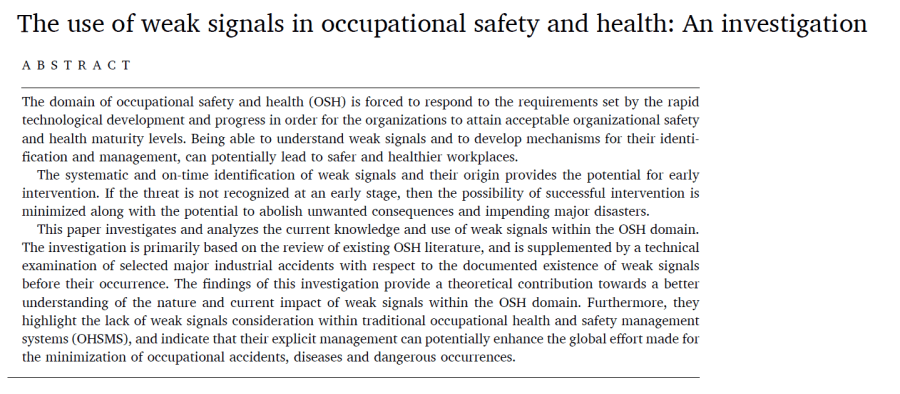
This study explored current knowledge and use of weak signals in safety.
Thanks to Clive Lloyd for sharing this a couple weeks back.
As you’d expect, this sort of topic, based on accidents, is pretty replete with hindsight and outcome knowledge but is interesting nevertheless.
Extracts:
· They have been defined as an “…imprecise early indication about impending impactful events” or “symptoms of possible change in the future”
· They can include several facets: 1) a trend that will affect the business, 2) new and surprising from the receiver’s view, 3), difficult to track down amid noise, 4) a threat, 5) scoffed at by workers who knew all along, 6) often has a time lag before becoming significant

· They can be difficult to identify and assign relevance to because “distinguishing signal from noise and recognizing the early signs of risk or, in other words, weak signals and threats, is a significant challenge”
· They quote Carl Macrae, who said that disasters were “essentially organised events”, as in they typically require “the systematic and prolonged neglect of warning signs and signals of danger, creating deep pockets of organizational ignorance, organizational silence and organizational blindness”
· At Piper, the failure of the work permit system wasn’t a one-off but was regularly “neglected, as evidenced by the lack of signatures and gas tests”

· For Macondo, they point out the ‘weak signals’ on the instability of the cement slurry without further investigation
· They point out the incorrect (in hindsight) interpretation of the signals relating to the negative pressure test
· “OSH researchers and practitioners have (in general) not sought to define and utilize ‘weak signals’ as an independent theoretical structure”
· “in all cases, a considerable number of organizational and operational weak signals existed before the accident took place, at different points in time”
· They say the four disasters had similar signals in the form of inadequate equipment, misperception of the relevance of other incidents, and workers not receiving clear instructions on critical activities

· “All these signals were essentially disregarded or misinterpreted, while they could have been potentially detected and managed”
· “Intangible, organizational weak signals, such as the noncompliance with safety rules [etc.] … exist over a long period of time but they are more difficult to be identified and managed due to their unique nature”
· “On the other hand, the identification and management of tangible, operational weak signals, which are usually the result of the long-term organizational deficiencies, require significant technical expertise”
I’ve included a link to my summary of Carl Macrae’s excellent paper below also.
Ref: Nicolaidou, O., Dimopoulos, C., Varianou-Mikellidou, C., Boustras, G., & Mikellides, N. (2021). Safety science, 139, 105253.

Study link: https://doi.org/10.1016/j.ssci.2021.105253
Macrae’s article: https://safety177496371.wordpress.com/2023/03/08/early-warnings-weak-signals-and-learning-from-healthcare-disasters/

 SafetyInsights.org