“What a time to be alive!” – People in 1913, probably.
This interesting article from 1913 about rail safety comes to some interesting proposals: human fallibility is a normal and expected thing, that we should seek design and systems solutions where possible, and companies always prioritise profit over ‘safety’ trade-offs:
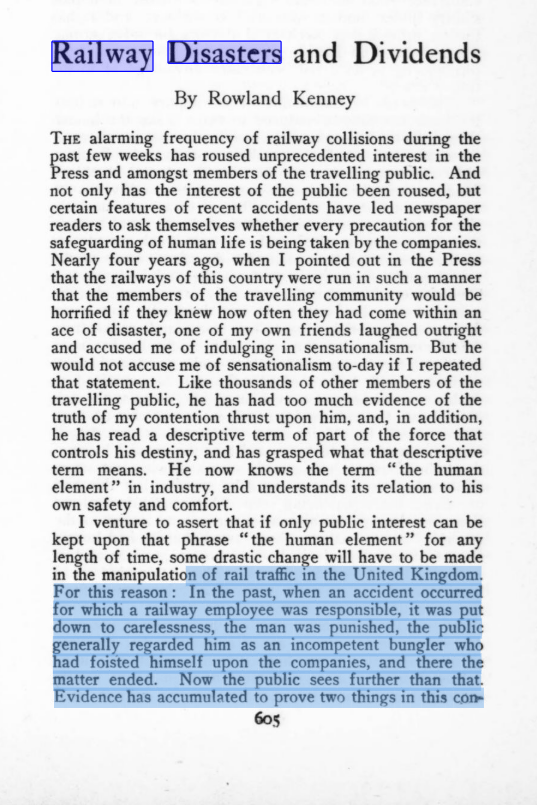
· “In the past, when an accident occurred for which a railway employee was responsible, it was put down to carelessness, the man was punished, the public generally regarded him as an incompetent bungler who had foisted himself upon the companies, and there the matter ended” [*** Thankfully blame disappeared post-1913 😁 ]
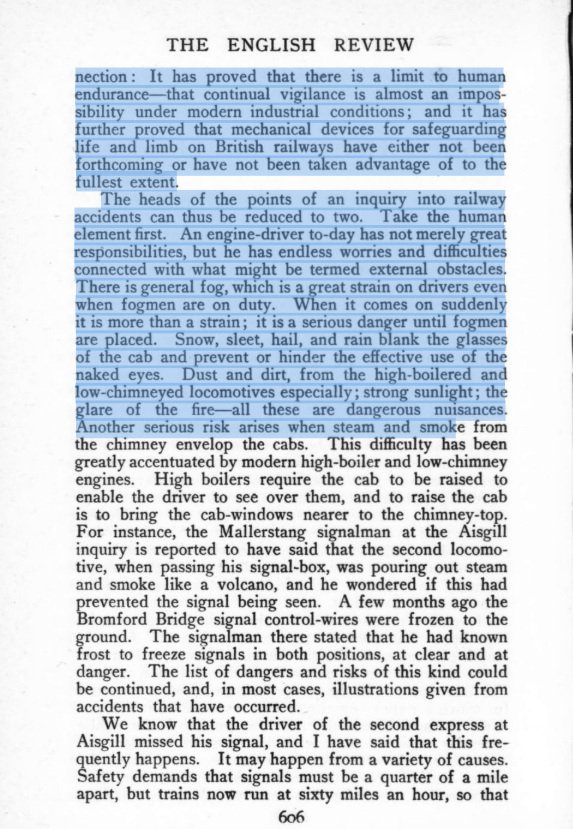
· “Evidence has accumulated to prove two things in this connection: It has proved that there is a limit to human endurance—that continual vigilance is almost an impossibility under modern industrial conditions; and it has further proved that mechanical devices for safeguarding life and limb on British railways have either not been forthcoming or have not been taken advantage of to the fullest extent”
· “The heads of the points of an inquiry into railway accidents can thus be reduced to two. Take the human element first. An engine-driver to-day has not merely great responsibilities, but he has endless worries and difficulties connected with what might be termed external obstacles”
· “There is general fog, which is a great strain on drivers even when fogmen are on duty. When it comes on suddenly it is more than a strain; it isa serious danger until fogmen are placed. Snow, sleet, hail, and rain blank the glasses of the cab and prevent or hinder the effective use of the naked eyes. Dust and dirt, from the high-boilered and low-chimneyed locomotives especially; strong sunlight; the glare of the fire—all these are dangerous nuisances”
· “Owing to speeding-up, the human element in the railway industry occasionally fails at a crucial moment. In some cases the resultant damage is slight; in others the result is too terrible to contemplate”
· “There are safeguards at present in existence which would minimise risks from human failures to a surprising degree, and no one can doubt but that, if inventors were given the slightest encouragement, mechanical devices for lessening risks would be more plentiful and infinitely more serviceable in a very short time”
· “But the companies neither care to adopt existing appliances, nor encourage inventors to design new ones”
· “Can anyone believe, in face of the wonders of mechanical invention in other directions, that the ingenuity of man cannot provide the necessary devices for practically eliminating the most serious of railway dangers? It is unthinkable”
Ref: Kenney, R. (1913). Railway Disasters and Dividends. The English review, 1908-1937, 605-614.


 SafetyInsights.org