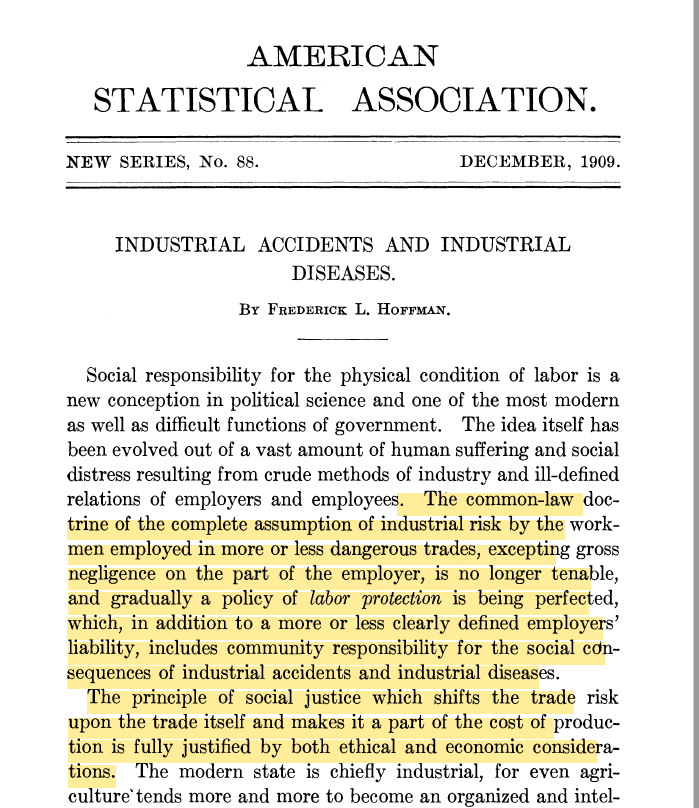
Another interesting read from 1909, talking about ‘social responsibility’ and industrial accidents & diseases in the US.
Really modern thinking here – that:
1) ‘trade’ should bear the fair burden of injury
2) compensation is about justice and social responsibility
3) a worker’s free will to work in dangerous industries is a myth (they often have little options)
4) industrial diseases from dust and lead etc. are entirely within the employers remit to eliminate and more.
· “Social responsibility for the physical condition of labor is a new conception in political science and one of the most modern as well as difficult functions of government”
· It was borne from ” a vast amount of human suffering and social distress resulting from crude methods of industry and ill-defined relations of employers and employees”
· It’s said that the common law doctrine where workers assume all risks “is no longer tenable”
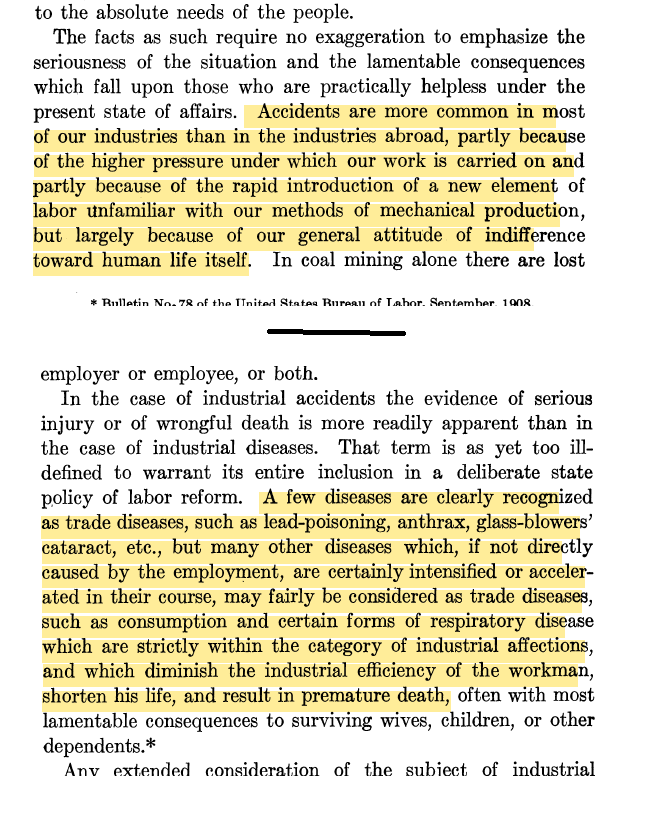
· It’s observed that workplace accidents are greatly higher in the US compared to overseas per employed persons, “partly because of the higher pressure under which our work is carried on and partly because of the rapid introduction of a new element of labor unfamiliar with our methods of mechanical production, but largely because of our general attitude of indifference toward human life itself”
· The author recognises that risk cannot be completely eliminated in many trades (shipping, coal mining, explosives) – but can be minimised
· Really interesting is the recognition of how controllable industrial diseases are compared to acute accidents, “it is not going too far to say that the causes responsible for industrial diseases are much more subject to control and gradual elimination than the causes and conditions responsible for industrial accidents”
· They recognise a number of clear ‘trade diseases’, eg lead-poisoning, antrax, glass-blowing cataracts, breathing diseases, and others that are accelerated by trade exposures
· “The conditions responsible for an excessive mortality in industry are, however, subject to control, and effective methods of ventilation and dust removal will very materially mitigate the evils which are now of common occurrence”
· The author goes to some length describing what is known about cleanliness of shop floors, dust control, using water while grinding, dust distribution and breathing zones
· And “This is but one of many similar illustrations.. to emphasize trade conditions, over which the employees themselves have but a limited amount of control”

On the social responsibility:
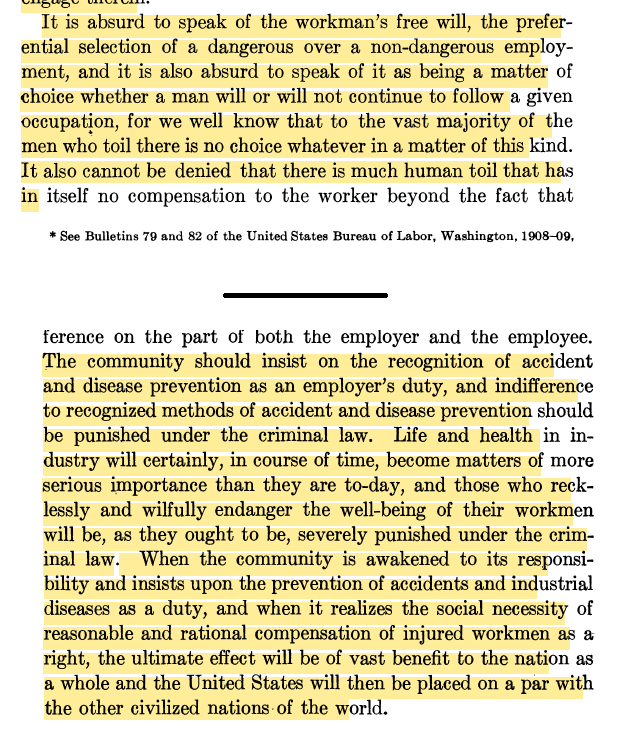
- “The community should insist on the recognition of accident and disease prevention as an employer’s duty, and indifference to recognized methods of accident and disease prevention should be punished under the criminal law”
- The tendency of American law-making has been clearly in-line with early English legislation, but we have hardly advanced beyond the English Employers’ Liability Act of 1880, which has long since been superseded in England by the acts of 1897and 1906”
- Because many industries provide for the existence of society itself, “it follows as a matter of simple justice that the consequences of such industrial enterprise should not fall upon the workman who, because of the necessity to earn his living, is compelled to engage therein”
- “It is absurd to speak of the workman’s free will, the preferential selection of a dangerous over a non-dangerous employment, and it is also absurd to speak of it as being a matter of choice whether a man will or will not continue to follow a given occupation, for we well know that to the vast majority of the men who toil there is no choice whatever in a matter of this kind”
- “It is not going too far even to say that many of the more dangerous occupations gradually dull the senses to such an extent that what may apparently be an act of negligence and indifference is in truth but the result of the work itself”
- “responsibility for the social consequences of industrial accidents or illness should, therefore, not rest wholly upon the laborer, whose wage at best and at most has furnished very little more than a plain living, but in conformity to a spirit of justice it should be a burden upon the cost of production”
- “The community should insist on the recognition of accident and disease prevention as an employer’s duty, and indifference to recognized methods of accident and disease prevention should be punished under the criminal law”
- “those who recklessly and wilfully endanger the well-being of their workmen will be, as they ought to be, severely punished under the criminal law”
- “the community is awakened to its responsibility and insists upon the prevention of accidents and industrial diseases as a duty, and when it realizes the social necessity of reasonable and rational compensation of injured workmen as a right, the ultimate effect will be of vast benefit fco the nation as a whole and the United States will then be placed on a par with the other civilized nations of the world”
Ref: Frederick L. Hoffman. Publications of the American Statistical Association, Vol. 11, No. 88 (Dec., 1909), pp.567-603

Study link: https://www.jstor.org/stable/2964905

 SafetyInsights.org