
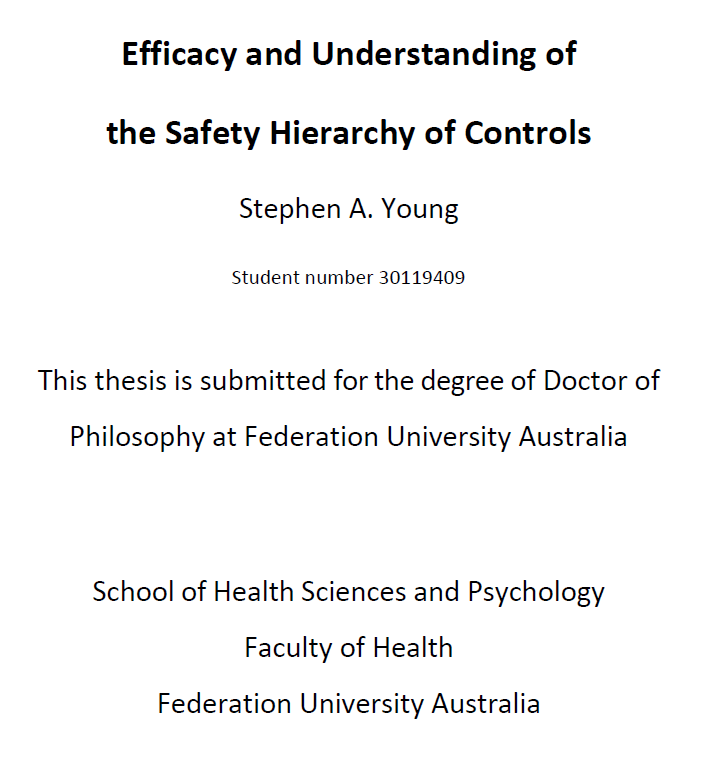
This PhD thesis from Stephen Young was interesting.
They studied evidence supporting the hierarchy of control (HOC), constraints on its efficacy, and more. Way too much to cover.
Some extracts:
· There isn’t a lot of evidence supporting the efficacy of the HOC
· One reason is: “An unequivocal demonstration of efficacy [of the HOC] is problematic, since a laboratory-like experiment to hypothesise and then substantiate the efficacy of the hierarchy of controls is impossible”
· One of Stephen’s studies looked at the application of the HOC in a hazardous plant, suggesting “an association between that plant’s near-absence of injury over a prolonged period of time and their use of the hierarchy of controls”
· “The contextualisation found a number of enablers, modifiers, and interventions that clearly drove the injury rates down to zero or near-zero levels; but the overwhelming commonality running through these interventions was an assiduous application of the higher levels of the hierarchy of controls”
· Longitudinally, at that same plant, it was observed over a period of financial distress that assiduous application of the HOC “as the key driver for their continuing success”
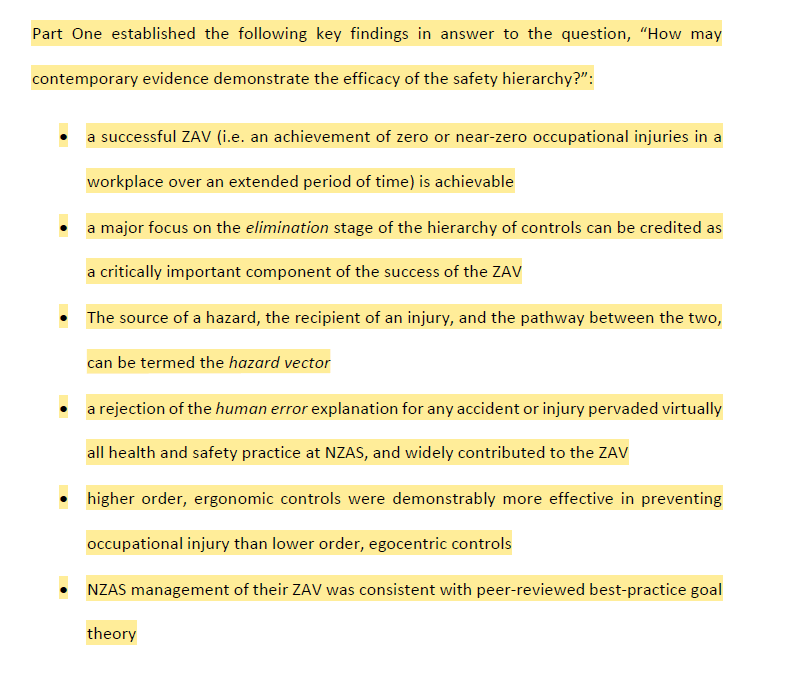
· “major focus on the elimination stage of the hierarchy of controls can be credited as a critically important component of the success of the ZAV”
· “The source of a hazard, the recipient of an injury, and the pathway between the two, can be termed the hazard vector”
· “rejection of the human error explanation for any accident or injury pervaded virtually all health and safety practice … and widely contributed to the ZAV”
· “higher order, ergonomic controls were demonstrably more effective in preventing occupational injury than lower order, egocentric controls”
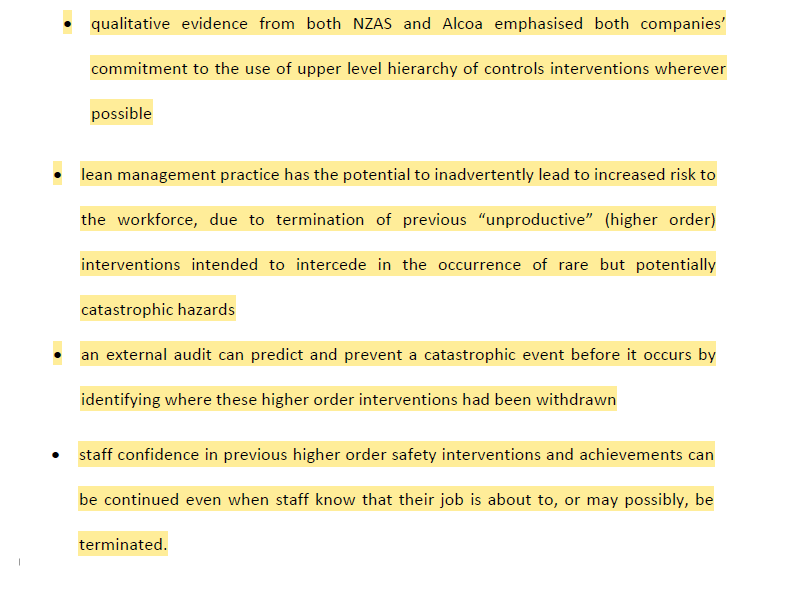
· “lean management practice has the potential to inadvertently lead to increased risk to the workforce, due to termination of previous “unproductive” (higher order) interventions intended to intercede in the occurrence of rare but potentially catastrophic hazards”
· “The word cause is often misunderstood as an active agent (the causing effect); whereas cause cannot be demonstrated as an active transporter of a hazard to a receiver (the victim), but instead, should be regarded as a passive conduit that can be managed in a straightforward manner”
Other findings:
- “an external audit can predict and prevent a catastrophic event before it occurs by identifying where these higher order interventions had been withdrawn”
- “The word cause is often misunderstood as an active agent (the causing effect); whereas cause cannot be demonstrated as an active transporter of a hazard to a receiver (the victim), but instead, should be regarded as a passive conduit that can be managed in a straightforward manner”
- “The concept of cause in the event of an injury is often obscured in anthropocentric attributions of blame”
- “The commonly cited “cause and effect” is often a contrived construct, required to establish perfunctory blame, simplistic rationalisation, and the tort of negligence”
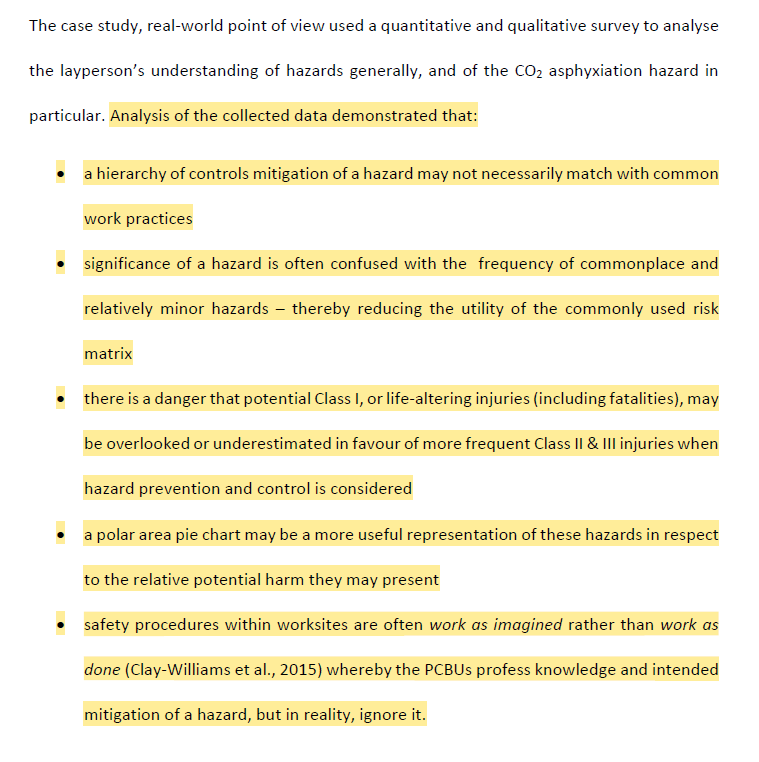
- “a hierarchy of controls mitigation of a hazard may not necessarily match with common work practices”
- “significance of a hazard is often confused with the frequency of commonplace and relatively minor hazards – thereby reducing the utility of the commonly used risk matrix”
- “there is a danger that potential Class I, or life-altering injuries (including fatalities), may be overlooked or underestimated in favour of more frequent Class II & III injuries when hazard prevention and control is considered”
- “safety procedures within worksites are often work as imagined rather than work as done (Clay-Williams et al., 2015) whereby the PCBUs profess knowledge and intended mitigation of a hazard, but in reality, ignore it”

Study link: https://core.ac.uk/download/pdf/213002649.pdf

 SafetyInsights.org