
Another extract from an upcoming summary from Mark Cannon & Amy Edmondson about ‘failing intelligently’.
They talk about the various technical, social and structural barriers for organisations to effectively learn from small & large failures.
In this section they zero in on the individual and manager-levels:
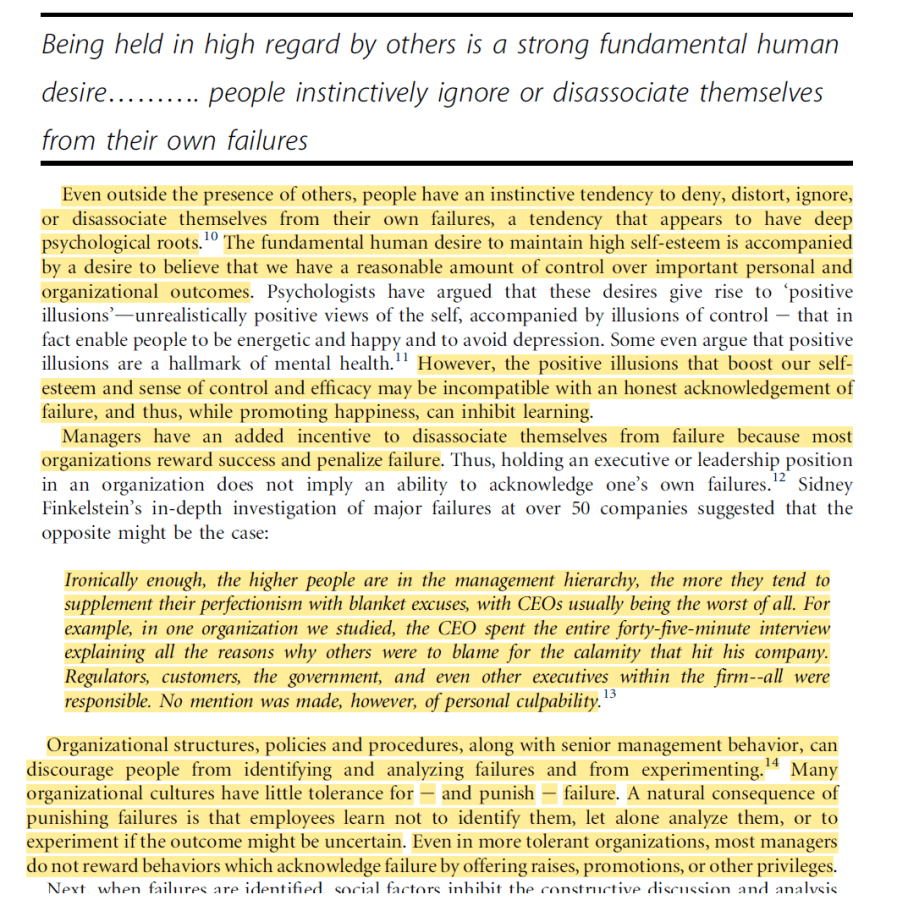
· “Even outside the presence of others, people have an instinctive tendency to deny, distort, ignore, or disassociate themselves from their own failures, a tendency that appears to have deep psychological roots”
· “The fundamental human desire to maintain high self-esteem is accompanied by a desire to believe that we have a reasonable amount of control over important personal and organizational outcomes”
· “the positive illusions that boost our self-esteem and sense of control and efficacy may be incompatible with an honest acknowledgement of failure, and thus, while promoting happiness, can inhibit learning”
· “Managers have an added incentive to disassociate themselves from failure because most organizations reward success and penalize failure”
· And “holding an executive or leadership position in an organization does not imply an ability to acknowledge one’s own failures”
· “Ironically enough, the higher people are in the management hierarchy, the more they tend to supplement their perfectionism with blanket excuses, with CEOs usually being the worst of all”
· “Organizational structures, policies and procedures, along with senior management behavior, can discourage people from identifying and analyzing failures and from experimenting”
· “Many organizational cultures have little tolerance for – and punish – failure”
· “A natural consequence of punishing failures is that employees learn not to identify them, let alone analyze them, or to experiment if the outcome might be uncertain”
· “Most managers do not have strong skills for handling the hot emotions that often surface – in themselves or others – in such sessions”
Ref: Cannon, M. D., & Edmondson, A. C. (2005). Failing to learn and learning to fail (intelligently): How great organizations put failure to work to innovate and improve. Long range planning, 38(3), 299-319.


 SafetyInsights.org