
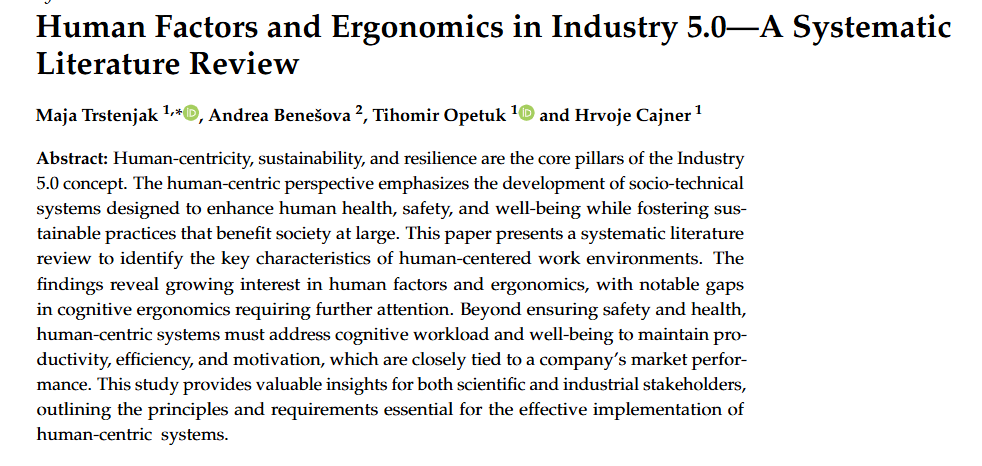
This open access article may interest people – it explored the future of human factors/ergonomics in Industry 5.0 (I05).
Not a summary but you can read the full paper freely.
Some extracts:

- “Industry 5.0 represents a human-centered, resilient, and sustainable system that should overcome the barriers of the previously presented Industry 4.0 concept”, of which Industry 4.0 didn’t apparently live up to its inspirations
- This is party due to “its very challenging implementation process in which the focus was set on automatization and digitalization that only referred to technology while neglecting the human role”
- Hence “why Industry 5.0 was presented as a socio-technical (manufacturing) system in which the human is back at the center” and about “combining human intelligence and creativity with advanced technologies to create a more sustainable, human-centric, and ethical industrial environment” [I think this reads a lot like what cognitive systems engineering has been talking about for some time]
- “With technology replacing less qualified human jobs, there is a shift toward more complex human roles and an increased emphasis on interdisciplinary cooperation”
- Operator 5.0 therefore represents a paradigm shift towards highly skilled professionals who collaborate with intelligent systems” [** not sure I agree with ‘intelligent’ systems, but whatever]
- The specialised areas of technology means a steep learning curve, and hence the learning curve should be minimised via special interface & user-centred design, which also nurtures novel skills, emotional intelligence, cognitive flexibility and more
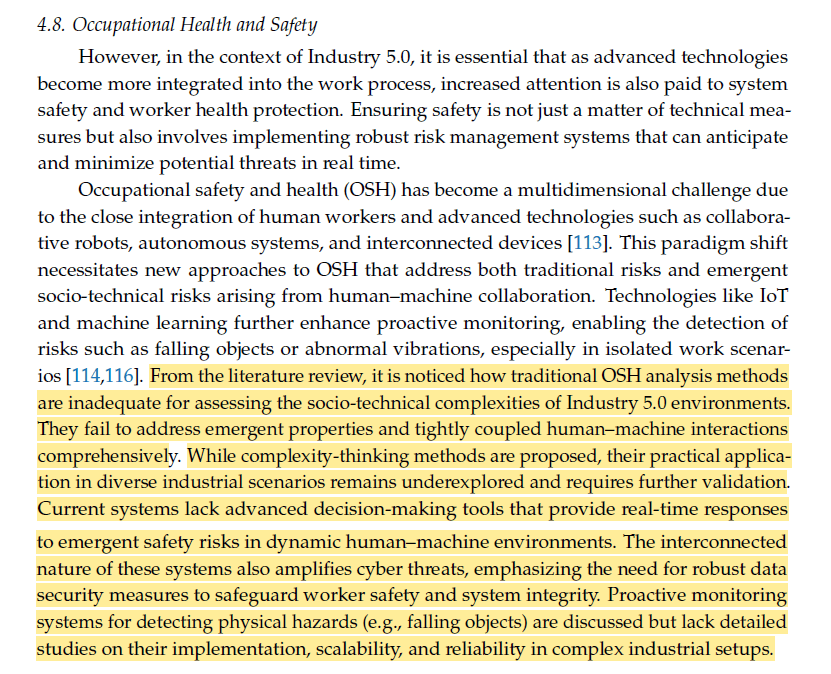
- Interestingly they observe “how traditional OSH analysis methods are inadequate for assessing the socio-technical complexities of Industry 5.0 environments”
- And “They fail to address emergent properties and tightly coupled human–machine interactions comprehensively”
- “While complexity-thinking methods are proposed, their practical application in diverse industrial scenarios remains underexplored and requires further validation”
- “Current systems lack advanced decision-making tools that provide real-time responses of emergent safety risks in dynamic human–machine environments”
- “The interconnected nature of these systems also amplifies cyber threats, emphasizing the need for robust data security measures to safeguard worker safety and system integrity”
- “Proactive monitoring systems for detecting physical hazards (e.g., falling objects) are discussed but lack detailed studies on their implementation”
- “Emerging tools, such as IoT frameworks and digital ergonomic analyses, offer promising avenues for redesigning manufacturing systems to prioritize employee well-being and social sustainability”
- “Current metrics for workplace optimization focus heavily on physical ergonomics, with insufficient indicators for cognitive and psychosocial aspects”
- “There is a lack of standardized procedures to balance operational performance with employee well-being, creating barriers to the widespread adoption of human-centric approaches”
- “Combining leadership with UX design enhances the ability to create systems that address employees’ needs and improve user experiences”
- Digital human modelling is another area of interest which helps model and simulate detailed ergonomic risk assessments, optimise workspace designs and enhance worker safety and efficiency
- Moreover, these tools can “further enriches the analysis, providing immersive and interactive experiences for both real-time and offline ergonomic assessments”
- Next is Wearables and Hardware, like AR/VR, exoskeletons, wearable sensors and more. These tools can provide new data but also simplify learning for people
- Next is issues relating to the Aging Population. They note “While the older generation tends to have challenges in accepting novel technologies and are more afraid that the technology will replace their work, younger workers have a novel view of the work organization and work–life balance, and this is another place where emotional intelligence can be very useful”
- I05 holds promise for enabling and creating new opportunities for older adults [or likely those with novel physical or cognitive demands] via “integrating age-friendly workspaces, real-time monitoring, and sustainable practices across behavioral, mental, physical, and psychosocial dimensions, companies can foster a more inclusive and effective workforce”
- Next is Collaborative Robotics and Human–Machine Relations, with a primary view that “a human as an irreplaceable and creative part of the work system and the machine as a constantly productive and precise part of the work system”
- They say in the adoption of I05 a focus not just on technical measures is necessary but “also involves implementing robust risk management systems that can anticipate and minimize potential threats in real time”

Study link: https://doi.org/10.3390/app15042123

 SafetyInsights.org