

[Edit: Just a minor update]
An interesting study to be posted soon evaluated nearly 4000 safety observation reports from a large infrastructure project.
What types of ‘unsafe acts’ and ‘unsafe conditions’ are identified by personnel? How do they conceptualise human error, human action or conditions in the workplace? How is blame used as an instrument of power? All of these were unpacked in the paper.
Key findings:
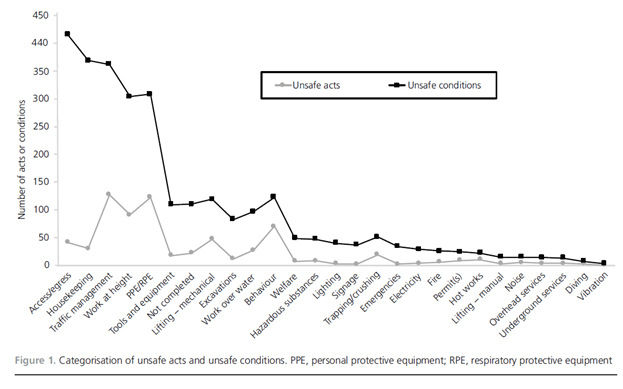
· Unexpected to the authors, most (75%) of safety observation reports were categorised as unsafe conditions rather than human acts
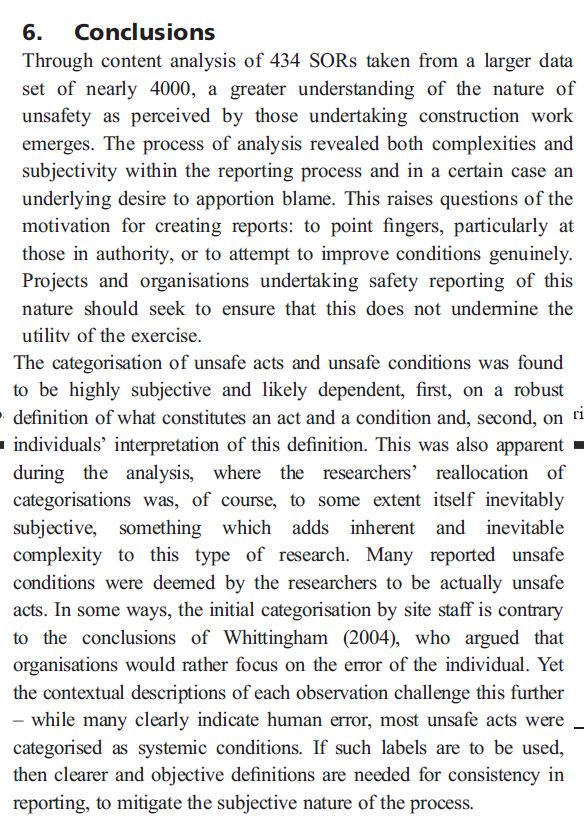
· Large inconsistencies were present in what constituted an unsafe act or condition, with authors re-categorising up to **90%** of the reports based on their own analysis
· This illustrates “the complexities involved in deciding at what point an act, or number of acts, eventually emerges into a condition; these decisions are inherently subjective”
· Moreover, while these findings “arguably supports more complex, non-linear and emergent approaches to analysing safety incidents”, of potentially more utility would be “clearly defined and shared understanding of the ‘line’ between acts and consequentially emergent conditions”
· Finger pointing and apparent blame was also observed through the SOR data, with an individuals’ name or company being identified directly; highlighting a “desire to apportion blame”
The categorisation of unsafe acts and conditions “was found to be highly subjective, and likely dependent first on a robust definition of what constitutes an ‘act’ and what a ‘condition’; and secondly on individuals’ interpretation of this definition”.
Hence, “If such labels are to be used then clearer and objective definitions are needed for consistency of reporting, to mitigate the subjective nature of the process”.
Moreover, these findings suggest that we should, predictably, be suspect on statistics based on these types of taxonomies, e.g. 80% of incidents due to unsafe acts and the like, given their subjective and inconsistent categorical nature (**cough** data from Du Pont **cough**).
[NB. This caution applies to most taxonomies and descriptors, e.g. what you look for is what you find.]
Ref: Smith, S, Sherratt, F & Oswald, D 2017, ‘The antecedents and development of unsafety’, Management, Procurement and Law.

Study link: https://doi.org/10.1680/jmapl.16.00021

 SafetyInsights.org
One thought on “Unsafe acts, unsafe conditions and unsafety – unstable, inconsistent and a matter of perspective”