A few extracts from James Reason’s ‘Human Contribution’.
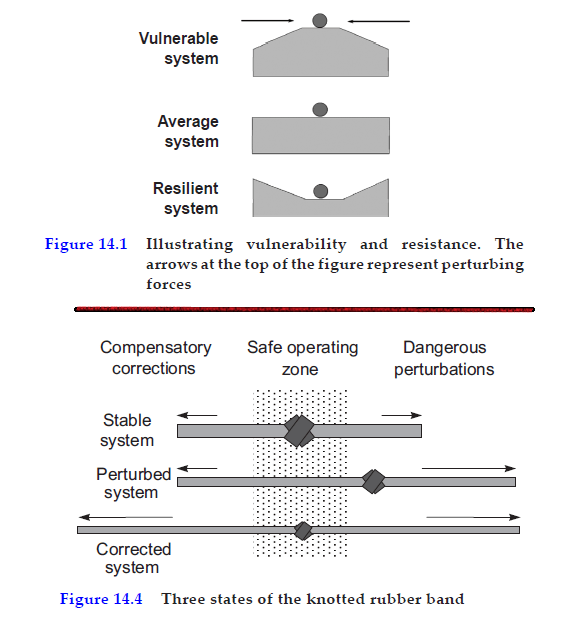
He proposes a couple of different representations of safety (image 1)

· The first (14.1), represents the notions of vulnerability and resilience
· The ball bearing is sitting at different locations on blocks – in the vulnerable system, perturbations topple the ball
· It’s of course the most stable in the bottom configuration, but can still be dislodged
· Proactive safety, design and resourcing measures change the block configuration towards the bottom condition, and heighten the walls
· Next he discusses a representation of the variable nature of performance (image 1 14.4) – similar to Rasmussen’s dynamic risk model in a sense
· The goals of organisational systems is to keep performance within the stable centre zone, where perturbations pull and stretch the knot towards unacceptable zones
· More vulnerable systems have larger knots, and corrections can reduce the knot size
· Maintaining the knot within the stable zone requires “an equal, opposite and simultaneous correction to any perturbation”; what he called the ‘simultaneity principle’
· Resources and capacities to counter stretch have clear implications: “coping resources are finite. They are used up by repeated stressors”
· This is often found in brittle systems where people are required to continually adapt
Next Reason concludes with several principles of safe systems:
· Whereas accidents have a large “random property”, the factors contributing to the intrinsic resistance (safety capacities, margin, stretch zones etc.) are largely “under the control of those who manage and operate the system”
· “Because of the chance element, even highly resistant systems can still experience negative outcomes. safety is never absolute”
· “even vulnerable systems can escape accidents for lengthy periods”
· “the relationship between a system’s resistance or vulnerability and its accident record, while generally positive over the long run, can be quite tenuous”
· “negative outcome data are imperfect, even misleading, indices of a system’s state of intrinsic resistance. This is especially the case when the accident rate is very low or asymptotic”
· “for any organisation, the only attainable safety goal is not zero accidents, but to strive to reach the zone of maximum practicable resistance and then remain there for as long as possible”
· This requires reliable navigational aids (proactive and reactive data, informational systems and more), and system ‘diagnostic checks’ for the system’s ‘vital signs’
· “operators of systems subject to relatively frequent disturbances are more likely to possess these [error correction] skills than those who supervise comparatively stable systems”
· “the goal of safety management: the attainment and preservation of a state of maximum practicable resistance to operational hazards”


 SafetyInsights.org