
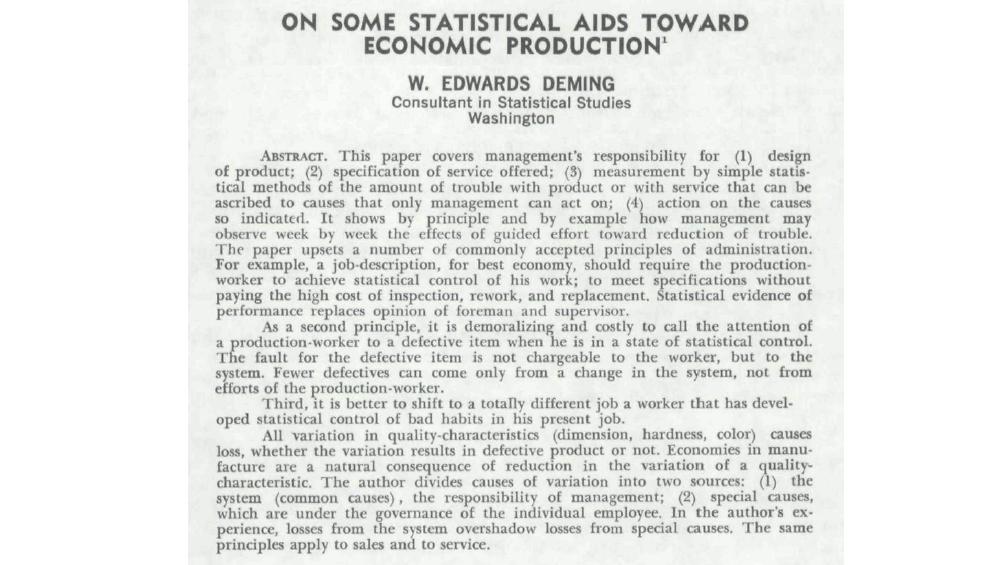
A banger from Deming in 1975, talking about applying statistical control to manufacturing and production variability.
He says that much of this paper is based on “principles taught in Japan since 1950”.
Don’t let the topic fool you – you’ll find a lot of similarities and overlaps with principles of HF/E, work design, New View etc.
Won’t be a lot new for the regulars. But if this is your first exposure to Deming, then quoting the wise Ash from Evil Dead: “Hail to the King, baby”.
Using a lot of direct quotes since I can’t put it better than Deming.
First, he highlights that this paper “upsets” several commonly accepted principles of management:
· “a job-description ..should require the production-worker to achieve statistical control of his work”
· Or that statistical evidence of performance can replace the opinion of supervisors and experts
· Most importantly, “it is demoralizing and costly to call the attention of a production-worker to a defective item when he is in a state of statistical control”
· And “The fault for the defective item is not chargeable to the worker, but to the system”
· “Fewer defectives can come only from a change in the system, not from efforts of the production-worker”.
Forms of Variation
All variation in quality-characteristics results in some loss, irrespective of whether its defective or not. Deming divides variation into two sources – see below.
In his experience, “losses from the system overshadow losses from special causes”. Further, “Effort to improve the performance of workers will be a disappointment until the handicap of the system is rectified”.
Common variation is common across whole groups of workers and belong to the system. He observes that “No improvement of the system, nor any reduction of special causes of variation and trouble, will take place unless management attacks common causes”.
The percentages cited above are only indicative of the fact that systems issues overshadow special causes, so don’t take them literally.
While removing special causes is important, it’s not improving the system – it merely reduces variation to a baseline level which then indicates common cause/system variability.
The American quality production system
Next he takes aim at the unproductive arena of American production (remember, 1975). American management have failed to grasp their impact and the value of statistical methods on production. Business schools were said to teach words and goals but not methods.
He says that a disappointment is where quality control is seen to be something that gets installed, like a new rug. Something that will be there and function as expected, rather than being a continual learning process, year by year, process by process, and from both the top and bottom.
Another barrier is “management’s supposition that the production-workers are responsible for all trouble: that there would be no problems in production or in service if only the workers would do their jobs in the way that they were taught”. Deming calls this “Pleasant dreams”.
(** You may recognise the bad apple fallacy as quite similar to this supposition).
In any case, again, “workers are handicapped by the system”.
Moreover, for American quality control approaches of the time, management were said to discharge their responsibilities for quality control by turning over to a quality team, thereby sweeping their role under a rug.
Amusingly, he argues that many companies aren’t actually implementing quality control, but “guerrilla sniping—no provision nor appreciation for the statistical control of quality in the broad sense”. (** Similar to the idea of firefighting issues that continually pop up)
Empty Management Platitudes
Next he says that statements and desires by management aren’t quality control, nor specific actions to improve. He also says that periodic reviews of quality and production aren’t quality control but can be “necessary but not sufficient”. (** This expression comes up a bit in the cognitive systems area)
Further, “Exhortations, pleas, and platitudes addressed to the rank and file in an organization are not very effective instruments for the improvement of quality”. Interestingly, Deming believed that while every competent worker who is doing their best generally “know all there is to know about their work except how to improve it”.
Hence, people get so good at their work that they’re not the best-placed to improve it, and additional assistance is often necessary.
(** Some from the New View lens may partially disagree with this sentiment. I’m not taking a position, but there is the matter of you don’t know what you don’t know. Also work tends to be locally optimised, but this can conflict with higher system goals.)
In comparison to the American system of the day, the Japanese QC-Circle movement “gives to production-workers the chance to study and revise the system of production at the local level”.
That is, Japanese workers were not “handicapped by the rigidity of the American production- line”. Instead, the Japanese approach provided “partial decentralization [to the workers] of management’s responsibility to find local faults in the system, and to take action on them”.
Further, Deming was critical of the term ‘zero defects’, saying it was often just a “theatrical catchword”. Even though it was posted all over the plants, it was intended to improve quality as if “expecting magic”. Instead, these are “Empty words they are till the management acknowledges responsibility toward reduction of common causes”.
Control Charts
The paper goes into some depth with control charts. I’ve skipped almost all of this, as I can’t be bothered writing it out. I’ve also summarised another paper which talks about applying control charts to safety incident data which I’ll post in the near future.
In any case, simply: a state of statistical control is a state of randomness. The up and down movements on a chart provide insights about when to respond to variation.
The control limits on these sorts of charts are also not specification limits, but just simple statistical calculations. However they can act as signals when to heed correction.
He observes that some naturally occurring processes exhibit statistical control, like radio-active disintegration. Apart from these few examples, “a state of statistical control is not a natural state for a manufacturing process” and instead requires continual energy and effort.
Below is an example of a process not in statistical control, and then with interventions, becomes within control. You can observe how difficult it would be to determine when to respond to the natural fluctuations of variability without statistical means.
(** For the safety people – you can run similar analyses on incidents, observations etc.)
System Faults
Deming provides some common system faults:
He observes that the worker is “helpless to reduce any of these causes of trouble”.
Further, it is misplaced to call attention to the behaviour of a worker in a generally poor climate or poor production system, since that condition “belongs to everybody and is the fault of management, not of any one worker, nor of all workers”.
Next he says that in his experience, “training in industry is deplorable”. New workers often get to work with little training or instruction; instead, the new worker’s coworkers “come to the rescue, instructions or no instructions, and in a few days he is running along with the herd”.
Finally, he provides an example of driver mistakes and how drivers were issued warning letters to drivers after each mistake. When plotted for statistical control, it’s shown that these letters are no less demoralising, and drivers are being “blamed for faults of the system”.
Hence, even some basic statistical control methods would have highlighted that these driver mistakes were separate types of issues, stemming from systems problems, needing individual study and resolution.
Finally, Deming reflects on this type of paper and statistical approach. He says some would call it operational research, others systems-analysis or industrial engineering. For him, he’s just a statistician trying to make statistical methods positive and helpful.
Ref: Deming, W. E. (1975). On some statistical aids toward economic production. Interfaces, 5(4), 1-15.

Study link: https://doi.org/10.1287/inte.5.4.1
LinkedIn post: https://www.linkedin.com/pulse/some-statistical-aids-toward-economic-production-ben-hutchinson-eyaoc

 SafetyInsights.org