Really interesting findings from 1910 challenging the concept of carelessness and workers as the main ‘cause’ of traumatic accidents.
From Eastman’s book 2 of the Pittsburgh’s Survey.
Was meant to be a mini-post. But, too many interesting statements.
Extracts:
· Eastman starts with “So you’ve come to Pittsburgh to study accidents, have you?” says the superintendent … “Well, I’ve been [in this business fifteen years and I can tell you one thing right now,-95 per cent of our accidents are due to the carelessness”
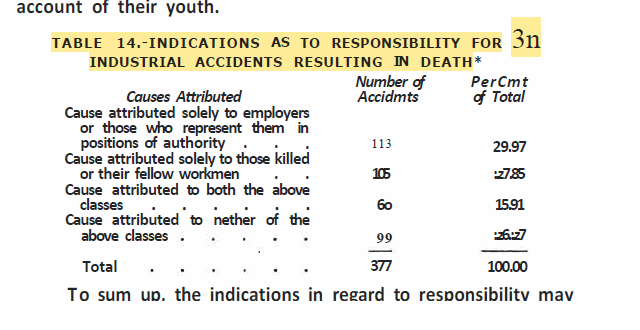
· However, Eastman’s data disagreed with the 95% of accidents due to careless workers (“disproving conclusively”, in their words)
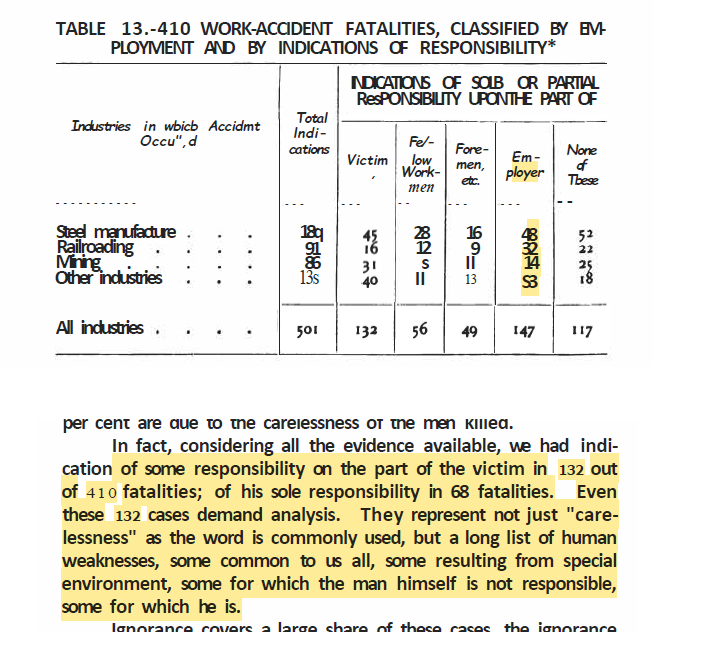
· Instead, “only 32 per cent of the fatal accidents can be laid in a measure to the responsibility of the victims”
· And of those 32%, 11% weren’t due to carelessness, 5% due to ignorance of the rules/danger, 1% due to physical weakness and 2% from drunkenness; leaving just 21% from ‘carelessness’
· And of that carelessness, the data indicates the environment often had a role
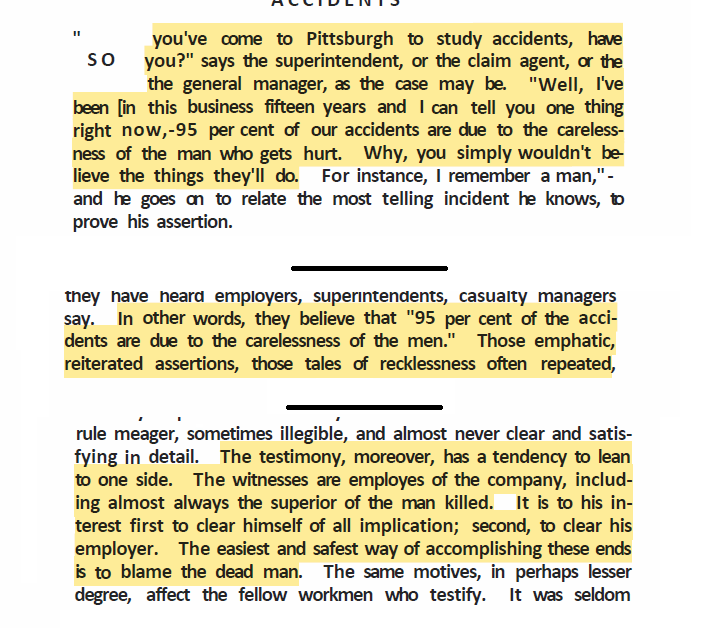
· It’s said that foremen, supervisors etc. are always quick to point out the role of people in their own accidents because “It is to his interest first to clear himself of all implication”
· And, aptly “The easiest and safest way of accomplishing these ends is to blame the dead man”
· From a sample of 410 accidents, “no one is to be blamed”, and from their analysis, was “unavoidable” (** modern interpretations would likely disagree with this)
· But whatever the figure, if 28% were unavoidable then it can’t be true that 95% of accidents are due to the carelessness of the worker
· And even the word carelessness, as commonly used then, included “a long list of human weaknesses, some common to us all, some resulting from special environment, some for which the man himself is not responsible, some for which he is”
· Ignorance covered a lot of instances, including young boys without the experience or knowledge, immigrant workers and more
· In their words, “22 out of 132 deaths in which the victim can be held accountable, he was “green.”
· Hence, accidents under carelessness cannot “be classed as arising from the same cause”
Eastman further unpacks carelessness and environmental/pressure issues:
· The dictionary definition had three definitions for careless – heedless, inattentive or rash
· While employers may argue that accidents are due to “heedlessness of a fool”, Eastman’s data again disagrees
· Further, “Nor is it likely that the record of American industries for speed, efficiency, and output, could have been won with any considerable proportion of such workmen” (** beautifully put by Eastman)
· Further, relying on workers for constant attentiveness is a folly, because paying attention to their surroundings is “bound to be secondary and incidental”, to the core work task
· And despite how instinctive their vigilance is, “it cannot be unfailing. Human powers of attention are naturally limited in at least two ways; heed can be given to but a limited number of things at a time, and to any one thing for but a limited time”
· Also in these sorts of hazardous work environments, there are other influences which “weaken the power of attention”
· Factors like the speed and intensity of work, heat and noise, weariness of the workers [** fatigue?] all “tend to numb the faculties most needed for protection”
· Eastman points out that while some people may also have “spontaneous recklessness”, it is rarely a cause of accidents
· For instance, “A trapeze performer does his act a thousand times without missing”, or brakemen and other trades largely succeed most of the time
· Further, many of their adaptive behaviours results in “some ease or time-saving secured by almost every risk that workmen willingly take”
· Also, workers may start out afraid of the environment, and hyper-vigilant, but the risk becomes normalised over time such that “the necessities of the work, as well as his temperament, help him to conquer his fear.”
· Once the worker loses their fear, they “[acquire] recklessness” and this is “natural, inevitable”
· Interestingly, it’s argued that we often reward risk taking and penalise caution
· For instance, “caution is as unprofessional among the men in dangerous trades as fear would be in a soldier”
· And “The reckless workman, then, is a man whose naturally daring temper has been selected, and then encouraged and accentuated, by an occupation involving constant risk”
· Also adaptive and time-saving actions are entirely expected, since “No one will take the slow, hard, safe way of doing a thing if there is a quick, easy way which is not too dangerous”
Next Eastman takes aim at supervisors and employers:
· “in modern industry, more actual responsibility for safety rests upon the foremen and under superintendents, those immediately directing the work, than upon any one else”
· Hence, it’s important to draw a distinction between those in positions of authority and the workers
· And while we can point the finger at workers for not following rules, “Often, too, a violation of rules is regularly ignored by foremen and superintendents”
· But we also shouldn’t blame management: “But it must not be forgotten that the foreman is human; his recklessness is largely the result of his environment; his powers of attention are often taxed beyond their endurance by the tension of work, by noise and heat, and by weariness. Moreover, the foreman is always under the greatest incentive to increase output”
· Hence, foreman work under pressure to increase output
· And while employers are ultimately responsible for creating safe workplaces, we shouldn’t just consider the employer’s mental attitude but also “the actual mediums through which his intentions, good, bad or indifferent, must operate”
· Of a sample of accidents where the employer was largely implicated, a large proportion come from defects in the condition of the plant or appliance which not planned or intended
· And finally, “Reasonable provision for safety in the construction of a plant, or in the organization of the work, should be part of the employer’s deliberate plan, and it is hard to find excuse for the lack of it. Under this heading come a large number of fatalities”
Ref: Eastman, C. (1910). Work-accidents and the Law (Vol. 2). New York, Charities Publication Committee.

LinkedIn post: https://www.linkedin.com/pulse/1910-pittsburgh-survey-challenging-worker-main-cause-ben-hutchinson-hrldc

 SafetyInsights.org