
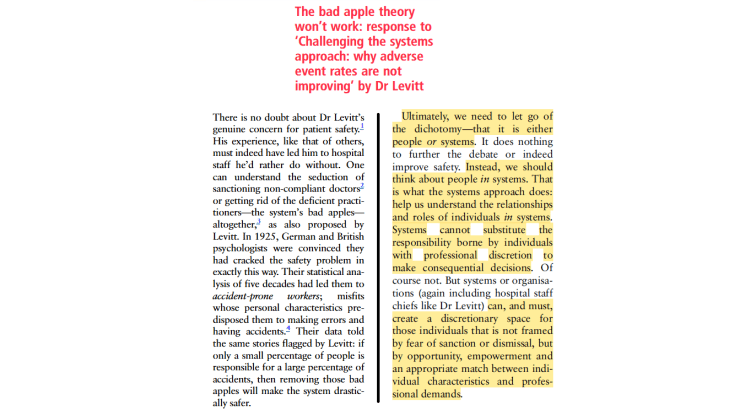
Another rebuttal article as a follow-up from the prior post on systems thinking in medicine, again from Dekker & Leveson.
I’ve skipped Levitt’s letters which prompted these letters to the editor.
Extracts:
· “One can understand the seduction of sanctioning non-compliant doctors2 or getting rid of the deficient practitioners—the system’s bad apple”
· They refer to research from the 1920 which was convinced that accident-prone workers had “cracked the safety problem”
· “Their data told the same stories flagged by Levitt: if only a small percentage of people is responsible for a large percentage of accidents, then removing those bad apples will make the system drastically safer”
· The authors challenge the statistical flaw in accident-proneness: the probability of error and accident “must be equal across every worker or doctor. Of course it isn’t”
· This is because different practitioners engage in “vastly different” problems and patient groups, with different risk factors
· “Personal characteristics do not carry as much explanatory load for why things go wrong as context does
· ”Getting rid of Levitt’s 3% bad doctors (as measured by complaints and adverse events) may simply get rid of a group of doctors who do the really difficult, tricky work”
· “we have realised that errors are not the flaws of morally, technically or mentally deficient ‘bad apples,’ but the often predictable actions and omissions that are systematically connected to features of people’s tools and tasks”
· They recognise that “Of course some practitioners should not be allowed to treat patients”
· But importantly, “who let them in? Who recruited them, trained them? Who mentored them, promoted them, employed them, supervised them?”
· So we shouldn’t be asking how to get rid of bad apples, but “what our responsibilities are in creating them in the first place”
· “the solution to this problem is to improve the system that identifies and deals with professional incompetence—from premedical education onwards”
· “Ultimately, we need to let go of the dichotomy—that it is either people or systems”
· “Instead, we should think about people in systems. That is what the systems approach does: help us understand the relationships and roles of individuals in systems”
· “Systems cannot substitute the responsibility borne by individuals with professional discretion to make consequential decisions”
· We must “create a discretionary space for those individuals that is not framed by fear of sanction or dismissal, but by opportunity, empowerment and an appropriate match between individual characteristics and professional demands”
Ref: Dekker, S. W., & Leveson, N. G. (2014). The bad apple theory won’t work: response to ‘Challenging the systems approach: why adverse event rates are not improving’by Dr Levitt. BMJ quality & safety, 23(12), 1050-1051.

Study link: https://citeseerx.ist.psu.edu/document?repid=rep1&type=pdf&doi=c2df8ae596267b4cc263df2924e24e8bd8f5d0ad

 SafetyInsights.org