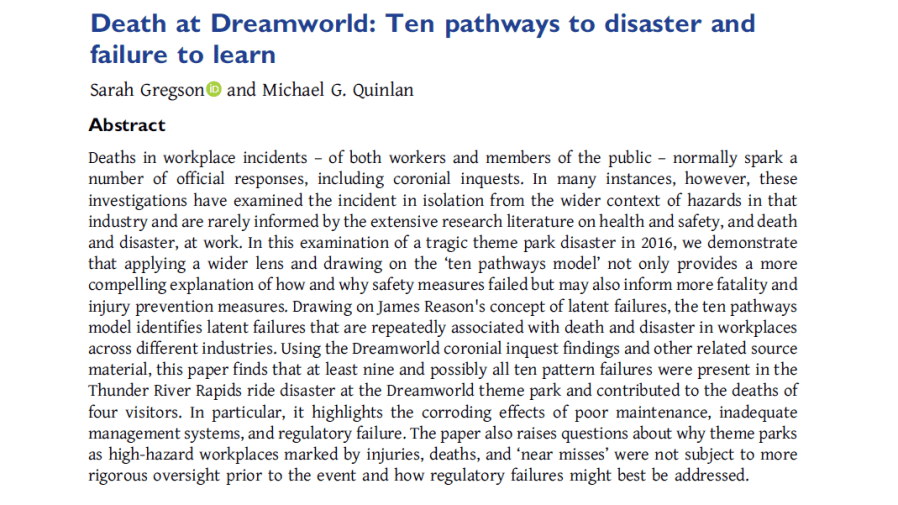

This paper from Sarah Gregson and Michael Quinlan applies his ten pathways framework to the Dreamworld accident in 2016, killing four people.
I’ve skipped a lot.
[** Yes, hindsight and outcome biases are present with this type of analysis, as with my own auditing work. Doesn’t mean there isn’t value in exploring learning opportunities, but do need to factor in post-hoc clarity.]
For background:
· Quickly speaking, the ten pathways model leverages Reason’s latent conditions as a central concept
· His model followed the approach of Barry Turner’s Man-Made Disasters framework, and was born from the analysis of 14 multiple and 9 single fatality accidents across 5 countries
· Quinlan found 10 repeat patterns across these accidents – with at least 3 of them present in every incident, and 5 or more factors present in the vast majority
Across all of his data, the ten pathways or repeat latent conditions repeatedly associated with workplace fatalities were: (quoting the paper)
1. Engineering, design, and maintenance flaws
2. Failure to heed warning signs
3. Flaws in risk assessment
4. Flaws in management systems
5. Flaws in system auditing
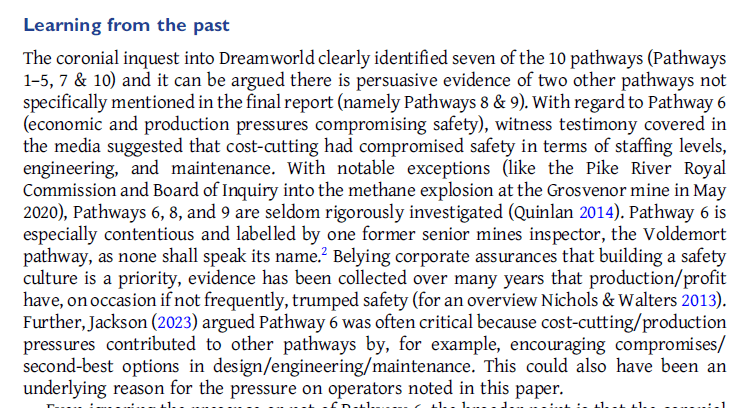
6. Economic, production, or reward pressures compromising safety
7. Failures in regulatory oversight
8. Concerns by workers, supervisors, and others that were ignored
9. Poor communication or trust between those responsible for risk and those exposed to it
10. Flaws in emergency and rescue procedures
They then apply the model to the Dreamworld event. I’m only covering a few points.
Engineering, design and maintenance flaws
Engineering, design and maintenance flaws were seen to be among the most common repeat latent conditions across accidents – with other work finding them present in 94% of 51 mining accidents inspected.
They were also found within the Dreamworld case. As identified by the coroner, the ride was built in-house in the mid-1980s, with few records related to its construction and later modifications.
According to the paper, the:
“speed of the ride meant that the major structural and technological components of the ride were what Perrow (1984) described as ‘tightly coupled’ ie time critical, non-variable sequences with very little slack for human intervention if there was a system failure”.
A naval architect observed that the raft design wasn’t a significant contributing factor, but that there was a critical rate that the water had to be pumped to maintain an adequate height of water (to ensure the rafts were buoyant and didn’t become stranded).
A host of factors were found relating to maintenance – including a shortage of engineering expertise on-site. The ride was found to have been in generally poor condition, with significant corrosion throughout the steel ride components.
Maintenance activities were also seen to be disorganised, and confusion among staff about the correct procedures.
They observed silo’ing between park areas, where “ For some risks in the park’ … ‘everyone thought it was someone else’s responsibility”.
These issues were found to be systemic.
The authors remarks that these types of engineering latent flaws “undermines the emphasis often given to behaviour controls (like behaviour-based safety)”, often following an accident. Such approaches may not cut to the crux of serious latent conditions.
Second, engineering, design and maintenance may be “weakened by other flaws, perhaps most notably financial cost-cutting that compromises safety”.
Failure to heed warning signs
Another item I’ve cherry-picked out of his paper to discuss is failure to heed warning signs. He remarks that prior accidents are possibly the most common warning signs.
There was a series of high potential incidents on Dreamworld rides prior to the rapid ride disaster. Some testified that the rapid ride “in particular had been beset with recurring safety incidents”.
Following one incident, some engineering controls were implemented and a reduction in the number of rafts operating. These changes were later reversed, and the coroner couldn’t locate any risk assessment process which guided the changes, nor was unsure whether the engineering function was consulted on these changes.
In 2005 an employee observed an extended gap between the rafts during operation – found to be rafts taking on water, and gaps in CCTV coverage. Additional admin controls were recommended, including installing more CCTV screens “to assist operators ‘who must perform numerous tasks simultaneously – many of which are cognitively draining”.
In sum, there was said to be a pattern of high potential incidents prior to the accident “but for which there was little evidence of sufficient learning”.
In response, “piecemeal adjustments that overemphasised administrative/procedural controls dominated”.
[** This is an area that I think is more susceptible to hindsight judgements, since ‘warning signs’ are really clear to us now but were possibly not so clear to people at the time]
Flaws in risk management
The coronial inquiry found a series of shortcomings in risk assessment processes at Dreamworld. This included weaknesses in HAZID and record keeping.
The author says that an absence of records “is a critical shortcoming, as documenting a risk assessment provides the basis for determining how decisions were made and future monitoring”.
He remarks that the value of documented risk assessments is amplified because “regulators and coroners now commonly assume that no risk assessment took place if there is no documentary evidence to substantiate it”.
Flaws in management systems
Several flaws in the safety management systems were present. Briefly this included:
· poor communication between different departments, including between the safety and engineering departments
· reporting and analysing incidents
· learning from problems/incidents
· operating procedures
· training
· significant loads on operators
· absence of sufficient engineering expertise on-site
They also found that the operating procedures were not particularly functional. Hopkins has remarked that operating procedures which are “overly complicated, confusing, or ambiguous” can introduce safety risk.
Issues were identified with critical ride training and verification of competencies. There was a reliance on largely informal training, “leaving operators unqualified to perform their tasks”.
The rapid ride had standard operating procedures which were supplemented with further memorandums – these were seen to be “extensive and confusing”.
The operators’ duties were also said to be excessive and unsound.
However, even if training was sufficient “it would never have been sufficient to overcome the poor design of the TRRR, the lack of automation and engineering controls”.
Flaws in system auditing
Issues in auditing were identified. They discusses two types – an internal monitoring type by the organisation on itself, something which should be ongoing, and an episodic independent auditing by an external party.
A US-based company had undertaken several external audits at the park, but these were found to have lacked rigour.
They were also found to have focused on largely superficial matters, e.g. “[W]hilst seemingly thorough, [they] were largely focused on the aesthetic issues associated with rides and attractions at Dreamworld, rather than a proper safety assessment against the applicable Australian Standards”.
[** We called this phenomenon “comprehensive shallowness” in our audit research – audits that dive excessively into minute details for a lot of trivial stuff, but barely scratch the surface on critical matters.]
Economic or reward pressures compromising safety
As expected, financial cutbacks and budgeted savings “had compromised safety” and especially regarding maintenance and safety staffing. However, there weren’t a lot of direct connections in this matter to the ride itself.
Worker, supervisor, or other concerns that were ignored or trust issues
The warnings of many stakeholders, including workers, supervisors and consultants were said to have been overlooked or ignored.
A ride senior operator remarked that the ride “ was extremely stressful to operate because of the multiple tasks to be undertaken over short periods of time”.
Issues with worker and management and communication and trust were also hampered. There was only limited examples provided in the coroner’s report, however the author notes that “There is evidence that implies communication with workers was lopsided, emphasising procedural observance and ignoring concerns about the task load on operators”.
The author quotes another source, but not directly related to findings from Dreamworld, that “behavioural control of sanctioning workers rather than addressing more fundamental problems with plant and operations weakened communication and created a climate of fear amongst operators”.
Flaws in emergency and rescue procedures
Issues in the emergency and rescue procedures received quite some attention. There was an overreliance on admin controls in emergency situations – and the coroner noted issues around coordinated action by operators and their training and knowledge.
A human factors professor provided evidence to the inquiry, remarking that the time-sensitive decision making load requires by oeprators, as they tried to balance multiple tasks was a challenge. This was amplified by the layout of the screens/displays/controls, all that could lead to procedural departures and/or unexpected outcomes.
Learning from the past
It’s said that the Dreamworld disaster based on the coronial inquiry had clearer examples of 7 of the 10 pathways, but arguably all were present.
They conclude that:
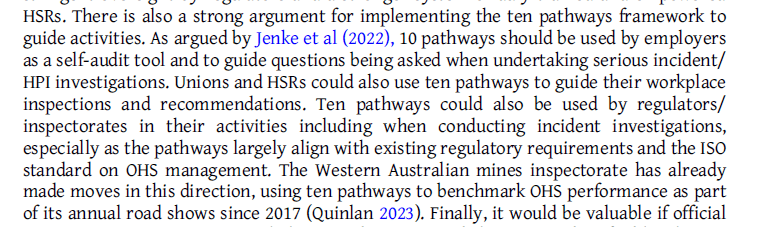
“Theme parks are high-hazard workplaces with a real and demonstrable risk of multiple-fatality events and they should be regulated accordingly, including requirements for an OHSMS addressing principal hazards and periodic independent and rigorous auditing together with more stringent oversight by regulators and a stronger system of duly trained and empowered HSRs.”
Ref: Gregson, S., & Quinlan, M. G. (2024). Death at Dreamworld: Ten pathways to disaster and failure to learn. The Economic and Labour Relations Review, 35(2), 436-453.

LinkedIn post: https://www.linkedin.com/pulse/death-dreamworld-ten-pathways-disaster-failure-learn-ben-hutchinson-c6n2c

 SafetyInsights.org