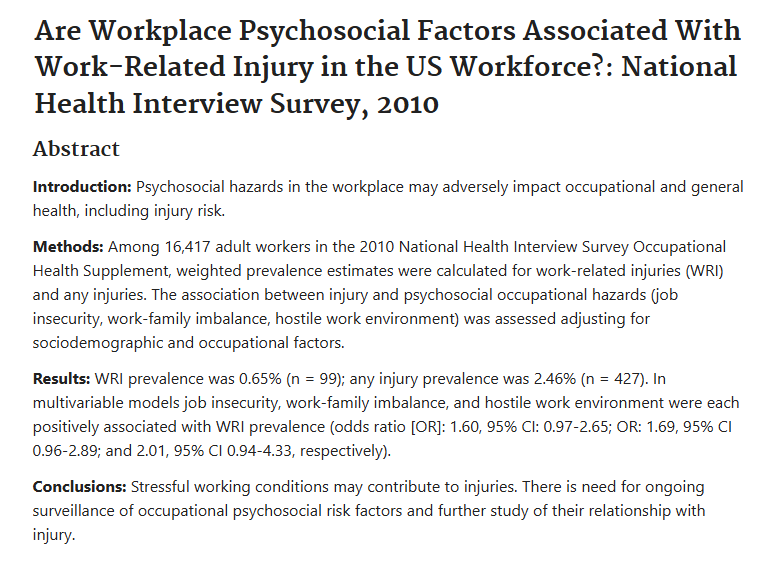
Another study on the links between work-related psychosocial factors and work injury.
Data was based on the 2010 National Health Survey in the US, including >16k workers.
Survey data, so consider limitations.
Key findings:
· In multivariate models, “job insecurity, work–family imbalance, and hostile work environment were each positively associated with WRI prevalence (odds ratio [OR]: 1.60, 95% CI: 0.97–2.65; OR: 1.69, 95% CI 0.96–2.89; and 2.01, 95% CI 0.94–4.33, respectively)”
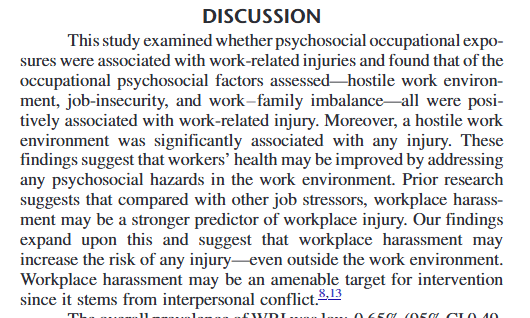
· Each of the three adverse psychosocial factors alone or in combination were positively associated with WRI, after controlling for sociodemographic and workplace characteristics
· However, “hostile work environment was the only factor significantly associated with any injury”
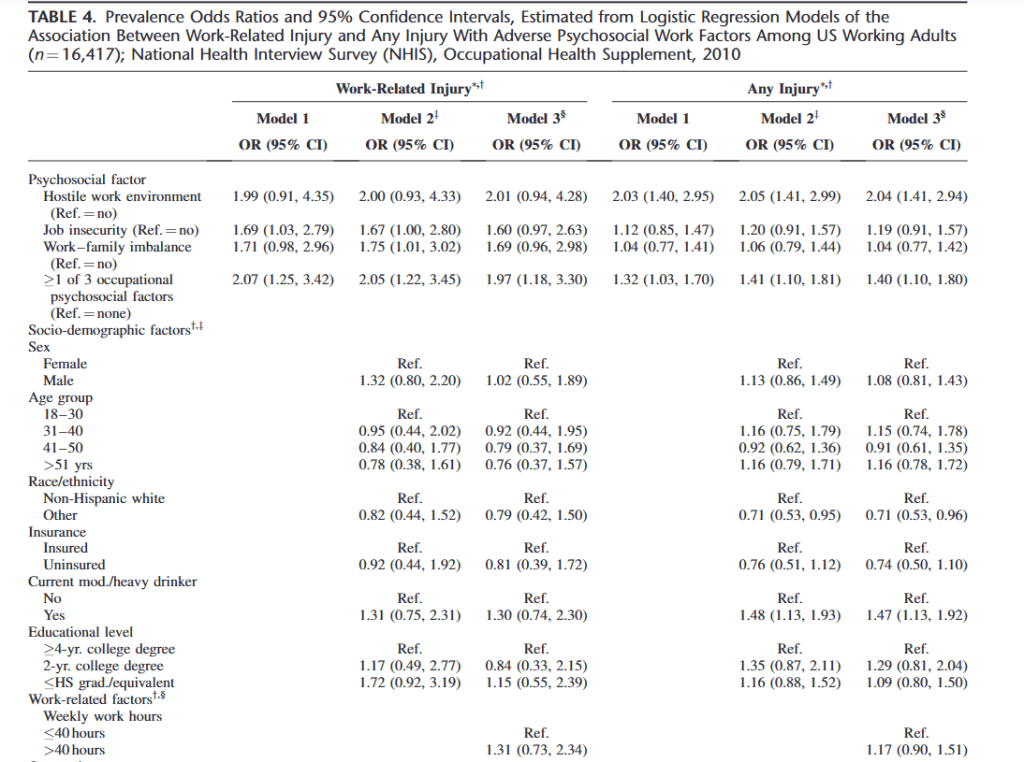
· “The relationships between WRI and work–family imbalance and job-insecurity were attenuated after adjusting for work-related factors”
· “Industries and occupations with employees engaged in manual labor had higher odds of work-related injury compared with office-based employment”
· Hence, “Stressful working conditions may contribute to injuries. There is need for ongoing surveillance of occupational psychosocial risk factors”
Ref: Farnacio, Y., Pratt, M. E., Marshall, E. G., & Graber, J. M. (2017). Are workplace psychosocial factors associated with work-related injury in the US workforce?: National Health Interview Survey, 2010. Journal of occupational and environmental medicine, 59(10), e164-e171.

Study link: https://journals.lww.com/joem/abstract/2017/10000/are_workplace_psychosocial_factors_associated_with.19.aspx

 SafetyInsights.org
One thought on “Are workplace psychosocial factors associated with work-related injury in the US workforce?”