
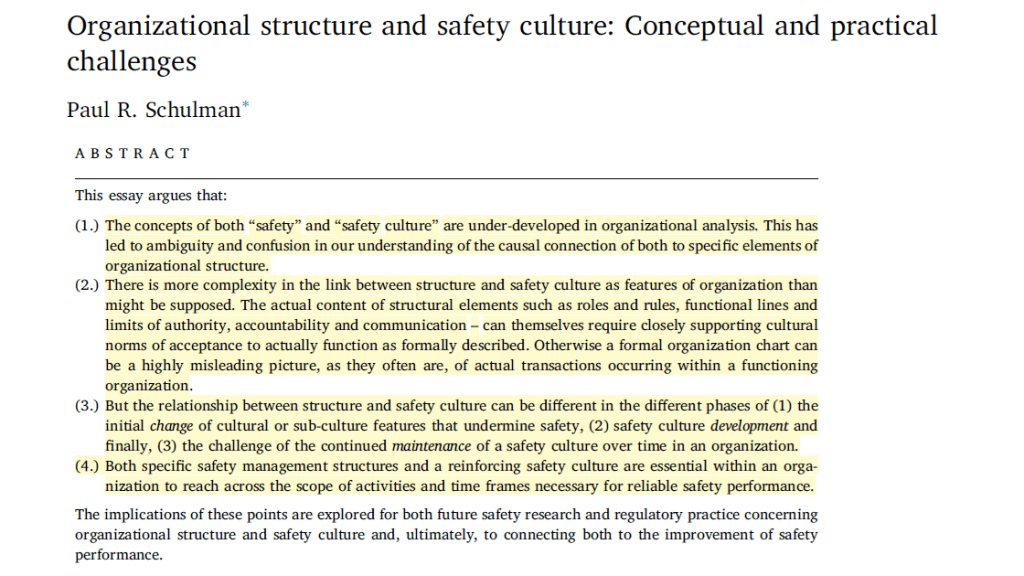
Organizational structure and safety culture: Conceptual and practical challenges
A banger read (as Schulman’s work often is) exploring some links and challenges about safety culture and organising/structuring for culture.
Not a summary as I can’t do it justice, so just read the paper (full link below).
This comes from an upcoming mini-compendium on safety culture / culture of safety / org culture / safety climate.
Random extracts:
· “Questions concerning the development of safety culture should still be research questions before legal ones because “safety culture” currently suffers from conceptual under-development”
· “It is not clear what constitutes a safety culture. A widely accepted definition of organizational culture offered by Edgar Schein is: “A pattern of shared basic assumptions that the group learned as it solved its problems of external adaptation and internal integration, that has worked well enough to be considered valid and, therefore, to be taught to new members as the correct way you perceive, think, and feel in relation to those problems.”
· “In more specific terms culture consists of widely shared values, basic assumptions, rituals and physical artifacts. But what makes an organization’s culture or sub-culture a safety culture as opposed to an organizational culture that discounts safety? “
· “a definition of organizational culture has been simplified down to “the way we do things around here.. But this seems to equate culture with behavior and leaves out the attitudes, beliefs and assumptions, values and motivations that lie behind the behavior”
· “Some of the formal structural elements typically associated with organizations are: roles, rules, communication links as well as authority and accountability .. But for each of these formal elements there are likely to be informal, shadow elements as well”
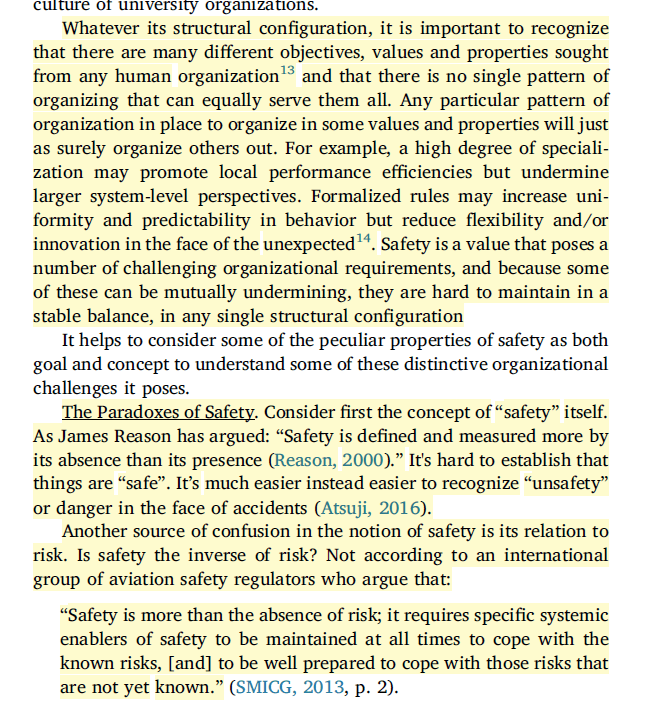
· “Any particular pattern of organization in place to organize in some values and properties will just as surely organize others out”
· “Consider first the concept of “safety” itself. As James Reason has argued: “Safety is defined and measured more by its absence than its presence (Reason, 2000).”
· “ It’s hard to establish that things are “safe”. It’s much easier instead easier to recognize “unsafety” or danger in the face of accidents”
· “Another source of confusion in the notion of safety is its relation to risk. Is safety the inverse of risk?”
· “How does an organization assign a valuation or priority to something which, in effect, means that things don’t happen? It is not surprising that many organizations will under-invest in safety relative to expenditures that produce determinate positive and measurable outcomes such as increased production”
· “Safety .. could be operationally defined as the effective implementation and operation of a safety management system, reinforced by a safety culture – and not simply by output measures of incidents and accidents as lagging indicators (Hollnagel 2014). But this requires that we can distinguish “dynamic non-events” in an organization”
· “All organizations have a culture, and probably sub-cultures, whether these support safety or not. There is clear evidence that high-level executives cannot simply order the dissolution of a deeply entrenched prior culture or sub-culture in their organizations, nor can they reliably order the implantation of a safety culture as a replacement”
· “As Schein’s definition of organizational culture cited earlier indicates, an existing culture “has worked well enough” in an organization to be considered valid and taught to new members.
· “High stakes, in both rewards or punishments, can and has led to falsification in performance reporting in order to appear in compliance with or fulfillment of formal safety performance goals”



 SafetyInsights.org