
More extracts from the Anglo American Grosvenor board of inquiry.
This focused on issues with defining critical controls / high potential incidents (HPI), and issues relying on injury measures, like TRIFR.
Extracts:
· The company standard didn’t require the business unit CEO to be notified of HPIs, and “whilst it prescribes a process of escalation in respect of repeat environmental incidents, no such process exists with respect to repeated HPIs”
· Strictly applying the ICMM’s definition of controls means that “a control excludes risk assessment tools, standard operating procedures (SOPs), behaviour-based safety tools, training and inspections”
· A critical control register (spreadsheet) was referred to as the reference source for critical controls
· This register “is a lengthy and unwieldy document which is of limited use in identifying the critical controls in place at Grosvenor”
· “Furthermore, and most surprisingly, gas drainage is not specified as a critical control with respect to the PUE of ‘gas/hybrid explosion’. It is difficult to comprehend how gas drainage could be regarded as anything other than a critical control”
· “Many of the items listed in the ‘critical control’ column in the register do not appear to meet the ICMM definition of a control. Items such as ‘review process for drained area’, ‘gas composition monitoring’ and ‘gas and gas flow monitoring’ are monitoring activities rather than controls”
· “Further, the item ‘drainage design and planning’ is not an act, object, or system that would control the methane hazard, although this activity could form part of a broader system. In short, .. the document appears to reflect a misconceived approach to the identification of critical controls”

On safety measurements:
· “published sources point to the limitations of some of the lag indicators listed above, particularly minor injuries and the LTIFR, as predictors of catastrophic incidents”
· At Macondo, “The day before the accident BP and Transocean managers were on the offshore rig to celebrate 7 years Lost Time Injury free and to undertake behavioural observations on such things as slips and trips and working at heights. None of the four executives took time to be curious about the operational challenges people on the rig were trying to address”
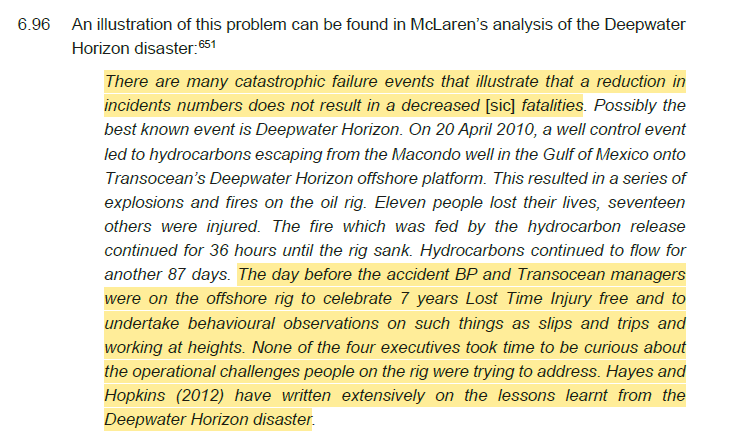
· From the Brady review, “Almost all of the fatalities were the result of systemic, organisational, supervision or training failures, either with or without the presence of human error. Human error alone would not have caused these fatalities. 17 involved no human error at all on the part of the deceased”
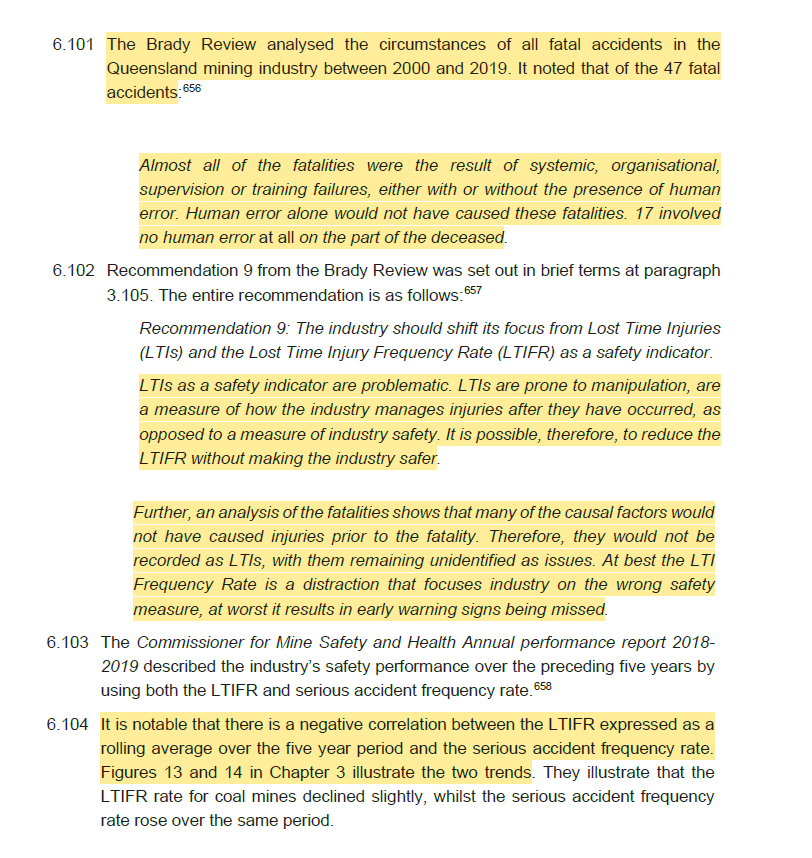
· “The industry should shift its focus from Lost Time Injuries (LTIs) and the Lost Time Injury Frequency Rate (LTIFR) as a safety indicator. LTIs as a safety indicator are problematic. LTIs are prone to manipulation, are a measure of how the industry manages injuries after they have occurred, as opposed to a measure of industry safety”
· “It is possible, therefore, to reduce the LTIFR without making the industry safer”
· “analysis of the fatalities shows that many of the causal factors would not have caused injuries prior to the fatality. Therefore, they would not be recorded as LTIs, with them remaining unidentified as issues”
· “At best the LTI Frequency Rate is a distraction that focuses industry on the wrong safety measure, at worst it results in early warning signs being missed”
· “The Commissioner for Mine Safety and Health Annual performance report 2018-2019 described the industry’s safety performance over the preceding five years … It is notable that there is a negative correlation between the LTIFR expressed as a rolling average over the five year period and the serious accident frequency rate”


 SafetyInsights.org