More extracts from Dekker’s 2013 paper ‘Drifting into failure’.
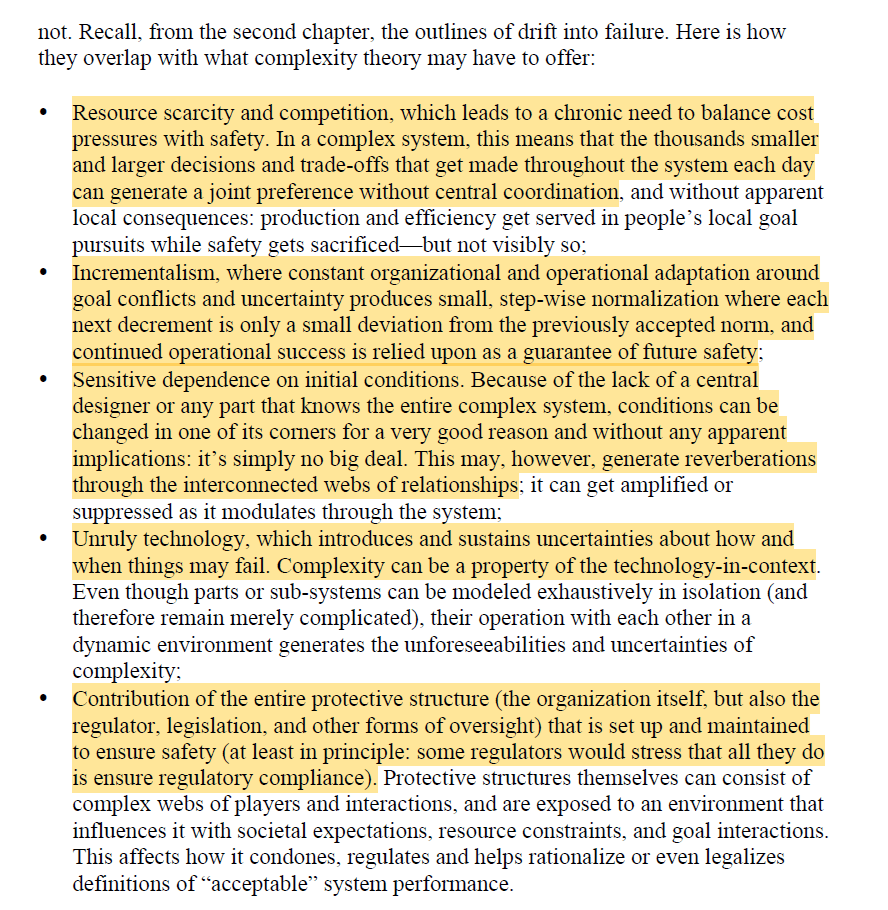
These parts focus on some properties of complex systems (image 1), and how systems drift to failure (image 2).
Extracts:
· “Open systems mean that it can be quite difficult to define the border of a system. What belongs to the system, and what doesn’t? This is known as the frame problem”
· “Where you place the frame is up to you, and up to the question you wish to examine”
· Systems drift to failure driven by resource scarcity and competition – this leads to “chronic need to balance cost pressures with safety”
· In complex systems, “the thousands smaller and larger decisions and trade-offs that get made throughout the system each day can generate a joint preference without central coordination”
· Incrementalism, where “constant organizational and operational adaptation around goal conflicts and uncertainty produces small, step-wise normalization where each next decrement is only a small deviation from the previously accepted norm, and continued operational success is relied upon as a guarantee of future safety”

· The influence of initial conditions, where “Because of the lack of a central designer or any part that knows the entire complex system, conditions can be changed in one of its corners for a very good reason and without any apparent implications”
· “Unruly technology … introduces and sustains uncertainties about how and when things may fail”
· “Contribution of the entire protective structure (the organization itself, but also the regulator, legislation, and other forms of oversight) that is set up and maintained to ensure safety (at least in principle: some regulators would stress that all they do is ensure regulatory compliance)”
· “The concern behind complexity and drifting into failure is how a large number of things and processes interact, and generate organizational trajectories when exposed to different influences”
· “Resource scarcity and goal oppositions form one such pervasive influence. They express themselves in thousands smaller and larger trade-offs, sacrifices, budgetary decisions—some very obvious, others hardly noticed. The ripple effects of such decisions and trade-offs are sometimes easy to foresee, but often opaque and resistant to anything resembling deterministic prediction”
· “Incrementalism shows up in all kinds of subtle ways as people in the organization adapt, rationalize and normalize their views, assessments and decisions”
Ref: Dekker, S. W. A. (2013). Drifting into failure. In: Banerjee, S. (Ed.), Chaos and Complexity Theory for management. Hershey, PA: IGI Global Business Science Reference.

Study link: https://maritimesafetyinnovationlab.org/wp-content/uploads/2021/03/DekkerDriftRiskChapter2013.pdf

 SafetyInsights.org