
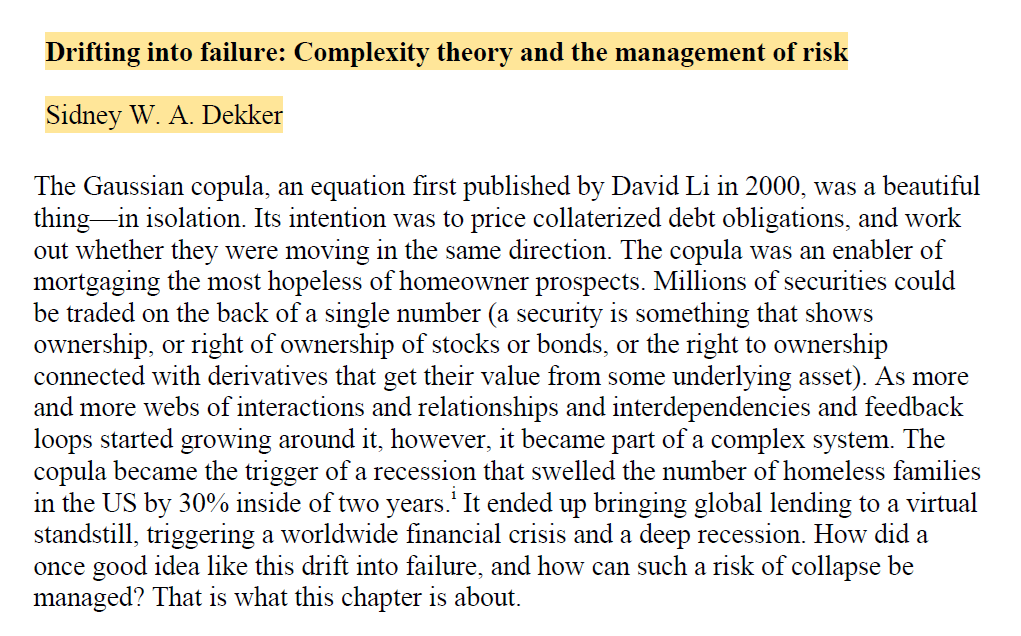
2013 paper from Dekker discussing drift into failure.
Nothing new if you’ve read his 2011 book.
Extracts:
· “organizations do not just fail because of component breakage or linear propagations of breakdowns. Instead, failure breeds opportunistically, non-randomly, among the very structures designed to protect an organization from disaster”
· “A common pattern seems to be a drift into disaster—a slow, incremental decline into bad judgment by organizations that take past results as a guarantee for continued success”
· “Small steps that increased risk, that took the organization away from previously accepted norms, were seen as routine and non-problematic or even necessary to achieve local gains”

· Drift is “hidden behind incrementalism, technical uncertainty and complexity, non-linear feedback loops, weak signals, personnel changes, job mandate horizons and more”
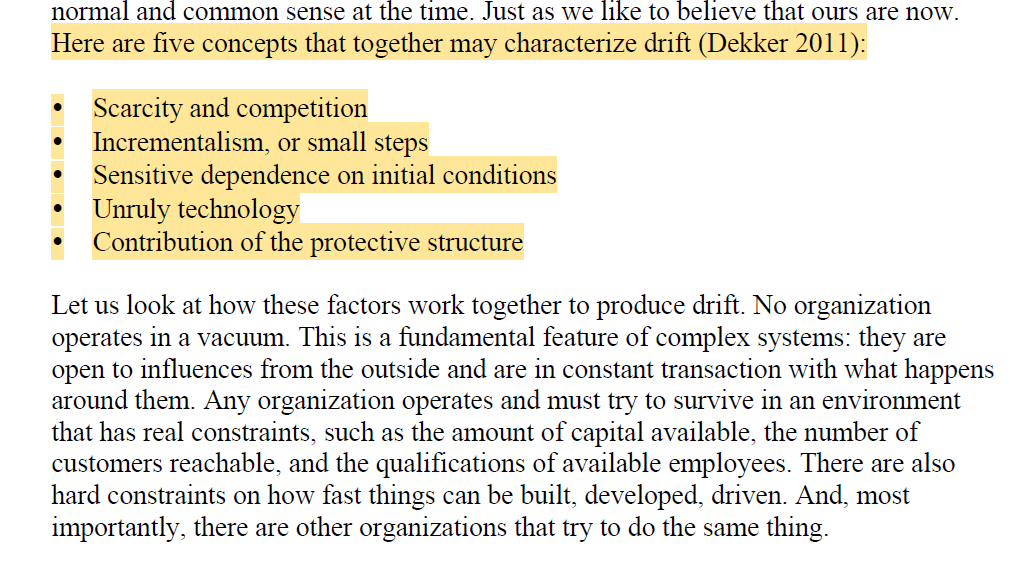
· Five concepts characterise drift (image 2): scarcity and competition, incrementalism, sensitive dependence on initial conditions, unruly technology, the protective structure
· “The major engine of drift hides somewhere in the conflict between production and protection, in the tension between operating with risk under control and operating at all”
· Normalisation of deviance is a ‘critical ingredient’ of drift
· “One big problem is a managerial feedback imbalance. Information on whether a decision is cost-effective or efficient can be relatively easy to get”, e.g. how much can be gained in productivity is easier to quantify
· “How much is or was borrowed from safety in order to achieve that goal, however, is much more difficult to quantify and compare”
· “Although each decision is locally rational, making sense for decision makers in their time and place, the global picture can become one of drift into failure”
· “One aspect of this, in complexity and systems thinking, is sometimes also called “sensitive dependency on initial conditions” (or butterfly effect)”
· The “structure that is designed (and has evolved) to keep the organization’s risk under control, can make the functioning and malfunctioning of that organization more opaque”
· “The meaning of signals gets constructed, negotiated, and transacted through the web of relationships that is strung throughout this structure”
· “In a complex system, each component is ignorant of the behavior of the system as a whole .. If each component “knew” what effects its actions had on the entire rest of the system, then all of the system’s complexity would have to be present in that component”
· “thousands [of] .. decisions and trade-offs that get made throughout the system each day can generate a joint preference without central coordination”
· This occurs without local consequences, so “production and efficiency get served in people’s local goal pursuits while safety gets sacrificed—but not visibly so”
· Resilience is argued to have a role in “Drifting into success”
· “Diversity is a critical ingredient for resilience, because it gives an organization the requisite variety that allows it to respond to disturbances”
· “Diversity means that routine scripts and learned responses do not get over-rehearsed and over-applied, but that an organization has different ways of dealing with situations and has a rich store of perspectives and narratives to interpret those situations with.”
· “Fully optimizing a complex system is undesirable because the lack of slack and margin can translate small perturbations into large events (Perrow 1984)”
· “Tight interdependencies or coupling means that there are more time-dependent processes (meaning they can’t wait or stand by until attended to), sequences that are invariant (the order of processes cannot be changed) and little slack (e.g. things cannot be redone to get it right)”
· “It means that small failures can cascade into bigger ones more quickly than if there is margin. Diversity of opinion (e.g. on a board) can be one way to make the organization stop and think but it requires the credibility and the courage to say “no” when everybody says “yes.”

Study link: https://maritimesafetyinnovationlab.org/wp-content/uploads/2021/03/DekkerDriftRiskChapter2013.pdf

 SafetyInsights.org