Another extract from Pupulidy and Vesel’s book ‘Human and Organizational Potential’.
This part looks at counterfactual thinking in investigations:
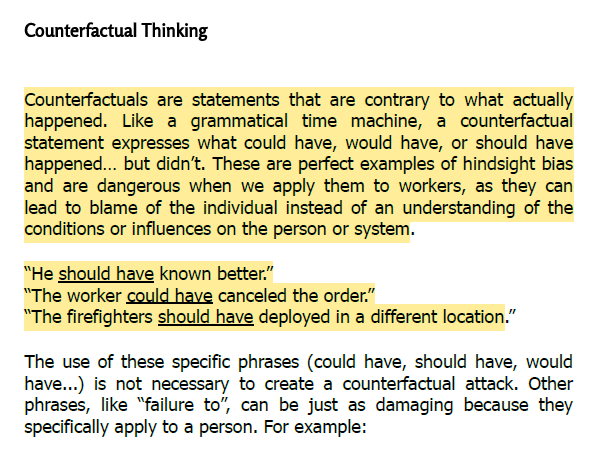
· “Counterfactuals are statements that are contrary to what actually happened”
· Counterfactuals “expresses what could have, would have, or should have happened… but didn’t”
· Problematically, counterfactuals as normative judgements during investigations describe a reality that did not occur (paraphrasing Johan Bergström)
· Counterfactuals can be used to good effect for prospective risk assessments and ‘what if’ thinking (safety imagination), but can be “dangerous when we apply them to workers, as they can lead to blame of the individual instead of an understanding of the conditions or influences on the person or system”
· These phrases aren’t the only examples – and includes phrases like ‘failure to’
· They cite the following as a statement replete with counterfactuals and normative judgements: “Failure to adequately anticipate the severity and timing of the burn over, and failure to utilize the best location and proper deployment techniques contributed to the fatalities and injuries.”
· They give another example of counterfactual blame from a 2018 duck boat sinking. The NTSB chairman noted “Had the Ducks Ride employees taken more appropriate actions and made better decisions, it is likely the duck boat would not have sunk”
· The authors take aim at this type of statement, noting that “Fundamentally, human problem-solvers possess finite capabilities. They cannot anticipate and consider all the possible alternatives and information that may be relevant or present in complex scenarios”
· Hence, rationality is always “local in the sense that it is significantly influenced by the situation and the complexity of the environment”
· Decisions are also related to other local factors, like pressure, competing goals, ambiguity, and excessive data/info
· “Human problem solvers cannot handle all the potentially relevant information, cannot activate and hold in mind all of the relevant knowledge, and cannot entertain all potentially relevant trains of thought”
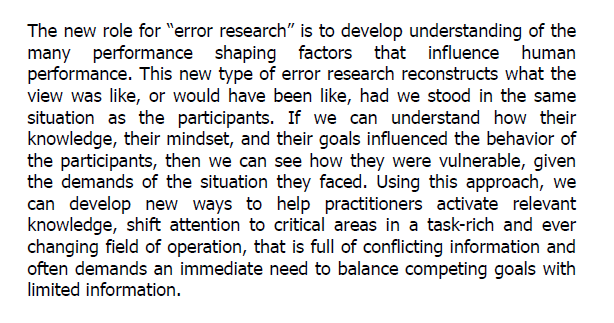
· They argue that we should seek to “develop understanding of the many performance shaping factors that influence human performance”
· This type of approach “reconstructs what the view was like, or would have been like, had we stood in the same situation as the participants”
· And by understanding their experience/perspective of the event, we can “see how they were vulnerable, given the demands of the situation they faced”

Study link: https://www.amazon.com.au/Human-Organization-Potential-Ivan-Pupulidy-ebook/dp/B0CQRRC86B

 SafetyInsights.org