
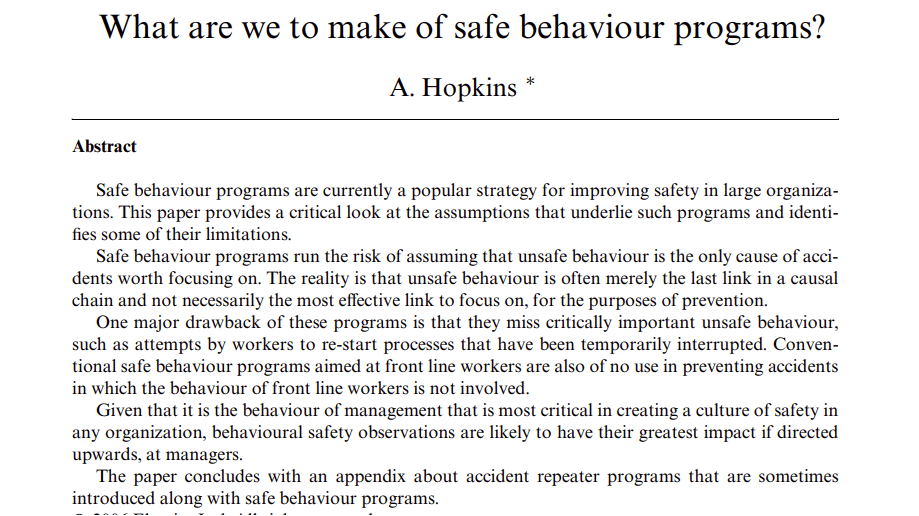
A 2006 article from Andrew Hopkins, discussing some merits and limitations of behavioural approaches to safety.
A lot of research has been done on behavioural safety approaches since 2006, but still a pretty reasonable article.
Note: This is broader than BBS, but that’s a well-known iteration.
Tl;dr – Hopkins argues:
· “Safe behaviour programs run the risk of assuming that unsafe behaviour is the only cause of accidents worth focusing on”
· “One major drawback of these programs is that they miss critically important unsafe behaviour [like start up processes]” and they are “aimed at front line workers are also of no use in preventing accidents in which the behaviour of front line workers is not involved”
· “Given that it is the behaviour of management that is most critical in creating a culture of safety in any organization, behavioural safety observations are likely to have their greatest impact if directed upwards, at managers”
Background
Some variations of behavioural programs are listed, like from DuPont or Chevron. Hopkins says these are “highly controversial, with unions arguing that they amount to a return to the strategy of blaming workers for the accidents that befall them”.
The fallacy of mono-causality
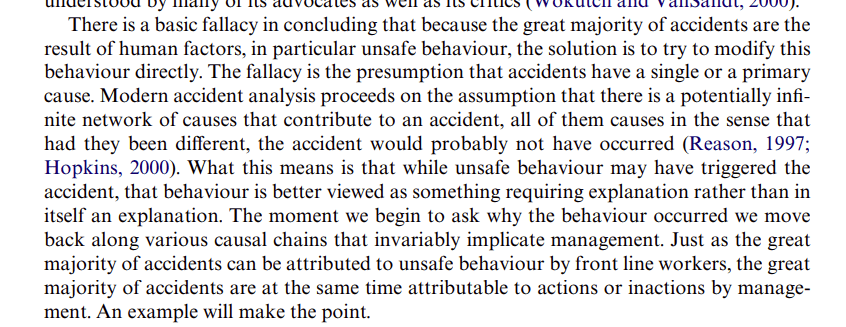
Hopkins argues that a fallacy of mono-causality may beset behavioural approaches. He says that the popularity of behavioural approaches “stems in part from the widely held view that “human factors” are the cause the great majority of accidents”. And this may result in a conclusion that accident prevention efforts should shift from engineering to compliance to “safe work practices”.
Hopkins says that there is a “basic fallacy in concluding that because the great majority of accidents are the result of human factors, in particular unsafe behaviour, the solution is to try to modify this behaviour directly”.
The fallacy presumes that “accidents have a single or a primary cause”. Hopkins says that while behaviour may often have a role in the direct triggering of an accident, “behaviour is better viewed as something requiring explanation rather than in itself an explanation”. By looking deeper into the event, Hopkins says inevitably management and workplace factors are implicated [** to various degrees, of course].
Many factors also shape or motivate behaviour, like production pressures. It’s said that “Despite all the company rhetoric about putting safety first, the experience of many workers, not all (Pitzer, 1999), is that production takes precedence over safety”.
An example of a stairway fall is given. One could remind people to hold the handrails, or one could design a safer stairway.
Some other misconceptions are provided. For one, based on a UK document, he says it’s kind of implied that focusing on behaviour is important because “the engineering and management level causes underlying accidents have already been addressed”. But this is a misconception.
Further, “we [should] find ways of eliminating or reducing risky behaviour that are not dependent on behaviour modification techniques”.
Human Factors professionals don’t commit these fallacies, since they’ve long recognised the importance of improving the environment that people work within. He cites aviation, which their response to errors “has not been to promote safe behaviour programs; rather it has been to identity the factors that have contributed to these errors and violations such as cockpit layout” etc.
Behavioural Approaches and Implicit Blame
More pointedly, Hopkins says that despite “the intention of behavioural safety advocates, their approach is inevitably associated with a tendency to blame the victims”.
He draws distinction between explanation and blame. Whereas explanation is a rationale process subject to empirical analysis, blame is a “fundamentally emotional response”, which is beyond reason.
So even despite the intention, “there is an almost universal tendency to allocate blame at the point where explanation comes to an end”. Because behavioural approaches explain accidents in terms of behaviour, “it is almost impossible to avoid attributing some degree of blame to the victim”.
Instead, if an organisation asks why the unsafe behaviour or procedural departure occurred – why it made sense – the explanation is often pushed further up the causal chain, with less blame.
Behavioural logics may also push improvements down the hierarchy of control towards PPE and rules. Hopkins says that these low hanging fruit changes “are adopted as an afterthought, after the machine or a process has been designed”.
Therefore, in Hopkins view (remember, as of 2006), “behaviour based safety directs attention to the least effective prevention strategies”.
However, he observes that in principle, there’s no reason why behavoural approaches have to come at t he expense of higher order system and engineering solutions. Many of the best performing organisations do both. However, behavioural approaches come with the risk of “the abandonment of any commitment to the hierarchy of controls”.
He provides examples from behavioural guides that support this contention.
Interestingly, Hopkins seems pretty optimistic about SLAM/Take 5 processes (‘mini risk assessments’) – believing them to be largely immune from many of the behaviorual criticisms he cited. Although he does mention that they aren’t always successful and can “rapidly degenerate into an ineffective ritual”.
What behavioural safety misses?
Behavioural approaches often encourage a focus on behaviour that is readily observable, observable to the naked eye, and frequent.
These characteristics “naturally highlight certain kinds of behaviour by front line workers, such as the wearing of PPE and the use of handrails when going up or down stairs”. Problematically, “many types of unsafe behaviour are systematically missed by this approach, either because they are infrequent, or because they are not obvious to the casual observer”.
Hence, focusing on frequent or readily observable behaviour makes it easier for observers, but limits the focus to “a very limited, even trivial class of behaviours”.
These behavioural programs are also said to lack an impact “on accidents that occur without any active behaviour, safe or unsafe, on the part of front line workers”. For instance, major accidents tend to be more steeped within organisational/management factors.
He cites examples like the Challenger and Columbia examples, but you could substitute virtually any other major accident.
Management behaviour
These approaches also tend to focus on worker behaviour and not management behaviour – their decisions etc. which often create the conditions of disaster incubation.
Hopkins believes this to be “one of the most serious limitations of conventional safe behaviour programs”
He notes that “Many commentators suggest that unless safe behaviour programs can include the behaviour of managers they will be relatively ineffective, in part because they will be missing crucial contributory factors”.
Conclusion
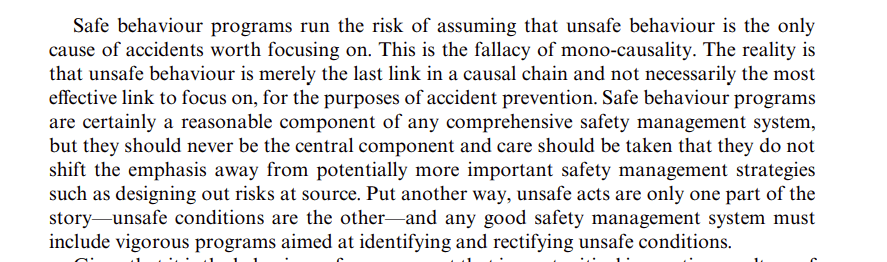
· Finally, Hopkins is careful not to outright discount behavioural approaches. He recognises that behavioural approaches can “certainly [be] a reasonable component of any comprehensive safety management system”, but they:
· “should never be the central component”, and
· “care should be taken that they do not shift the emphasis away from potentially more important safety management strategies such as designing out risks at source”
· May have their greatest impact if “directed upwards, at managers”
Hopkins, A. (2006). What are we to make of safe behaviour programs?. Safety science, 44(7), 583-597.

Study link: https://doi.org/10.1016/j.ssci.2006.01.001
LinkedIn post: https://www.linkedin.com/pulse/what-we-make-safe-behaviour-programs-ben-hutchinson-obquc

 SafetyInsights.org