Fascinating read of a CEO charged for not exercising due diligence, resulting tragically from a work-related death (Ports of Auckland Limited (POAL).
Posted over multiple days, as it also covers work as done, critical risks, audits, indicators, inconsistent nightshift practices and more.
Starting with due diligence:
· “A good leader and a conscientious officer may have the best intentions in the world but may still breach that duty”
· “if directors .. are unable to find time to take a positive interest in safety and health, it is unrealistic to suppose that this will not adversely [affect] the attitudes and performance of junior managers, supervisors and employees on the shop floor”
· “an officer cannot comply with .. due diligence obligations by simply relying upon those with specific responsibilities for health and safety .. or by assuming, without proper enquiry, that the organisation’s systems are adequately addressing .. risks”
· “an officer to exercise due diligence does not mean that the officer must do everything that the PCBU must do to ensure compliance with its own duty and that a failure by the PCBU does not, of itself, demonstrate a failure by its officer to exercise due diligence”

· They summarise due diligence principles, including:
a) The duty applies to all officers across the PCBU, large and small and with both flat and hierarchical structures
b) “The fact that an officer may operate at the head of a large, hierarchical organisation does not mean that the officer’s obligations are diminished”
c) In large hierarchical organisations, the duty “is not limited to governance or directorial oversight functions”, and an officer does not “need to be involved in day-to-day operations in a hands-on way but cannot simply rely upon others within the organisation who may be assigned health and safety obligations”
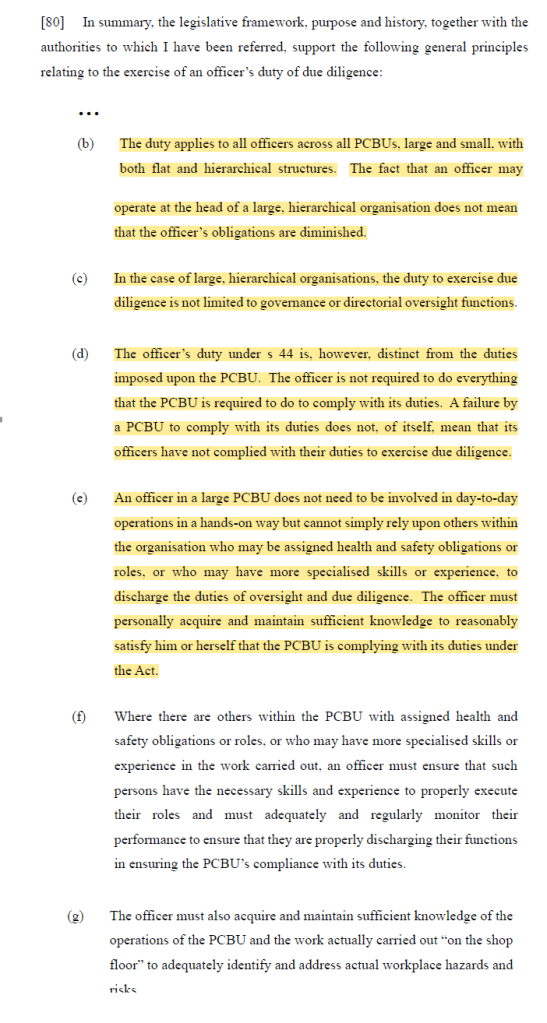
d) Therefore the officer “must personally acquire and maintain sufficient knowledge to reasonably satisfy him or herself that the PCBU is complying with its duties”
e) “An officer does not satisfy the due diligence duty by merely putting in place policies or procedures as to how work is to be carried out”
f) The officer must “ensure that entrenched and adequate systemic processes are put in place”, which the “adequacy of such systems are key”

g) An officer must make sure there are effective reporting lines and systems, and that info about safety issues, hazards etc. “flows to the officer and others in the organisation with governance and supervisory functions”
h) “An officer cannot assume that the PCBU is compliant with its duties .. in the absence of being told otherwise, or simply assume that the information they receive from their subordinates … is accurate and sufficient”
· “The fact that the Board may have approved [the CEO’s] approach to health and safety is not determinative as to whether [the CEO] failed … [in his duty]”


Report link: https://www.transporting.nz/wp-content/uploads/2025/01/MARITIME-NEW-ZEALAND-v-GIBSON-BC202464396.pdf

 SafetyInsights.org