
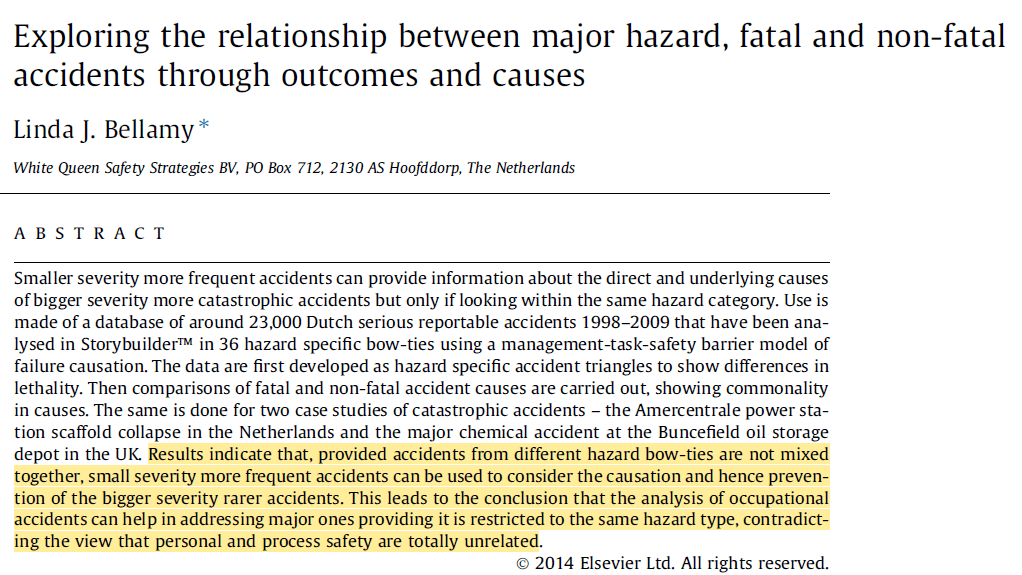
This study from Linda Bellamy explored whether there is a relationship between major hazards, and fatal and non-fatal accidents.
Analysis of 23k Dutch serious reportable accidents was analysed via the StoryBuilder software (largely based around bowties).
[NB. As always, there’s certain limitations and nuances with relying on reported accidents, particularly around how they’re reported, how the contributing factors are categorised, accident beliefs and models etc.]
Background:
· Based on major accident inquiries, “Organisations are found with blind spots, communication problems and conflicts, incubating accidents and ignoring their warning signs”
· “Increasingly complex high hazard technologies are seen as generating the inevitable ‘‘normal’’ accident (Perrow, 1984) where a seemingly minor malfunction can trigger an unexpected serious of interactions leading to catastrophe”
· However, in contrast to these high profile major disasters, occupational accidents, with single or multi-fatalities “rarely make … the news” [** in the same public shock and condemnation response, she means]
· Bellamy discusses earlier works around Heinrich, Bird and Germain, noting that “unsafe acts and unsafe conditions are considered to be symptoms of bigger problems”, but others believe that these such links don’t really exist
· E.g. “In others they are thought to be unrelated as concluded by the Baker (2007) report of the Texas City refinery explosion which criticised the use of occupational injury statistics to measure process safety performance”
· Also, Hale in 2002 “concluded that thinking that the prevention of minor accidents leads to the prevention of major accidents is based on careless and unsupported reasoning and highlights the need to take a scenario specific approach to understanding accident causation”
· This study, therefore, directly explores the linkages, if any, between minor and major accident scenarios
NB. These types of studies always have important caveats/nuances around what is reported and investigated, and how the findings are constructed and categorised (e.g. WYLFIWYF, among other considerations).
Results:
· “Smaller severity more frequent accidents can provide information about the direct and underlying causes of bigger severity more catastrophic accidents but only if looking within the same hazard category”
· The 23k Dutch serious occupational accidents analysed, “shows a relationship between the smaller severity outcome more frequent accidents and the more severe outcome rarer accidents when the data are scrutinised within the same hazard category” (emphasis added)
· “This contradicts what Hopkins (2009) has said regarding occupational versus process accident risks, that the distinction between personal and process safety ‘‘is really a distinction between different types of hazards”
· In contradiction to Hopkins’ statement, Bellamy notes that “there is a link between occupational and process safety and between fatal and nonfatal occupational accidents, and that link is the hazard” (emphasis added)
· “There is no one fatal accident barrier failure cause which has not also occurred in non-fatal accidents
It’s said that the “underlying causes of same hazard accidents can be the same types of barrier failures with the same management issues they are not necessarily in the same proportions when separating into severity outcomes”. Therefore, breaking down incidents at a barrier level is important for risk management.
Importantly, “It is not a matter of just looking at the more frequent incidents or using their decline as an indicator of overall safety. Hazards and their barriers need independent and deeper scrutiny”.
Using the below data as example, it’s explained that the hazard specific ‘hills’ shows how the hazards are different in the distribution of outcome severities, and importantly, the most lethal hazards aren’t the biggest killers. The smaller the hill, the more lethal is a hazard because there’s a smaller ratio between fatal vs non-fatal accidents.
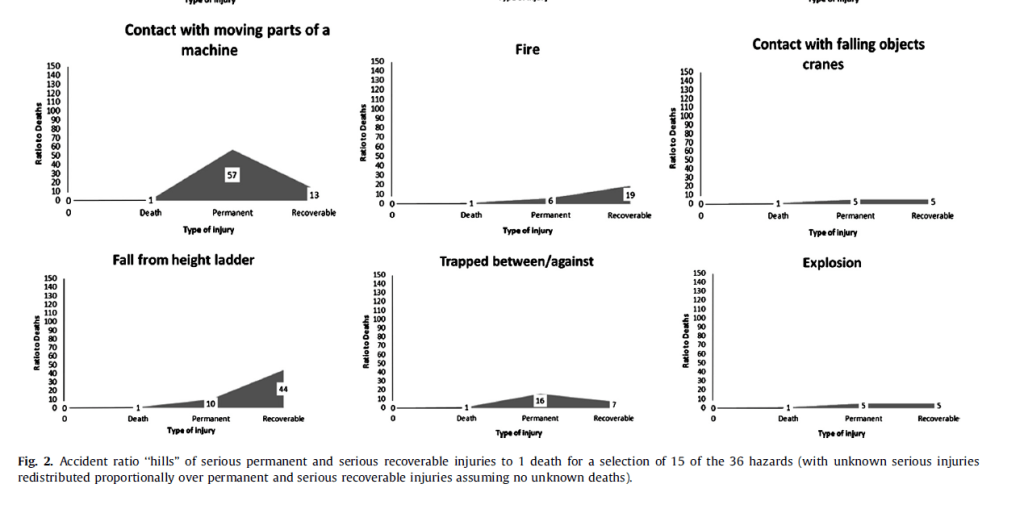
It’s argued that, not surprisingly, in contrast to the direct lethality of a hazard, other factors like exposure, barrier measures, management systems etc. also influence fatal accidents.
It’s found that “the number of rarer fatal accidents correlate with the number of non-fatal accidents suggesting common underlying factors. When analysing safety barrier failures, fatal and non-fatal accidents were found to share the same underlying causes except in different proportions” (emphasis added).
Found also was that when a hazard was separated into its safety barrier failures, different barrier failure modes occurred with different accident severity levels. Hence, the barrier performance was linked to fatal vs non-fatal accidents.
While major accident rarity is a challenge for prediction and prevention efforts (in some sense), these results “suggest that investigating the underlying causes of the more minor more frequent incidents or deviations and fixing the safety barrier problems with a higher severity potential could help prevent the bigger accidents of the same hazard type”.
Back to the lethality, again the most lethal hazards aren’t the biggest killers in this data. Interestingly, it’s observed that “is no significant correlation between lethality and either the number of fatal accidents (r = _0.27) or non-fatal accidents (r = 0.02)”.
Indeed, falls from height or contact with falling objects have a lot more serious/fatal accidents than hazard types that are more lethal. However, when looking within the same hazard types, “there is a significant correlation found between the number of non-fatally injured victims and fatally injured victims of r = +0.64 (N = 36, p < 0.0001)”.
Bellamy explains this relationship with the most profound, but obvious, link: “to fall from a roof, fatal or not, the victim has to be working on the roof in the first place”. That is, we need to be concerned with the hazards and scenarios.
i.e. the hazard is the central and critical link between minor and major accidents.
Based on the 907 fatal accidents across 35 bow-ties built from the Dutch data, all of the non-fatal accidents had equivalents to the fatal accidents in terms of the safety barrier failures (with just one exception).
Or more pointedly, there is no one fatal accident barrier failure cause which also did not occur within the non-fatal accidents.
Hence, “the general pattern is that the less serious accidents of the same hazard are a more frequent occurrence so it could be useful to consider these as indicators of the potential for a more serious accident”.
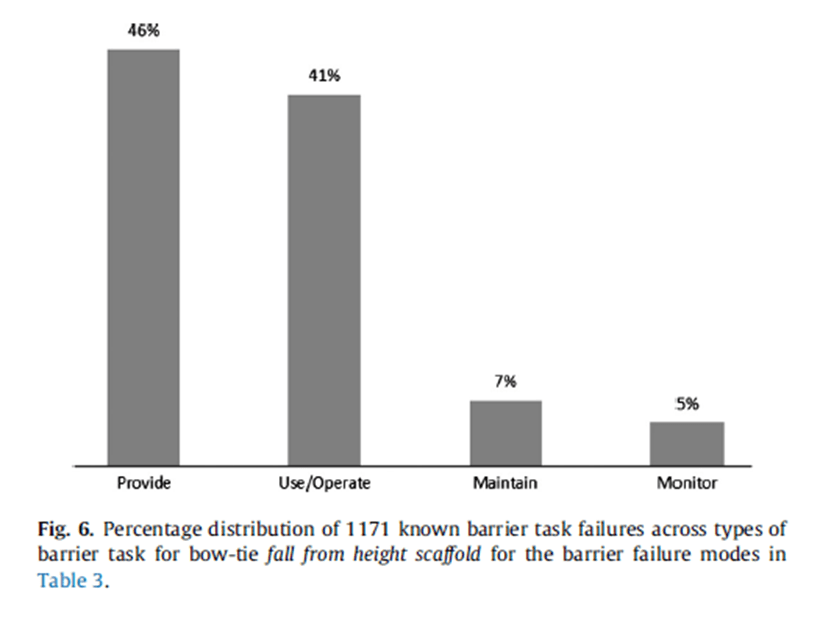
The data also went into details about barrier performance, for instance for the barrier failures for fall from height on scaffolds. In this specific scenario, barrier systems were not provided in 46% of instances, not used or operated as expected in 41%, not maintained as expected in 7%, and not monitored as expected in 5%.
Ref: Bellamy, L. J. (2015). Exploring the relationship between major hazard, fatal and non-fatal accidents through outcomes and causes. Safety Science, 71, 93-103.

Shout me a coffee (one-off or recurring monthly)
Study link: https://doi.org/10.1016/j.ssci.2014.02.009
LinkedIn post: https://www.linkedin.com/pulse/exploring-relationship-between-major-hazard-fatal-ben-hutchinson-6ch1c

 SafetyInsights.org