

Some extracts from Guldenmund’s interesting article ‘Organisational safety culture principles’:
· Culture can be studied via different aggregated levels, with many authors relating it as “consisting of a core surrounded by one or more layers, not unlike the anatomy of an onion”
· “Whereas the core is something (deeply) hidden, the culture projects itself gradually through and onto the outer layers”
· “The more remotely a layer is located from the core, the more easily it can be observed but also the more indirect, or interpretive, its relation with the core becomes”
· “ With regard to changing a culture a similar rule is sometimes put forward: the more deeply a layer is located, the more difficult it becomes actually to change it”
· Image 1 highlights the conceptualisations from several authors with all all posing values, convictions, principles etc. at the core
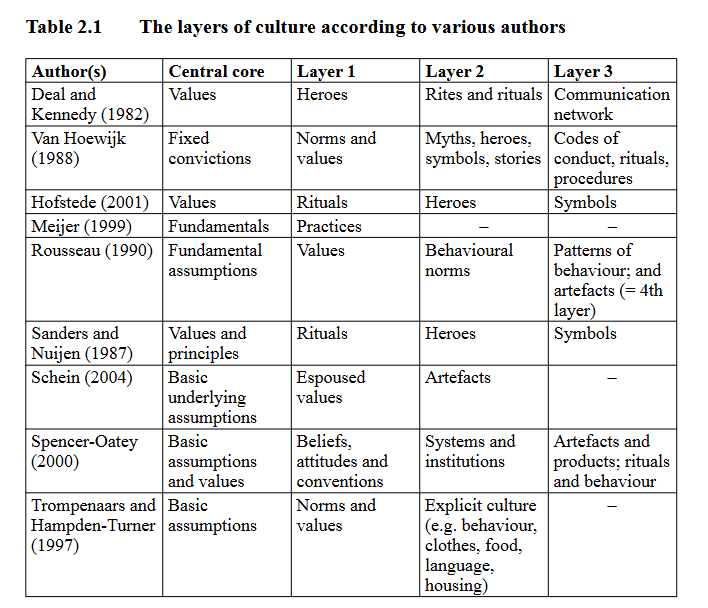
· “Regarding organisational culture, Hofstede argues that the core – i.e. the values – is less relevant for the study of organisations, although it offers a reflection of the organisation’s national values”
· “Schein does not differentiate between the more visible aspects of culture, i.e. between rituals, heroes and symbols”
· “However, he divides the core into ‘espoused values’ and ‘basic assumptions’”
· “ Schein also makes a point of calling his core ‘basic assumptions’ and not ‘values’. To him, values are still negotiable whereas basic assumptions are not”
· “Spencer-Oatey introduces the notion of institutions [who] either teach or otherwise develop and disseminate some of the values of a culture”
· “the labels given to the layers are typically assigned from an analyst’s point of view. For a member of a particular culture these aspects are thoroughly intertwined and their meaning is obvious. It is therefore the researcher who labels these activities as such and in many cases their differences are not clear-cut”
· “Regarding research on culture it is possible to distinguish two contrasting approaches; one approach considers culture a sociocultural (i.e. behavioural) system, whereas the other considers it an ideational system, i.e. a system comprising ideas, concepts, rules and meanings”
· “Whether it is sufficient to observe the practices and not understand their underlying rationale seems much more a matter of preference for a particular paradigm .. On the one hand, researchers observing only practices might sometimes be bothered by their inconsistency, their irrationality or their incongruence [and] and might end up relying researchers focussing on the core have a hard time untangling it”
· ”People become emotional when their fundamentals are questioned or under attack (Avruch 1998; Hofstede 1991), often without being aware of why this is so important to them”
· “Yet culture is not only deep because it is so fundamental and covert, it is also immensely patterned and therefore related to everything we think, perceive and do. When attempting to change one belief, we have to change many related ones and much that has been built upon these. The ‘large quantities of basic anxiety’ and the process of mourning mentioned here are quite understandable when such basic belief networks are taken apart”
· “Trying to formulate such deeply seated assumptions, these ‘webs of significance’ as Geertz calls them (1973: 5), will be particularly difficult because they are so taken for granted”



 SafetyInsights.org