Third post from the Maritime NZ case where the CEO was charged under a failure to exercise due diligence for a work fatality (Ports of Auckland Limited (POAL).
Some extracts on audits (and systems in post 2 in comments):
· “Any effective system should also incorporate regular review and audit processes”
· “the prosecution submits that prior to and during the period reflected in the charges the HSSC [H&S committee] was failing to discharge its obligations, in that it was not operating as a strategic oversight committee as POAL’s Health and Safety Manual required”
· “The prosecution submits that the ACC [insurance company] audits were ‘compliance audits’, focussed on the existence of documentation and the paper trail of activities rather than on outcomes, and engagement with health and safety personnel”

· The audits “were expressly limited in their scope. They could only provide POAL and its officers with limited reassurance” and were “not designed to “drill down into the organisation to determine what the systems, standards and procedures are actually translating to in terms of worker behaviours and engineering controls directed at managing risk”
· Expert evidence “accepted that the ACC audits would have only told Mr Gibson that “on paper, the safety system, management system looked solid”
· “While the ACC audits are relevant, they did not serve the purpose of ensuring that POAL’s resources and processes were appropriate in terms of its duties”
· “the 2018 KPMG report recommended improvements to the monthly Health & Safety Performance Report. The audit report identified that the reports contained no commentary on achievement of the health and safety strategy, or the effectiveness of critical controls for critical risks”
· “I am satisfied that POAL and the Executive team did not appropriately advance the KPMG recommendation in a timely manner. The monthly Health & Safety reports from 9 February 2018 through to 10 June 2019 routinely referred to the need to develop lead indicators for Board reporting, without apparent progress”
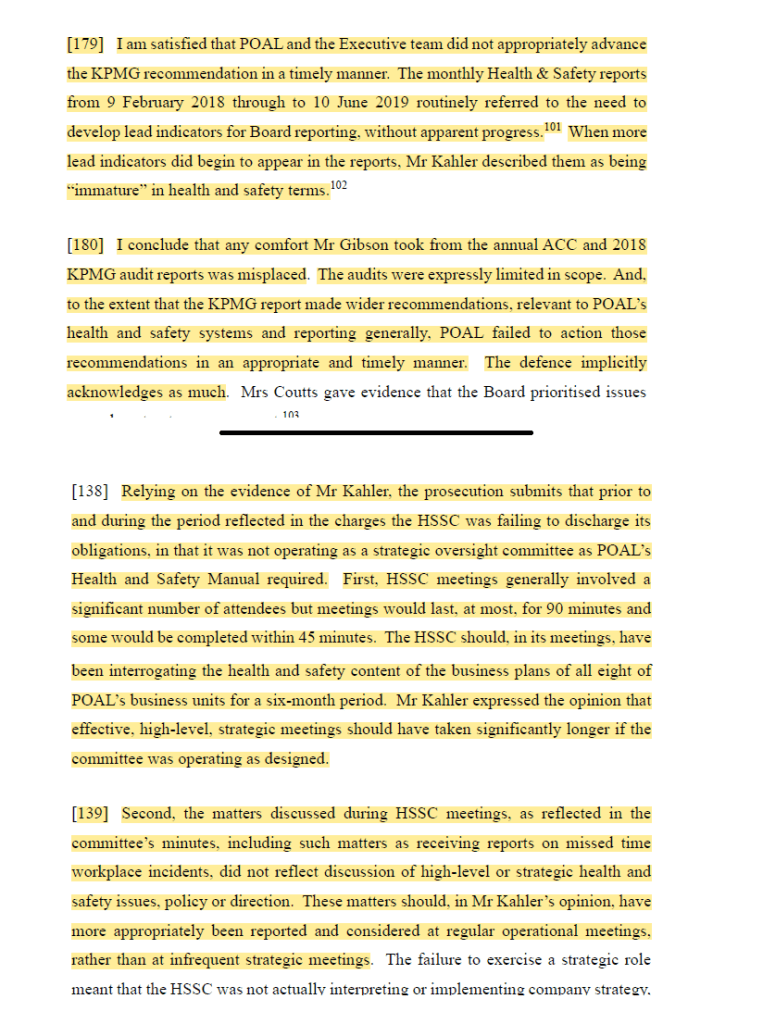
· “When more lead indicators did begin to appear in the reports, Mr Kahler described them as being “immature” in health and safety terms”
· “I conclude that any comfort Mr Gibson took from the annual ACC and 2018 KPMG audit reports was misplaced. The audits were expressly limited in scope”
· “effective, high-level, strategic meetings should have taken significantly longer if the committee was operating as designed”
· “the matters discussed during HSSC meetings .. including such matters as receiving reports on missed time workplace incidents, did not reflect discussion of high-level or strategic health and safety issues, policy or direction”
· “The HSSC was also not monitoring performance against company policy by means of the development and use of leading indicators. The sole function of the HSSC which the committee appeared to be discharging, of those set out in the Health and Safety manual, was the review of highlevel issues and the management of responses to operational issues”
· “Systems are the means by which a business translates its policies and objectives into reality. Policies are statements of intent. They express the standards of practice and behaviours that are required of people who work for the organisation”
· “For a system to be effective there must be an ability to monitor and measure the performance of the system. Common metrics which act as indicators of the effectiveness of the system’s functions as designed include the use of leading and lagging indicators”


Shout me a coffee (one-off or recurring monthly)
Report link: https://www.transporting.nz/wp-content/uploads/2025/01/MARITIME-NEW-ZEALAND-v-GIBSON-BC202464396.pdf

 SafetyInsights.org