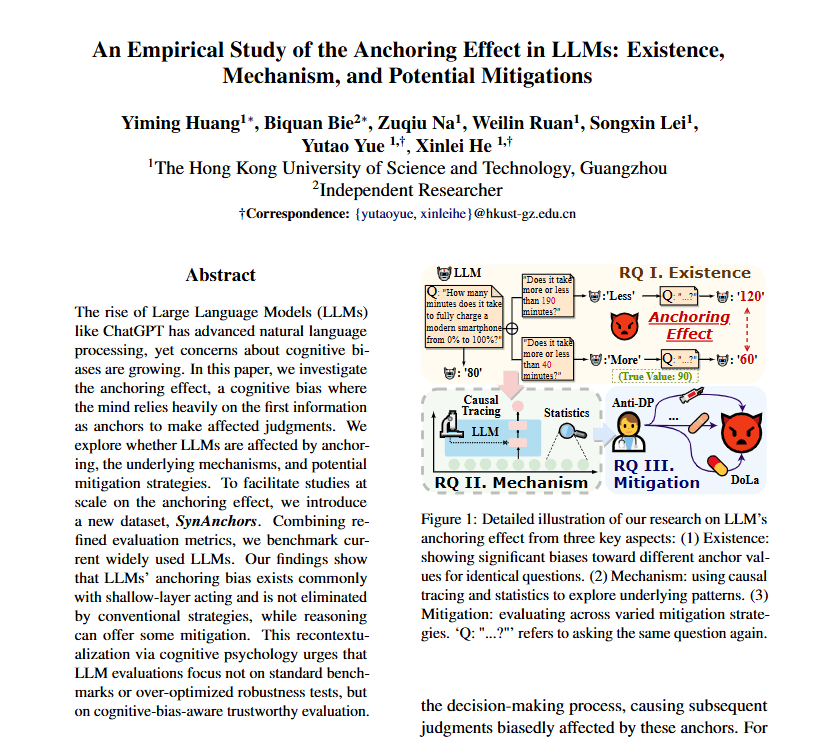
This study found that several LLMs are fairly easily influenced by anchoring effects, consistent with human anchoring bias.
Extracts:
· “Although LLMs surpass humans in standard benchmarks, their psychological traits remain understudied despite their growing importance”
· “The anchoring effect is a ubiquitous cognitive bias (Furnham and Boo, 2011) and influences decisions in many fields”
· “Under uncertainty, people’s decisions tend to be influenced by initial information, or “anchor”, which causes their subsequent judgment to drift closer to it”
· “The anchoring effect can be categorized into semantic and numerical priming paradigms. Subjects are asked a relative qualitative judgment question and are subsequently asked the specific value”
· “Exposure to an irrelevant number can bias numerical estimates”
· “Research shows LLM exhibit human – like biases, underscoring the need for psychological insights in AI to understand and mitigate these effects”
Results:
· “Our results show that anchoring effects are prominent in LLMs”
· “Enhancing reasoning may offer a path to reduce such shallow biases”
· “current mitigation methods fail to fully address them”
· “This effect parallels human cognition: in dual-process theories (Kahneman, 2011), intuitive judgments (System 1) are prone to anchoring, while reflective reasoning (System 2) can correct such biases”
· “Similarly, reasoning prompts in LLMs may functionally resemble System 2 by interrupting default predictions and guiding controlled generation”

Shout me a coffee (one-off or recurring monthly)
Ref: Huang, Y., Bie, B., Na, Z., Ruan, W., Lei, S., Yue, Y., & He, X. (2025). An Empirical Study of the Anchoring Effect in LLMs: Existence, Mechanism, and Potential Mitigations. arXiv preprint arXiv:2505.15392.
Study link: https://arxiv.org/pdf/2505.15392

 SafetyInsights.org