
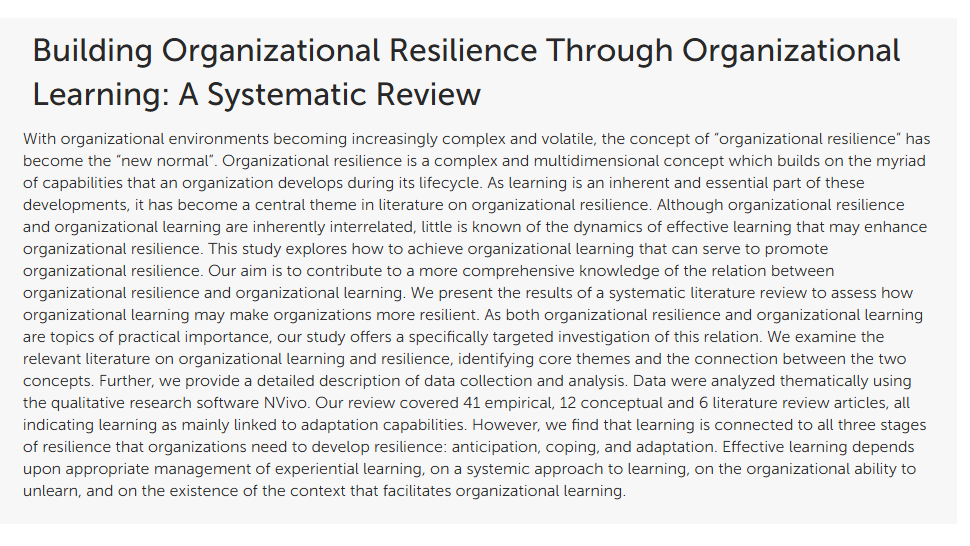
This explored organisational resilience (OR) through the lens of organisational learning (OL). I found it a pretty tough paper to summarise.
In short, OL relies on experiential learning, a systematic approach to learning, an organisational ability to unlearn, and a context that facilitates OL.
OR is defined as an organisation’s “ability to anticipate potential threats, to cope effectively with adverse events, and to adapt to changing conditions”. It includes anticipation, coping and adaptation. Research suggests that OR is an “essential organizational meta-capability for the success of modern organizations”. OR is multi-dimensional, involving an organisation’s abilities to learn, adapt and self-organise.
They suggest that OR has become a “new normal” in how organisations adapt for survival, and re-emerge after disruptions.
For context:
· OL capability is positively related to building and sustaining OR capability
· OL represents an ongoing “social process of individuals participating in situated practices that reproduce and expand organizational knowledge structures”
· Being a social process, OL is therefore embedded in everyday practice when people leverage and repeat knowledge
· Moreover the individual component of knowledge, explicit or tacit, also must be leveraged into the organisational repository, including tools, routines, social networks and transactive memory sytems
· Nevertheless, efforts for OL must be cultivated as learning “does not always lead to true knowledge, as organizations “can incorrectly learn, and they can correctly learn that which is incorrect”
· Learning is emergent in nature and may flow from single loop where “OL results in detection and correction of errors “without questioning or altering the underlying values of the system”, double loop where “errors are corrected by changing the governing values and then the actions” or triple loop where “(deutero-learning) enables organizations to learn about their own learning processes”

Literature Review Findings
Some key findings:
· “Our findings affirm and strengthen the link between Organizational Learning (OL) and Organizational Resilience”
· Some research found that either “learning increased resilient performance” or even learning is a “precondition for resilience”
· OL has a predictive element of OR and in other cases, limited OL is a “disadvantage for developing resilience”
· Hence, in order to develop the adaptive capacities, one must “aim at facilitating organizational learning
· They also found that capacity for “resilience can be learned and therefore deliberately built”
Learning From Experience
Experiential learning has had a lot of focus in the literature, stressing that experience can be derived during real events, training exercises and drills.
Training and exercises and use of post-exercise debriefing all promote learning, and therefore OR. Greater focus on sharing and unpacking the learnings from incidents is also stressed.
Both positive and negative learning are crucial for expanding OL. They say that learning from failure is a key capability among resilience-promoting organisations, with arguing that “organizations can learn more from failure than success, particularly on the case of major failures”.
However, successful or normal variability must also be a source of learning, with “organizations that do not “reflect on positive outcomes might inhibit organizations not seizing all the benefits of intentional experiential learning”. Others argue that past experiences may provide just limited learning.
It’s further stated that while “experience can enable organizations to replay what has been previously learned, they may fail “to prepare [. . . ] for unforeseen and unpredicted events”.
Further, past experience may get codified into standard practices and responses, but that this codified learning is problematic because the actual situation that faces people may be different enough from the codified response.
To maximise learning, acquired knowledge should be applied to real situations, where OR is built through a combination of theoretical input and experiential learning. One way of enhancing this is through types of what-ifs and counterfactual exercises.
They find even for organisations that prepare for disasters, they still often struggle to learn effectively in preparations. This failure to learn results in part from the “fragmented nature of our understanding, and the resulting piecemeal conceptualization of the learning process”.
They give an example where a “a disturbance may be familiar to the organization; but, due to bounded rationality, the need for new learning is not always identified, as organizations will often choose to fall back on old practices instead of developing new ones”.
Also the time lag and spatial distance between the events and the impetus and means for learning may challenge the opportunity for effective learning.
They say another barrier to successful OL is “confusing learning with identifying lessons”.
Importance of Continuity and Need for a System
Building the capacities for resilience requires capturing learning into a capability, itself requiring learning from adversity and “codifying this learning into resilience capabilities against specific threats”.
Continuous learning systems are necessary and must incorporate a range of learning practices. Learning from major and minor disturbances must be integrated to a degree, as with the normal functioning of everyday activities.
They found that “resilient learning is “ambidextrous,” with a diversity of practices that organizations should explore and exploit .. balancing flexible and procedural strategies”.
Resilient capacities are nurtured via maintaining corporate knowledge as people come and go. Improving OL depends on feedback – where individual lessons are shared collectively. A diversity of opinions and perspective is important, as with exchanging within, between and across the organisation.
They argue that “In the absence of such systems, OR will remain “reactive (brittle) and restricted to the frontlines, with no way of advancing to team and organizational levels”.
Dimensions of Learning Practices
OL is facilitated via formal and informal practices. Formal practices were found in one study to be more associated with learning from failure, and may help ensure a more thorough transfer of information, and “highlighting that disruption may undermine informal systems for knowledge exchange”.
However, informal practices are also critical. Some research has shown that OL efforts have been too focused on formal rules and policies for learning, and that “new insights might emerge through a fuller examination of how informal organizational rules, norms and practices work”.
Learning also comes about via intentional and unintentional means. Intentional learning are anticipative, situational and vicarious learning. Anticipative learning involves anticipating possible disruptions, knowledge transfer via formal training or collaboration. It can establish new or modify existing routines.
Situational learning occurs via the coping stage, in the moment of disruption and targets the “challenges that could have been anticipated but were not”. Vicarious learning happens in the adaption stage, and involves reflection.
Unintentional learning include processual, collaborative and experiential learning. They don’t give a good definition of processual learning, Saying it “occurs because of the proactive knowledge creation deduced from inherent organizational processes (e.g., changes in strategy, organizational growth, and operational refinement)”. Collaborative learning occurs during the response phase of a disruption when an immediate solution is needed, but where procedures provide little guidance.
Experiential learning happens particularly during the recovery phase of disruption. They say that improved future performance is heavily reliant on rigorous learning from experience. However, the “The trap of retrospective simplification of experience .. can be avoided by focusing on interpreting experience .. instead of simplifying it”.
Unintentional learning is said to be a largely overlooked element of OL.
The Role of Unlearning
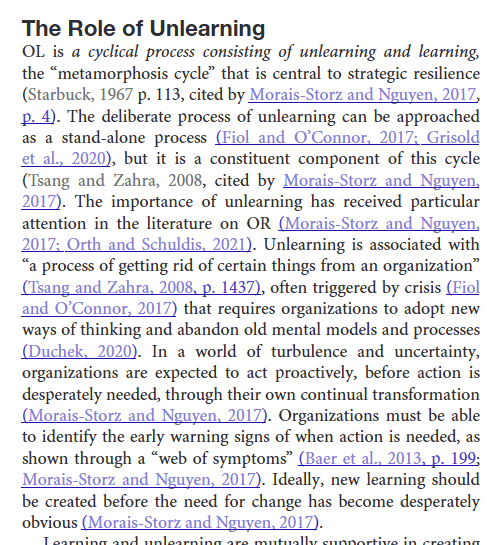
OL involves a cyclical process of unlearning and learning. It’s associated with getting rid of certain things from an organisation, and is often triggered by crisis. It requires “organizations to adopt new ways of thinking and abandon old mental models and processes”.
Learning and unlearning are mutually supportive in creating knowledge transfer and OL. The most important part of unlearning is to “clear away obstacles created from misleading knowledge and obsolete routines, so as to pave the way for future learning”.
Unlearning is said to be a necessary precondition for learning and that it has been proposed that “the greater the capacity for unlearning capability, the stronger may be the positive effect of OL on OR”.
In concluding, they argue that:
· “adaptation is recognized as vital for resilience, but that goes for learning as well, as it facilitates the development of the other resilience .. capabilities”
· “Just as OL relies on multiple levels of interactions within and outside an organization so does OR”
Ref: Evenseth, L. L., Sydnes, M., & Gausdal, A. H. (2022). Building organizational resilience through organizational learning: A systematic review. Frontiers in Communication, 7, 837386.

Shout me a coffee (one-off or monthly recurring)
Study link: https://doi.org/10.3389/fcomm.2022.837386
LinkedIn post: https://www.linkedin.com/pulse/building-organizational-resilience-through-learning-ben-hutchinson-uq5gc

 SafetyInsights.org