Part 2 of Meadow’s banger ‘Indicators and Information Systems for Sustainable Development’.
Extracts:
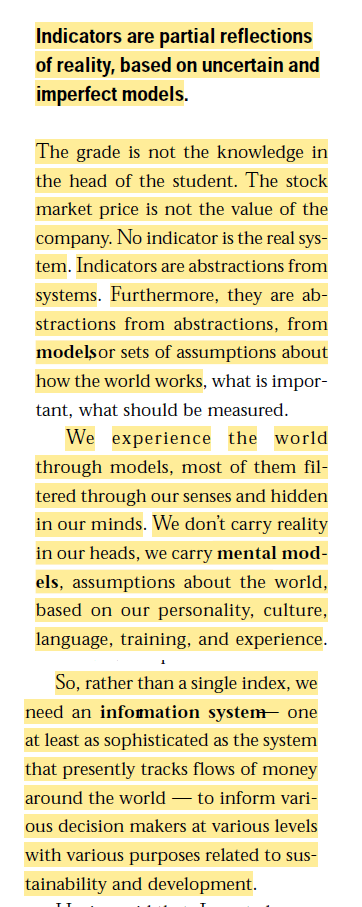
· “Indicators are partial reflections of reality, based on uncertain and imperfect models”
· “The stock market price is not the value of the company. No indicator is the real system. Indicators are abstractions from systems”
· And are “are abstractions from abstractions, from models, or sets of assumptions about how the world works, what is important, what should be measured”
· “We experience the world through models, most of them filtered through our senses and hidden in our minds. We don’t carry reality in our heads, we carry mental models, assumptions about the world, based on our personality, culture, language, training, and experience”
· “All our models, mental and formal, are only models. They are necessarily incomplete”
· “We need many indicators, because we have many purposes— but there may be over-arching purposes that transcend nations and cultures, and therefore there may be overarching indicators”
· “So, rather than a single index, we need an information system — one at least as sophisticated as the system”
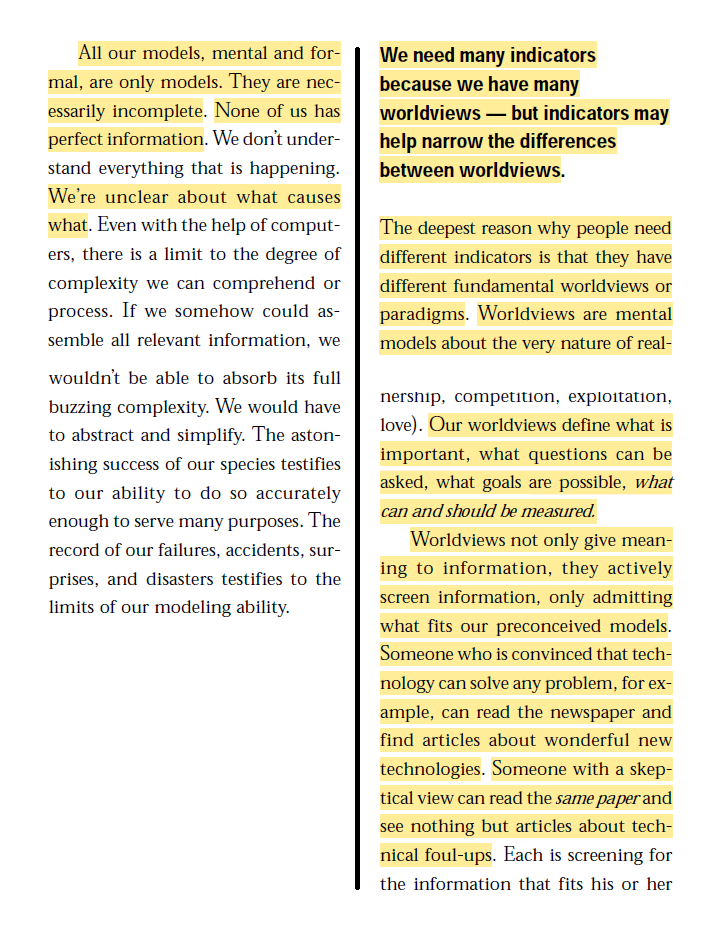
· “We need many indicators because we have many worldviews — but indicators may help narrow the differences between worldviews”
· “The deepest reason why people need different indicators is that they have different fundamental worldviews or paradigms”
· “Worldviews are mental models about the very nature of reality … Our worldviews define what is important, what questions can be asked, what goals are possible, what can and should be measured”
· “Worldviews not only give meaning to information, they actively screen information, only admitting what fits our preconceived models”
· Someone sceptical of something, like technology, will find examples where technology can solve a problem whereas a sceptic and see “nothing but technical foul-ups”
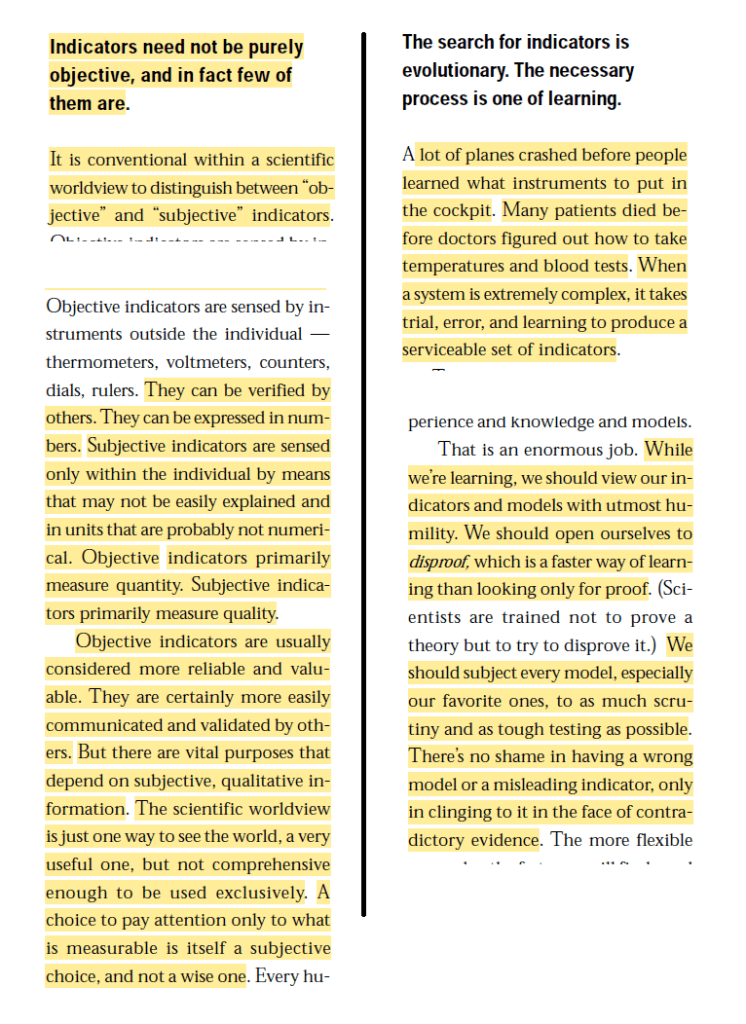
· “Indicators need not be purely objective, and in fact few of them are”
· “Objective indicators are sensed by instruments thermometers, voltmeters, counters, dials, rulers. They can be verified by others. They can be expressed in numbers”
· “Subjective indicators are sensed only within the individual by means that may not be easily explained and in units that are probably not numerical”
· “Objective indicators primarily measure quantity. Subjective indicators primarily measure quality”
· “The scientific worldview is just one way to see the world, a very useful one, but not comprehensive enough to be used exclusively”
· “A choice to pay attention only to what is measurable is itself a subjective choice, and not a wise one”
· “Every human being knows that some of the most important things in life — freedom, love, hope, harmony, even the beauty of scientific precision — are qualities, not quantities”
· “All indicators are at least partially subjective. The very choice of an indicator is based upon some value, some inner human purpose that tells us what is important to measure”
· “These difficulties don’t mean, however, that we shouldn’t use indicators. We have no choice. Without them we fly blind. The world is too complex to deal with all available information”
· “The search for indicators is evolutionary … Many patients died before doctors figured out how to take temperatures and blood tests”
· “When a system is extremely complex, it takes trial, error, and learning to produce a serviceable set of indicators”
· “We should open ourselves to disproof, which is a faster way of learning than looking only for proof”
· “We should subject every model, especially our favorite ones, to as much scrutiny and as tough testing as possible. There’s no shame in having a wrong model or a misleading indicator”

Shout me a coffee (one-off or monthly recurring)
Study link: https://donellameadows.org/wp-content/userfiles/IndicatorsInformation.pdf

 SafetyInsights.org