
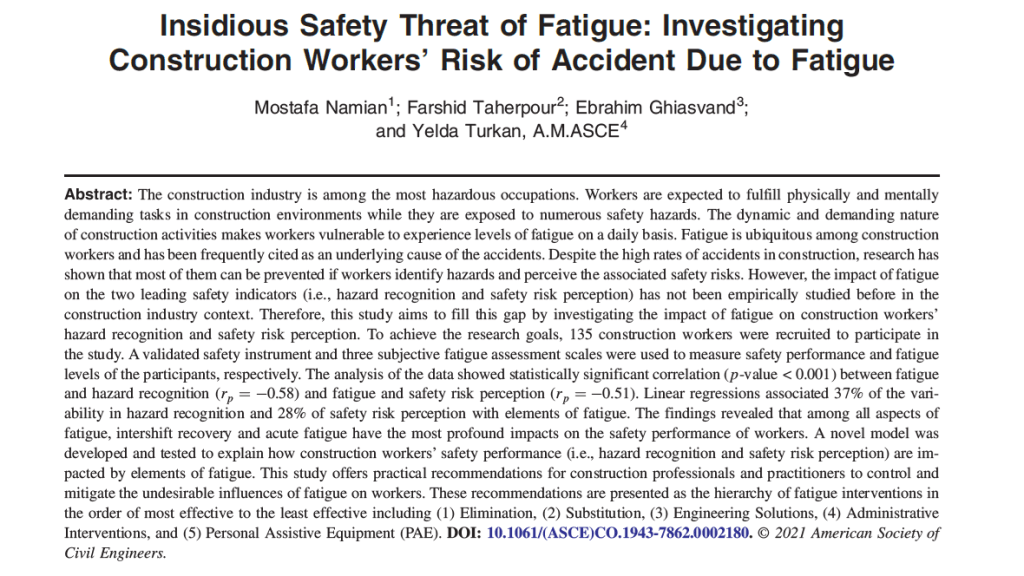
This was really interesting. It studied the impact of self-assessed fatigue on hazard recognition and safety risk perception in construction.
Fatigue is a ubiquitous phenomenon and among construction workers is said to be no different. It’s been implicated in a range of safety and performance implications.
135 construction workers were recruited to participate in the study, which involved the use of three validated subjective fatigue assessment scales, an instrument for studying safety risk perception and safety performance, and a selection of real construction photos which included hazards.
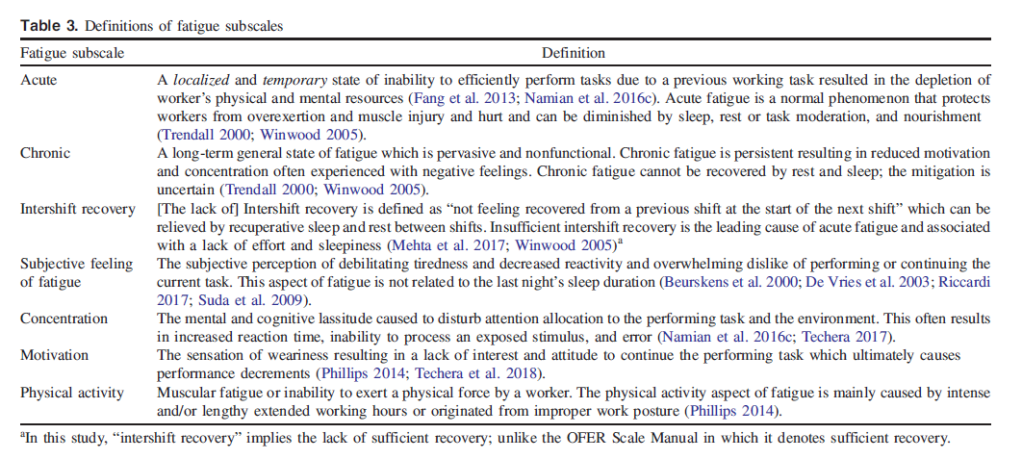
Seven elements of fatigue were included in the model to study specific influences on hazard recognition and risk perception, which were: 1) acute fatigue, 2) chronic fatigue, 3) intershift recovery, 4) subjective feeling of fatigue, 5) motivation, 6) concentration, 7) physical activity.
Definitions of measurement subscales below:
Results
First of all, self-assessed fatigue was prevalent among the sample, with ~80% of the participants indicating current moderate or high levels of fatigue. Further, 74% of the sample reported at least one accident when they were fatigued (* although noting the issues of recall bias).
For the main findings, a strong and statistically significant negative relationship was found between fatigue levels and hazard recognition, and safety risk perception among the construction workers. That is, as self-assessed fatigue levels increase the number of identified hazards decreases and the general level of danger that is assessed is reduced.
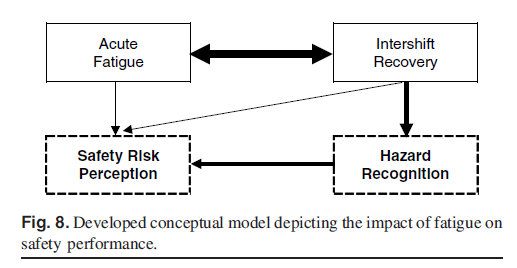
Specifically, 37% of the variability in hazard recognition was explainable via the studied elements of fatigue and 28% of safety risk perception was explainable via elements of fatigue.
Not all of the elements of fatigue had equal impacts. In fact, only intershift recovery and acute fatigue had any significant impacts. Intershift recovery was the most prominent factor, directly impacting hazard recognition and safety risk perception (whereas acute had no significant impact here). One unit increase of the intershift recovery scale was found to decrease the value of hazard recognition performance by 0.45%.
Acute fatigue was found to a lesser extent to impact safety risk perception, as was intershift recovery.
In contrast, chronic fatigue, subjective feelings of fatigue, concentration, motivation and physical activity didn’t significantly predict safety risk perception or hazard perception.
The authors then discuss practical implications, including the hierarchy of fatigue interventions.
In summarising, it’s said that “The results of analyses have revealed that the underlying aspect of fatigue that has the most devastating impact on workers’ safety performance is intershift recovery followed by acute fatigue. In other words, short-term aspects of fatigue fundamentally impact the hazard recognition and safety risk perception of workers” (p11).
Authors: Mostafa Namian; Farshid Taherpour; Ebrahim Ghiasvand; and Yelda Turkan, 2021, Journal of Construction Engineering and Management

Shout me a coffee (one-off or monthly recurring)
Study link: https://doi.org/10.1061/(ASCE)CO.1943-7862.0002180
Link to the LinkedIn article: https://www.linkedin.com/pulse/insidious-safety-threat-fatigue-investigating-workers-ben-hutchinson

 SafetyInsights.org