
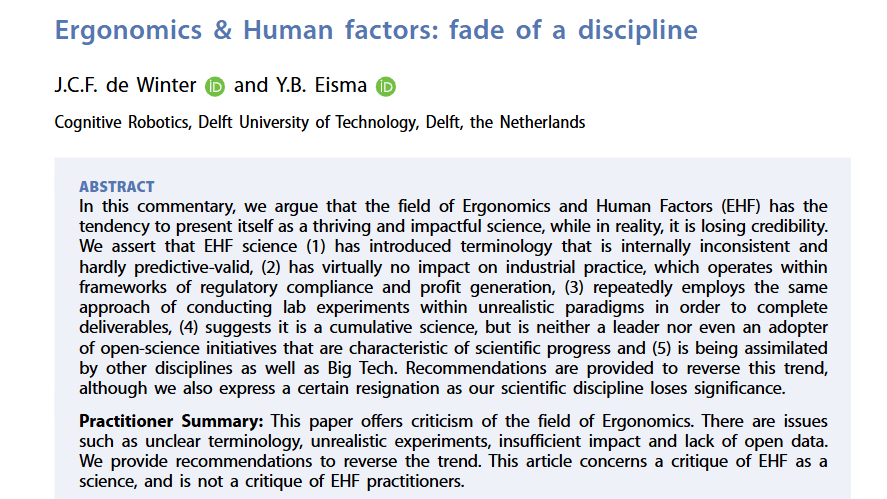
This commentary from de Winter and Eisma argues that Human Factors & Ergonomics (HFE) may be “losing credibility” and significance.
Despite claims about being a thriving science, it’s argued that the discipline may be at risk of slowly fading because of some of these challenges.
This paper had several follow-up articles and rebuttals from other authors. This summary is a bit different in that I’m summarising all of the articles, but in a highly condensed, dot-point format.
Expect mistakes…lots of them. I highly recommend reading all of the articles and not rely on my summary.
de Winter and Eisma’s core arguments:
They assert that HFE has “introduced terminology that is internally inconsistent and hardly predictive-valid”
· They point to examples like “human error, complacency, workload and situation awareness”
· They also highlight the NASA Task Load Index, used for evaluating perceived demands, effort, performance and physical experience, arguing that “scores on these measures correlate only weakly with each other”
· In all, it’s argued that some of these tools etc. have “elevated into themes/constructs, giving the pretence of the construct representing some psychological entity and being something more theoretically coherent and predictive-valid than it actually is”
HFE research has apparently had little impact on practice:
· They use human-automation interact as an example, where automation researchers have “largely ignore the numerous research articles from the EHF domain”
· Interestingly, they point to Tesla’s Full Self driving system and against the “doomsday predictions”, some evidence suggests that driver attentiveness has increased and fatigue decreased
· And EHF has adopted a cynical perspective which stymies progress by “warning, with a wagging finger, that this new technology is dangerous, typically without real-world evidence”
They argue that much of academic research serves to “produce a research paper and lack an identification of the real issues”. They criticise hundreds of studies, like driving simulator studies. I’ve skipped a lot here.
They criticise the lack of open HFE data principles. Unlike psychology, which they say was shaken up around replication issues, they say that only a small percentage of HFE journals adhere to open science principles.
In their view, HFE would tend to replicate well, but is also hampered by lack of studies using robust statistical tests, and more.
HFE is also argued to have been subsumed by other disciplines. In their view, innovative HFE research seems to be emerging from adjacent disciplines, like big tech, automated systems and more, rather than “the traditional EHF field”.
Quoting Paul Salmon, it’s argued that “AI is an obvious area where EHF should be taking centre stage…Our inability to sufficiently impact the evolution of ANI is arguably our most significant failure as a discipline,”, where HFE has had a lack of meaningful impact.
Response 1:
Patrick Waterson challenges de Winter and Eisma’s interpretation as being a “narrow interpretation of what EHF represents”, and for “selectively read[ing] some of the classic papers”.
HFE is, instead, a “conglomerate of a wide variety of disciplines”, involving craft, engineering and applied science. Therefore, it’s “far too broad brush” to treat all HFE tools as invalid based on just a few cherrypicked concepts, like situational awareness or workload.
There are, however, recognised research-practice gaps. Further, HFE’s involvement in evaluation, implementation, testing and other stages in the design lifecycle of technologies, like railway automation “represents a triumph of EHF input”.
However, Waterson agrees that HFE has been “slow to take up the opportunities of the open Access publishing paradigm”. But, the same criticism could be levied against most of the academic communities.
Waterson doesn’t agree that HFE has been subsumed by other disciplines, but in fac the reverse: “more disciplines are being subsumed within EHF”.
Therefore, rather than HFE shrinking, it’s growing.
Response 2:
Hancock & Hancock acknowledge how de Winter and Eisma’s paper needs serious consideration.
They think that perhaps the impact of HFE has been a bit optimistic, and concur that HFE has “borrowed” it’s theoretical foundations from other fields.
Hence, in their review, we should see this as a “shortfall that we must acknowledge, concede, and in the future rectify”.
They also concur that HFE may have some inapplicability to real-world problems, and that much of the HFE work is academically-focused.
They discuss the ethics of open data principles, which I’ve skipped. However, they question whether we should expect HFE to flourish as a single, separate discipline, since it works so well as a “creche for so many spinoffs”.
Response 3:
Baber agrees that “the state of the discipline…suffers from the general problem of a funding environment and academic career structure that is directed towards short-term emphasis on deliverables”.
Despite this, de Winter & Eisma arguments “over-simplifies the nature of our discipline”, primarily by ignoring the craft/practitioner aspect of HFE, and focussing too narrowly on applied science.
Baber thinks the argues about workload and situational awareness isn’t an over-commitment to the theoretical basis, but more an under-commitment, since “they are often used as “theoretically neutral providers of data”.
In Baber’s view, HFE is seen as a cornerstone in the development of automated systems, and is central is user-centred design.
Baber emphases that it’s HFE’s “ability to abstract from real-life (and the ability to link real-life problems to theory through our methods) that characterizes our discipline”.
Baber argues a few more points which I’ve skipped.
Response 4:
Paul Salmon mentions that critical self-reflection is “”healthy and indeed essential”, but thinks de Winter and Eisma’s commentary has a “narrow focus on cognitive EHF, driving simulation, and experimental research”.
This narrow focus “overlooks two significant areas of EHF research and practice: physical EHF and systems EHF, as well as a whole raft of EHF approaches such as naturalistic study and qualitative analysis methods”.
In Salmon’s view, HFE is likely becoming stronger in applications, translation and impact, and doesn’t “fit the description of something that is fading”.
Salmon agrees that there is a lack of open data, and that HFE does risk being subsumed. But he disagrees that HFE is having “no influence”, and rather has influence for policy, work processes, SMSs, analysis, training and more.
For Salmon, HFE must “develop robust and standardised ways in which to formally assess the impact of EHF”, since the impact of HFE has always, and will always be “a major point of contention”.
Response 5:
For Walker & Greening, HFE needs to “kick the tyres” during an era of “unprecedented, disorientating change”.
However, de Winter & Eisma’s “armchair diagnoses” are “far too cynical”.
For these authors, the research design and open data ‘issues’, are, rather, “relatively parochial non-issues”.
Therefore, HFE is “manifestly not in fade”. HFE is also important in transport decarbonisation in large-scale UK projects.
HFE also doesn’t take a view that technology is inherently risky, but instead the narrative is about “optimisation of both humans and technology”.
They argue that the open data area does need to be addressed, and that HFE’s current lack of capability to handle new sources of big data means that “data and computer scientists” will fill the void”.
Response 6:
Endsley & Sasangohar strongly contend that “the ergonomics and human factors (EHF) profession has never been more needed” due to widespread use of technology in facets of life.
Companies with strong user-centred design “out-performed their industry competitors by as much as 2 to 1”.
In their view, de Winter and Eisma have cherrypicked the evidence around invalid constructs. To counter, a meta-analysis of situational awareness measures found “89% of studies using objective measures of SA showed they were predictive of performance”.
They recognise the gap between development of knowledge in research settings and its real-world applications, calling it a valley of death, but this challenge exists across industries.
They dismiss the idea that HFE will be subsumed, arguing it “oversimplifies the relationship between disciplines and ignores the fact that EHF is inherently interdisciplinary”.
Rather, HFE is evolving and intersecting with other domains, like AI, robotics and data science.
Response 7:
For Shorrock & Cebola, HFE may not be “living up to its potential”. They focus on five pain points:
1. A shortage of HFE specialists, like in the UK. Moreover, HFE is mostly applied where there is regulatory requirement to do so
2. HFE has become a broad and all-encompassing and “not necessarily design-led or system-oriented”. This may lead to a blurred purpose and selling point.
a. They also predict a split between HF and Ergonomics, where Ergonomics/Human Factors Engineering focused on design-based, and Human Performance Improvement being training, culture, coaching and the like
3. There is a persistent gap between HFE research and practice, and that developments in HFE are largely ignored in practice
4. The benefits of HFE are not “clearly articulated or quantified either in research or practice”, making it difficult to demonstrate the value add to businesses
5. They also describe a positioning problem, where HFE practitioners are “organisationally homeless”, being spread across departments
a. This affects HFE practitioners from having a “clear space and position for itself in industry”
Nevertheless, in their view HFE practitioners in highly regulated, high-hazard industries are “well served”, and never a shortage of work.
Response 8:
Todd & Thatcher concur with de Winter & Eisma on the lack of open science initiatives, and a reliance on lab experiments that are not grounded in real-world problems.
They don’t however agree with the pessimistic view on HFE’s impact, arguing instead of the growth of the industry globally and many federated societies.
They argue that rather than shrinking, HFE is spawning new areas in useability, and helping to solve challenges like climate change or AI proliferation.
They cover several other arguments, including technology ones, that I’ve skipped.
Finally, de Winter & Eisma address the rebuttal/follow-up articles:
The authors recognise that most respondents disagreed that the discipline is fading, and maintains substantial value to industry.
They still maintain that “EHF science is lagging behind the rapid developments in AI, remains entrenched in past-century achievements, and is in decline”.
They further believe that metrics involving “membership counts, conference attendance numbers, and new regulations reflect activity, but not necessarily impact”.
Moreover, much of the HFE research “appears to remain stuck in the methodology of the previous century”.
They reiterate their criticism of HFE constructs like workload and situational awareness as inconsistent and lacking predictive value, and stating that “AI is increasingly being used as a symbiotic aid to humans…which means that the traditional ‘loss of SA’ narrative is becoming less interesting and relevant”.
In their predictions, within 5-10 years Big Tech companies will launch highly advanced products and HFE researchers risk continuing to “discuss 1990s topics such as ‘loss of situation awareness’ and ‘ironies of automation’…not sensing the greater irony that their own situation has long been lost”.
Finally, they call on the HFE discipline to “gain control over big data and AI” and “find a new role,” or else “the old era of EHF research will come to an end”.

Shout me a coffee (one-off or monthly recurring)
Commentary: https://www.tandfonline.com/doi/pdf/10.1080/00140139.2024.2416553
LinkedIn post: https://www.linkedin.com/pulse/ergonomics-human-factors-fade-discipline-responses-ben-hutchinson-xentc
Refs:
Baber, C. 2025. “Ergonomics and Human Factors History as craft, engineering, and Applied Science: A response to de Winter and Eisma.” Ergonomics. doi:10.1080/00140139.2025.2507505139.
de Winter, J.C.F., and Y.B. Eisma. 2024. “Ergonomics & Human factors: fade of a discipline.” Ergonomics. doi:10.1080/00140139.2024.2416553140.
de Winter, J.C.F., and Y.B. Eisma. 2025. “Ergonomics and human factors: still fading—and why we need to embrace the AI revolution.” Ergonomics. doi:10.1080/00140139.2025.2509352141.
Endsley, M., and F. Sasangohar. 2025. “Human factors and ergonomics: a vital profession for today and the future.” Ergonomics. doi:10.1080/00140139.2025.2509347142.
Hancock, P.A., and G.M. Hancock. 2025. “Can ergonomics/human factors survive?” Ergonomics. doi:10.1080/00140139.2025.2509349143.
Peachey, B. 2025. “Seize the moment – demonstrating the value of Ergonomics and Human Factors.” Ergonomics. doi:10.1080/00140139.2025.2509351144.
Salmon, P.M. 2025. “As some things fade, others amplify: a response to de Winter and Eisma.” Ergonomics. doi:10.1080/00140139.2025.2509354145.
Shorrock, S., and N. Cebola. 2025. “Putting EHF into practice: five (more) challenges.” Ergonomics. doi:10.1080/00140139.2025.2509360146.
Todd, A., and A. Thatcher. 2025. “The fade of a discipline or a shift in the centre of gravity?” Ergonomics. doi:10.1080/00140139.2025.2509363147.
Walker, G., and P. Greening. 2025. “Burning out or fading away: response to de Winter and Eisma.” Ergonomics. doi:10.1080/00140139.2025.2509364148.
Waterson, P. 2025. “Protesting too much.” Ergonomics. doi:10.1080/00140139.2025.2509365

 SafetyInsights.org