
I recorded a new ep on my podcast Safe AF, looking at factors which influence what investigations find, or more precisely, ‘construct’ as causal, and the factors which influence what gets fixed. One set of factors are ‘stop rules.
So, here are some examples of different authors discussing investigation stop rules.
Not systematic, and no rhyme or reason.
Stop rules for investigations are implicit or explicit rules, principles, norms, assumptions or constraints on when an investigation’s search (* construction) of contributing factors, or explanations, finishes.
A definition from International standard IEC 62740:2015 (quoted in Manuel’s article, below) put stop rules as “the point at which action can be defined or additional proof of cause is no longer necessary for the purpose of the analysis”.
Essentially, they’re the points at which people stop looking for causal explanations.
Note: Stop rules aren’t inherently a ‘bad’ thing. There will always be practical constraints and limitations, and goals in play.
However, they’re said to be often arbitrary, based on prevailing norms, sociopolitical factors, tools, and cognitive accident models (in this sense, belief systems of how accidents come to be).
Rasmussen remarked that they’re usually not explicitly listed.
Kletz, T. A. (2006). Accident investigation: Keep asking “why?”. Journal of hazardous materials, 130(1-2), 69-75.

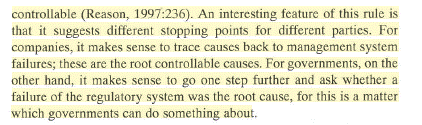
Reason, J. (2016). Managing the risks of organizational accidents. Routledge.

Reason, J. (1991). Too little and too late: A commentary on accident and incident reporting systems. In Near miss reporting as a safety tool (pp. 9-26). Butterworth-Heinemann.
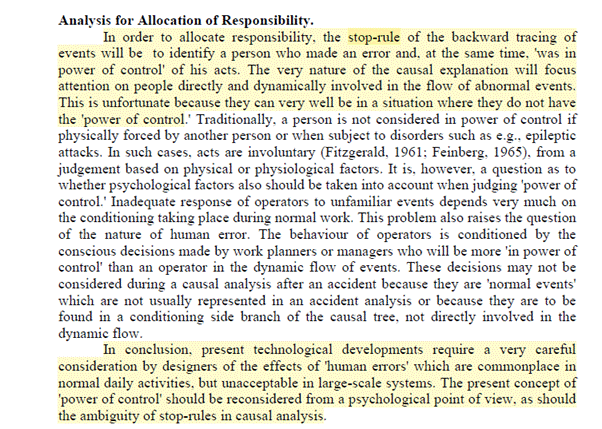
Rasmussen, J. (1990). Human error and the problem of causality in analysis of accidents. Philosophical Transactions of the Royal Society of London. B, Biological Sciences, 327(1241), 449-462.


Rasmussen, J. (1988). Coping safely with complex systems. In AAAS Annual Meeting 1988.
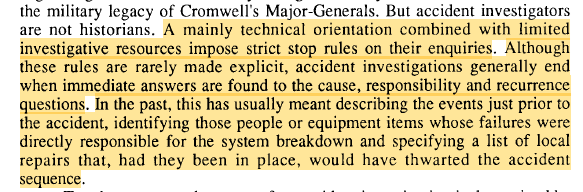
Cedergren, A., & Petersen, K. (2011). Prerequisites for learning from accident investigations–a cross-country comparison of national accident investigation boards. Safety Science, 49(8-9), 1238-1245.

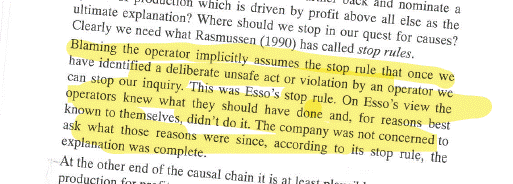
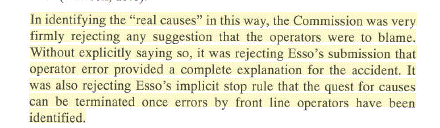
Lessons from Longford: the Esso Gas Plant Explosion. Andrew Hopkins. CCH Australia, Sydney. 2000

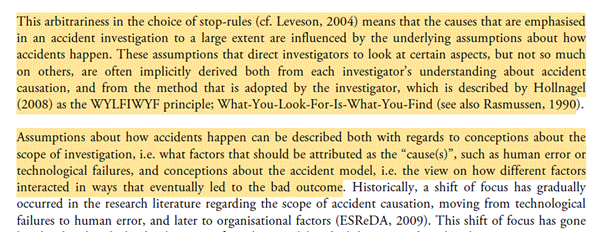
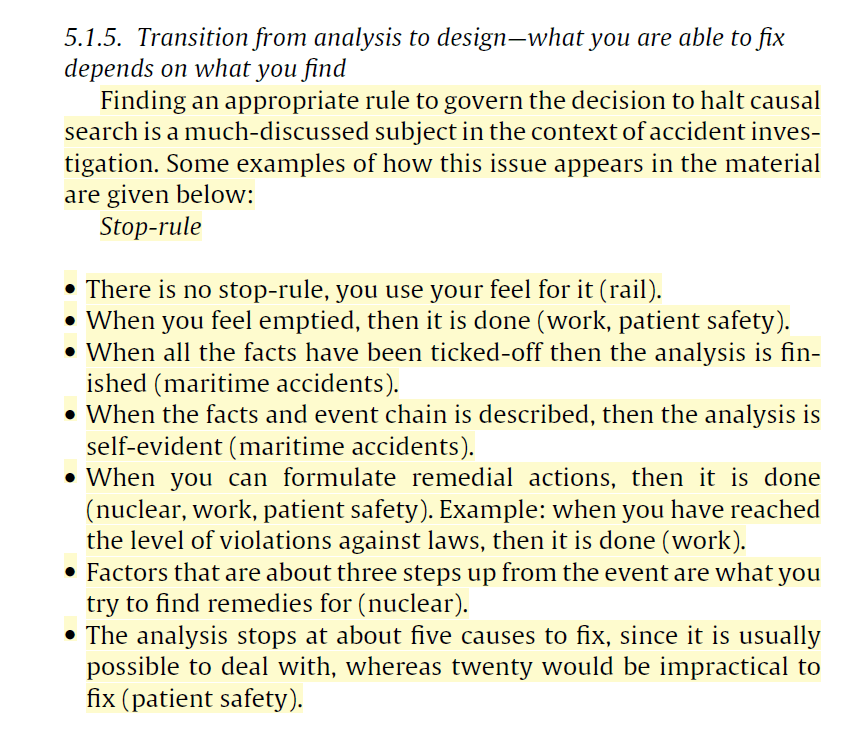
Lundberg, J., Rollenhagen, C., & Hollnagel, E. (2010). What you find is not always what you fix—How other aspects than causes of accidents decide recommendations for remedial actions. Accident Analysis & Prevention, 42(6), 2132-2139.
Manuele, F. A. (2016). Root-Causal Factors: Uncovering the Hows & Whys of Incidents. Professional Safety, 61(05), 48-55.


Stoop, J., & Benner Jr, L. (2015). What do STAMP-based analysts expect from safety investigations?. Procedia Engineering, 128, 93-102.


Shout me a coffee (one-off or monthly recurring)
LinkedIn post: https://www.linkedin.com/pulse/stop-rules-investigations-ben-hutchinson-q67hc
Safe AF podcast: https://open.spotify.com/show/7y8PySyHoIrAHsCrIxqSJ0?si=304b199b40cd42c2

 SafetyInsights.org