
This review explored how to design for worker participation, drawing on the design of resilient systems.
Not much to say – the extracts cover core resilient design principles.
Some extracts to contextualise the images:
· Participation refers to “the worker’s influence in decision-making related to safety, involving information sharing between people”
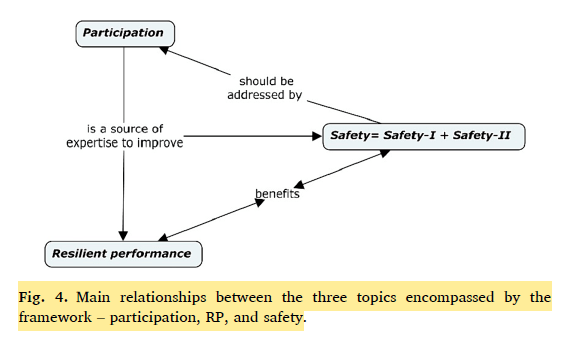
· “Design for resilient performance Design for resilient performance (DfRP) is the use of design principles to support integrated human, technical, and organizational adaptive capabilities” (image 1)

· “These capabilities should play out before, during and after changes or disturbances, balancing safety and production goals as both are necessary for the system survival”
· “a resilient system must produce acceptable outcomes (consonant with Safety-II), and not just avoid harmful events (Safety-I)”
· Image 2 mapped the resilient performance design principles to enhancing worker participation

They had some interesting arguments around work-as-imagined vs work-as-done:
· For one, they argue that participation design principles should be used to “support visibility of risks in real-time” and to “Make variations in performance visible”
· Participation is a “means to align work-as- imagined and work-as-done”
· Interestingly, “While some authors use the term reduce the gap between work-as-imagined and work-as-done … others prefer the term align”
· “The term align was chosen in this study as it conveys that work-as-imagined must be compatible with work-as-done, without judging one as superior over the other”
· “The term reduce can be misunderstood as a recommendation to fully comply with procedures regardless of the context; work-as-imagined is not necessarily safer than work-as-done”
· “In particular, eliminating the gap between work representations, which can also include others such as work-as-disclosed and work-as-trained … is not necessarily a goal worth pursuing as the different representations offer complementary perspectives”
· “Further, in activities characterized by high uncertainty, significant gaps are inevitable to cope with unexpected events”
Ref: Cambraia, F. B., Saurin, T. A., Bulhões, I. R., & Formoso, C. T. (2024). A knowledge framework of participation supportive of resilient and safe construction projects: A systematic review. Safety science, 175, 106494.

Shout me a coffee (one-off or monthly recurring)
Study link: https://doi.org/10.1016/j.ssci.2024.106494

 SafetyInsights.org