

This study investigated how workplace accidents are affected by who manages occupational safety – owner/partner, managing directors, branch managers, OHS officers or safety representatives.
They control for company size. Survey data was collected was across the EU (at least 32 countries and >44k companies).
For context:
- “Operations managers are responsible for ensuring workers are safe, and safety is often regarded as a core operational outcome, alongside performance outcomes like cost, quality, delivery, and flexibility”
- “However, in many firms, the management of safety is delegated to dedicated safety managers, who work separately from the operations managers even though the empirical evidence suggests safety and operations should be managed jointly”
- Prior research on operational safety are useful, but “are mostly silent on who should manage safety in an establishment. Safety is mainly the result of how the operations are managed and impacts operational workers, yet it is often managed by a separate safety function”
- Hence, “the unanswered question of who should manage safety is not trivial”
- This study focuses on who managers safety rather than the formal titles for safety
- They hypothesise that owners are more likely to prioritise profitability and growth which can compromise worker safety, whereas employees who manage safety are more likely to prioritise safety “due to their direct stake in working conditions”
- This effect is likely influenced by firm size, since larger companies have more resources
Results
They found:
· “evidence that it is not beneficial to have owners manage safety in establishments”
· “When owners manage safety in establishments, accidents increase, even when controlling for firm size”
· “we find that in smaller establishments, it is more beneficial to have an employee representative manage safety, while in larger establishments, a dedicated safety officer should be in charge of managing safety”
· Hence, “when more owners or partners manage safety, establishments experience more accidents. This simple finding conveys a powerful message”
They argue that “one of the simplest things that firms can do, and regulators and policy makers should encourage or mandate, is to make sure that owners are not managing safety”.
And “regardless of firm size, firms should not place the owner in the position of managing operations and worker safety at the same time”.
They suggest that specialised safety people should manage the safety function in larger organisations, because of the increased complexity of large firms and operating processes/work.
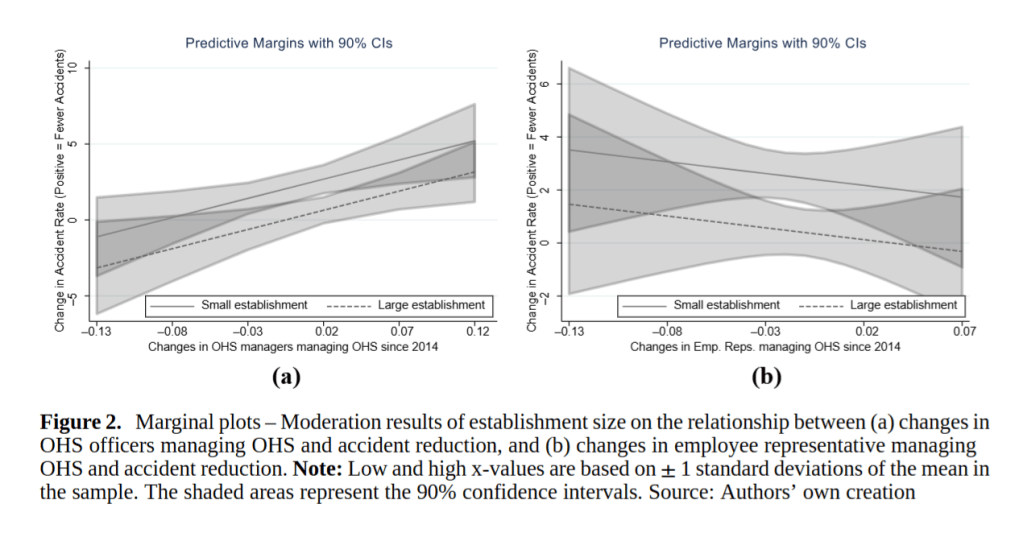
Moreover, the findings also support “worker representatives, because they are close to the people doing the work and the people most likely to get harmed at work, should be involved in ensuring an operation is safe (much in line with arguments offered in section 5.4 of ISO 45001), even if they should not have final responsibility to manage OHS in larger firms”.
They argue that it “may seem counterintuitive [not to have owners managing the safety function] since safety is on the agenda of most owners, and owners claim to be committed to safety in most firms”.
Hence, it may seem like an effective way for owners to demonstrate that safety is important to them by managing it directly. However, the results “suggest that no matter how well intentioned such an action might be, that it will be counterproductive”.
In concluding, they advise that “It seems to be more effective to have someone else manage OHS, give them the resources they need, and back them up when safety priorities come in conflict with other operational priorities”.
They recognise the limitations of this study design – survey data and trying to capture a multi-dimensional construct of ‘safety’ by just incidents.
Ref: Wiengarten, F., Durach, C. F., Pagell, M., & Humphreys, P. (2025). Who should manage worker safety to reduce occupational accidents?. International Journal of Operations & Production Management, 45(13), 63-90.

Shout me a coffee (one-off or monthly recurring)
Study link: https://www.emerald.com/insight/content/doi/10.1108/IJOPM-11-2024-0977/full/pdf
LinkedIn post: https://www.linkedin.com/pulse/who-should-manage-worker-safety-reduce-occupational-ben-hutchinson-bwnic

 SafetyInsights.org