Does certification, like under ISO 18001, or likely 45001, only have positive effects, or does it also introduce unintended byproducts, like a focus on managing the paperwork and not ‘real’ issues, and oversimplifying psychosocial issues?
Safe AF podcast #9 explored the byproducts of certification – just 9 mins of your life. Links below.
They observed certification:
· Resulted in almost all the indicators to involve easily measurable elements of safety, with “few measuring long-term health hazards or aspects of the psychosocial work environment”
· “This focus on measurable safety indicators results in safety being the key word in daily conversation, whereas the concept of work environment is rarely mentioned and even then understood to refer only to safety”
· The knowledge base of the certified system was characterised by “what can be measured with key performance indicators (KPI)” rather than a focus on the work environment
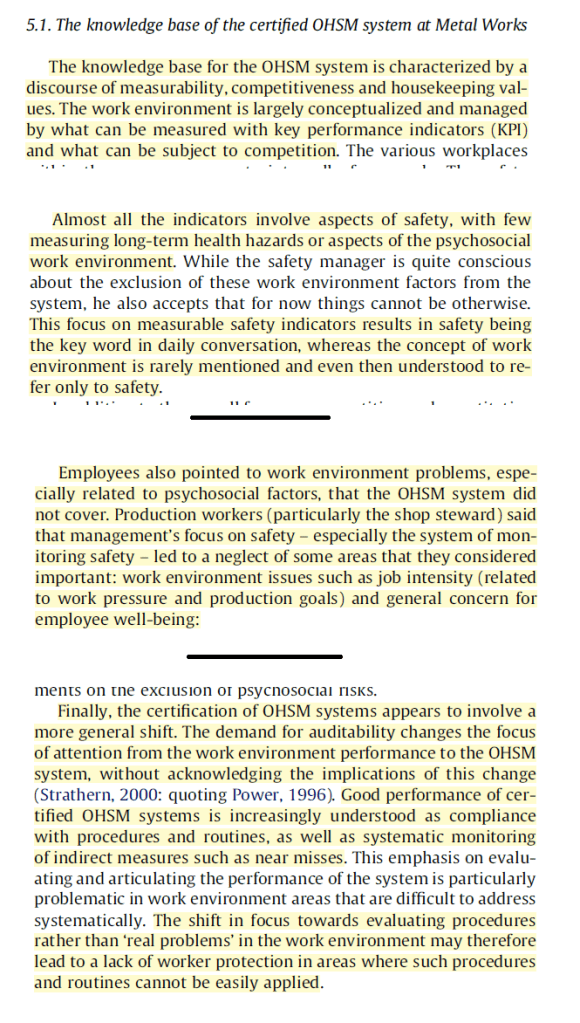
· Moreover, “Almost all the indicators involve aspects of safety, with few measuring long-term health hazards or aspects of the psychosocial work environment”
· “Employees also pointed to work environment problems, especially related to psychosocial factors, that the OHSM system did not cover”
· Hence, the logics underpinning the certified system “led to a neglect of some areas that they considered important: work environment issues such as job intensity (related to work pressure and production goals)”
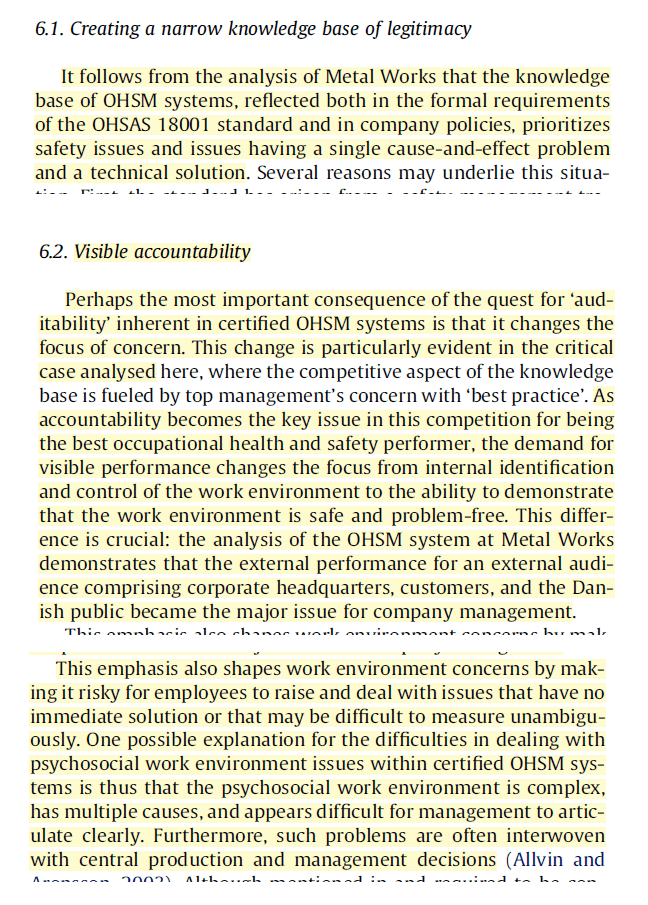
· The certified system and its management “prioritizes safety issues and issues having a single cause-and-effect problem and a technical solution”
· In contrast to easily measurable safety issues, psychosocial factors “are often interwoven with central production and management decision” and “not very well suited for use as an external indicator of good performance”
· “Thus in a system that values external auditability [readily measurable and auditable factors], such issues [psychosocial] carry little weight”
· Certification seems to shift the focus of work “from the work environment performance to the OHSM system”, that is, more time rustling paperwork for good audit scores and less managing functional issues
· “Good performance of certified OHSM systems is increasingly understood as compliance with procedures and routines”
· “The shift in focus towards evaluating procedures rather than ‘real problems’ in the work environment may therefore lead to a lack of worker protection in areas where such procedures and routines cannot be easily applied”
Ref: Hohnen, P., & Hasle, P. (2011). Making work environment auditable–A ‘critical case’ study of certified occupational health and safety management systems in Denmark. Safety science, 49(7), 1022-1029.

Shout me a coffee (one-off or monthly recurring)
Spotify:
Apple:

 SafetyInsights.org